6 inch vs 8 inch
6 Inch vs 8 Inch Work Boots
Height does not equal support. It equals how much gets into your boot and how long the thing takes to break in.
Buy eight inches if material gets into your boots - dirt work, demolition, tear-off, grain, welding, landscaping, anything with gravel or offcuts at ankle level. Buy six inches for everything else, which includes most work on finished floors, in shops, in vehicles and on flat slabs. Height is mainly about keeping things out; the support difference is real but smaller than people assume, and it depends entirely on whether you lace the extra height properly.
This is one of the most common questions in work footwear and it usually gets answered with a vague claim about ankle support. The useful version separates the three things height actually changes - what gets in, how much lacing you have, and how long the boot takes to live with - and then matches them to the work.
What an 8-inch shaft genuinely does
- Keeps material out. This is the big one. Gravel, mulch, concrete crumbs, metal shavings, grain and weld spatter all enter a 6-inch boot over the collar, and every one of them causes a problem - abrasion, burns, or a stone you stop to shake out six times a day.
- Gives you more lacing. Ankle stability comes from the boot being tightly coupled to your leg, which needs lace purchase above the ankle joint. More eyelets higher up is the mechanism.
- Protects the ankle bones. Four more inches of leather is real abrasion and impact protection against rebar, scaffold tube and pallet corners at exactly the height they tend to be.
What it does not do
It does not prevent rolls on its own. A high shaft laced loosely allows most of the same movement as a low one, and a stiff supportive midsole does more to keep your foot stable on uneven ground than shaft height does - which is why boots for construction argues for chassis stiffness first. It also does not make a boot more protective underfoot: puncture resistance is a plate or a midsole rating, and has nothing to do with height.
The other honest point is that an 8-inch boot is harder to live with. It takes longer to break in across the ankle because the leather has to crease where your leg bends, it is warmer, it is slower on and off, and it weighs more at the end of the lever your leg swings. Over a ten-mile warehouse day those costs are not trivial - see boots for warehouse work, which recommends the lightest compliant boot rather than the most protective.
Head to head
Ranked by our published scoring rubric. Tap any row for the full write-up.
| # | Product | Best for | Score | Price |
|---|---|---|---|---|
| 1 | 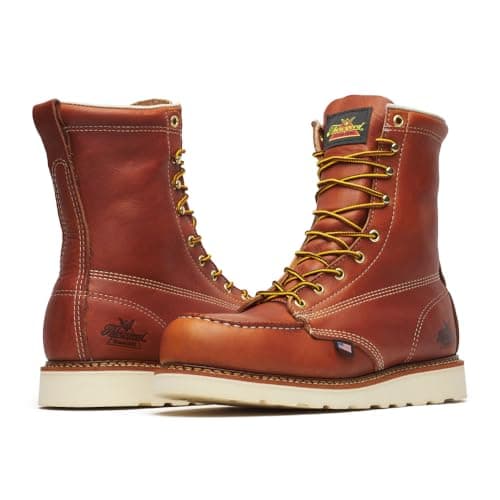 Thorogood American Heritage 8" Steel ToeThe 8-inch case made properly: debris exclusion and lacing height on a resoleable welted boot. | Trades that need the extra four inches | 9.4 | |
| 2 | 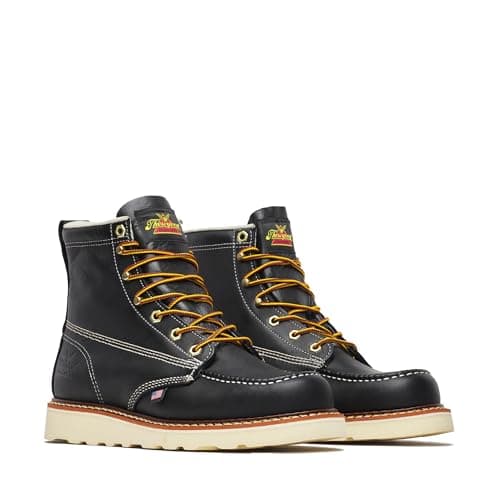 Thorogood American Heritage 6" Moc ToeThe same boot four inches shorter - lighter, cooler, faster to break in, and enough for most trades. | Finished floors and long walking days | 9.3 | |
| 3 | 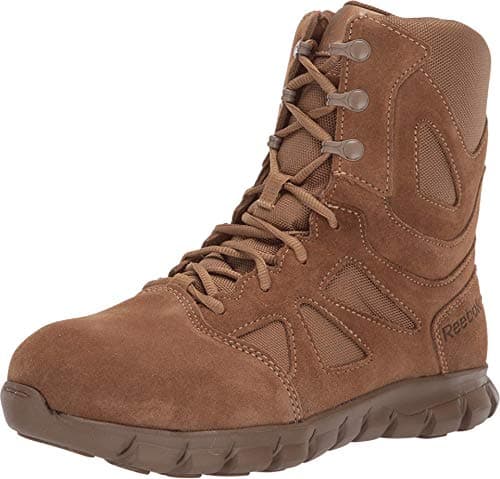 Reebok Work Sublite Cushion 8" Safety Toe Side-ZipAn athletic-construction 8-inch safety boot with a side zip - height and coverage at trainer weight. | Wanting eight inches without the weight | 9.4 |
#ad Prices pulled from Amazon and stamped as of November 14, 2026; they change, and we show no number we cannot verify. How we are funded.
Best 8 inch · Trades that need the extra four inches
Thorogood American Heritage 8" Steel Toe
The 8-inch case made properly: debris exclusion and lacing height on a resoleable welted boot.
#ad Price as of November 14, 2026. How we are funded
- Our score
- 9.4/10
Outstanding
If you work in dirt, demolition, grain or anywhere material ends up at ankle level, eight inches is the right answer and this is the clearest example of it. The extra shaft keeps gravel, mulch, offcuts and weld spatter out, and - this is the part people miss - it gives you four more inches of lacing, which is where ankle support actually comes from. A taller boot you lace loosely supports nothing.
The costs are real: longer break-in across the ankle, more weight, noticeably warmer in summer, and slower to get on and off. It is also a soft-toe brand's steel-toe model, so cold conducts through in winter. The six-inch version of the same boot is the better buy if debris is not your problem.
Specs that matter
- Toe:
- Steel toe, ASTM F2413 rated
- Height:
- 8 inch
- Sole:
- MAXwear wedge
- Build:
- Goodyear storm welt
Rubric profile
Raw per-criterion marks out of 10, before weighting — this is the shape of the pick, not its published score. A low mark is a scope limit, not a fault: how we score.
- Ankle support
- 8.8
- Debris exclusion
- 9.4
- Comfort
- 7.6
- Low weight
- 6.4
- Value
- 8.4
Why we picked it
- Safety toe plus resoleable welt construction in one boot
- Taller shaft keeps debris out on demolition and dirt work
- Full-grain leather that takes conditioner and keeps going
Good to know: Order your measured length, not a size up — and expect the 8-inch shaft to need about two weeks before it stops feeling stiff across the ankle.
Best 6 inch · Finished floors and long walking days
Thorogood American Heritage 6" Moc Toe
The same boot four inches shorter - lighter, cooler, faster to break in, and enough for most trades.
#ad Price as of November 14, 2026. How we are funded
- Our score
- 9.3/10
Outstanding
Six inches is the default for a reason. On a finished floor, in a shop, in a van or on a slab, the extra shaft of an eight-inch boot buys you nothing and charges you weight, heat and ankle stiffness for it. This is literally the same platform as the pick above with less leather: the same welt, the same wedge, the same leather, lighter and cooler.
It gives up the debris exclusion, so it is wrong for dirt work, tear-off or anything that gets into a boot - and because it is a soft toe, it is not eligible where a safety cap is required. If you want the six-inch height with a safety toe, that is a different model.
Specs that matter
- Toe:
- Soft toe (no safety rating)
- Height:
- 6 inch
- Sole:
- MAXwear wedge, slip-resisting
- Build:
- Goodyear storm welt, resoleable
Rubric profile
Raw per-criterion marks out of 10, before weighting — this is the shape of the pick, not its published score. A low mark is a scope limit, not a fault: how we score.
- Ankle support
- 7.0
- Debris exclusion
- 6.4
- Comfort
- 8.8
- Low weight
- 8.2
- Value
- 8.0
Why we picked it
- Welt construction means a cobbler can resole it instead of you rebuying
- Flat wedge does not pack mud and does not scuff finished floors
- Removable footbed, so an aftermarket insole drops straight in
Good to know: Soft toe, so confirm your site's PPE rule before ordering; the wedge is at its best on flat shop floors rather than ladders.
No. 3 · Wanting eight inches without the weight
Reebok Work Sublite Cushion 8" Safety Toe Side-Zip
An athletic-construction 8-inch safety boot with a side zip - height and coverage at trainer weight.
#ad Price as of November 14, 2026. How we are funded
- Our score
- 9.4/10
Outstanding
This is the boot that breaks the trade-off. It is eight inches tall with a safety toe, but built like a trail shoe, so you get the coverage and the lacing height without the mass of a welted industrial boot. The side zip means you keep lace tension set properly and still get in and out in seconds, which removes the usual objection to tall boots.
The zipper is the obvious failure point, textile panels tear on rough material handling, and there is little puncture protection underfoot - so it is a clean-environment boot rather than a demolition one. For more of this category, see lightweight work boots.
Specs that matter
- Toe:
- Safety toe, ASTM F2413
- Height:
- 8 inch
- Closure:
- Laces plus side zipper
- Weight:
- Athletic-shoe construction
Rubric profile
Raw per-criterion marks out of 10, before weighting — this is the shape of the pick, not its published score. A low mark is a scope limit, not a fault: how we score.
- Ankle support
- 8.0
- Debris exclusion
- 8.8
- Comfort
- 9.0
- Low weight
- 9.2
- Value
- 8.0
Why we picked it
- Among the lightest 8-inch safety boots sold
- Side zip means you keep the lace tension and still get out quickly
- Cushioning suited to miles of walking on hard floors
Good to know: The side zip is the convenience and the wear point; textile panels keep it light but will not take rough material handling.
Height by trade
| Trade or setting | Height | Why |
|---|---|---|
| Demolition, tear-off, renovation | 8 inch | Debris at ankle level, and ankle-bone protection |
| Welding | 8 inch or taller pull-on | Spatter must not enter over the collar - see our welding list |
| Landscaping, farming, grain | 8 inch | Mulch, gravel and grain get into anything shorter |
| Carpentry and finish trades | 6 inch | Flat floors, long days, nothing to keep out |
| Warehouse and distribution | 6 inch | Miles of walking; weight matters more than coverage |
| Electrical and service work | 6 inch | Mobility and getting in and out of vehicles |
| Concrete pouring and finishing | 8 inch | Wet concrete is caustic and will find a low collar |
The middle options people forget
There is more on the shelf than six and eight. Mid-cut boots sit around five to six inches with an above-ankle collar and suit service and warehouse work. Ten- and eleven-inch pull-on wellingtons exist precisely because welders and concrete crews need height without laces to burn or clog - pull-on work boots covers those. And for genuinely wet ground, height is measured in how deep the water is, which is the argument in leather vs rubber work boots.
The verdict, plainly
Material gets in your boots: eight inches, and lace it to the top or you have wasted the money. Nothing gets in and you walk a lot: six inches, every time. You want the coverage and hate the weight: an athletic-construction 8-inch boot like the Reebok above is the honest compromise, at the cost of upper durability. One thing height on its own does not buy you is ankle support, which comes from sole stiffness and lacing instead: do work boots need ankle support.
Frequently asked
Are 8 inch work boots better than 6 inch?
Only for the right work. Eight inches is better where material would get into a lower boot - demolition, dirt work, welding, grain, concrete - and where ankle-bone protection matters. For flat floors, long walking days and vehicle work, six inches is better because it is lighter, cooler and faster to break in.
Do taller work boots give more ankle support?
They can, but only if you lace them tight to the top. Support comes from the boot being firmly coupled to your leg, which requires lace purchase above the ankle joint. An 8-inch boot laced only to the sixth eyelet supports about as much as a 6-inch one and weighs more.
Are 8 inch boots harder to break in?
Yes. The leather has to crease where your leg flexes above the ankle, which takes longer than breaking in a shaft that stops below the joint - expect a week or two more. They are also warmer and slower to put on, which are real daily costs rather than one-off ones.
What height work boots do welders need?
Eight inches at minimum, and many welders prefer a 10- or 11-inch pull-on. The hazard is spatter entering over the collar and lodging against your sock, and laces are themselves a problem because they burn. Smooth, tall, lace-free uppers are the standard answer.
Is a 6 inch work boot enough for construction?
It depends on the task rather than the industry. Framing on a clean deck, six inches is usually fine; demolition, tear-off, trenching or anything with debris on the ground, it is not, because the material will enter over the collar. If you own one pair for mixed work, eight inches is the safer default.
Our recommendation
If you read nothing else on this page, these are the two to look at — the one we would buy, and the one to take instead if its trade-off suits you better.
Best 8 inch · Trades that need the extra four inches
Thorogood American Heritage 8" Steel Toe
The 8-inch case made properly: debris exclusion and lacing height on a resoleable welted boot.
#ad Price as of November 14, 2026. How we are funded
Runner-up · Finished floors and long walking days
Thorogood American Heritage 6" Moc Toe
The same boot four inches shorter - lighter, cooler, faster to break in, and enough for most trades.
#ad Price as of November 14, 2026. How we are funded
Prices are read live from Amazon and stamped with the date. How we pick.
Sources
Back to Comparisons, or see how we pick. Spotted something wrong? We publish corrections — see our editorial policy.