Best steel toe boots
Best Steel Toe Work Boots
Steel is thinner and cheaper than composite. Those are the only two advantages, and sometimes they are enough.
Steel toe is the phrase most people search for when they mean "safety boot", and it is worth separating the two. What your employer almost always requires is footwear meeting ASTM F2413's impact and compression ratings - and steel is one of three materials that can do that. So the first thing to know is that choosing steel is a preference, not a compliance requirement, unless your site specifically says steel.
What the rating actually means
A safety-toe boot sold in the US carries a marking inside the tongue, typically reading something like `ASTM F2413-24 M I/75 C/75 EH`. The I/75 is impact resistance tested at 75 foot-pounds; C/75 is compression resistance at 2,500 pounds. Those numbers are the protection, and they are the same whether the cap is steel, composite or alloy - the standard tests outcomes, not materials.
Additional codes follow for other hazards: EH for electrical hazard, Mt for metatarsal, PR for puncture resistance underfoot. Every one of them is decoded in ASTM F2413 safety ratings explained, which is the guide to read before buying any safety boot.
Where steel wins and where it loses
| Factor | Steel | Composite |
|---|---|---|
| Protection at same rating | Identical | Identical |
| Weight | Heavier | Lighter |
| Cap profile | Thinner, slimmer toe box | Bulkier |
| Cold conduction | Conducts cold badly - a real winter complaint | Much warmer |
| Metal detectors | Sets them off | Clears them |
| Price | Cheaper | Premium |
| Electrical work | Conductive mass in the boot | Non-metallic |
In short: steel if you want the slimmest toe box or the lowest price, composite for cold weather, electrical work, secure facilities or anywhere weight matters. The full argument is in composite toe vs steel toe, and the alternatives are at composite toe work boots.
Quick picks
Ranked by our published scoring rubric. Tap any row for the full write-up.
| # | Product | Best for | Score | Price |
|---|---|---|---|---|
| 1 | 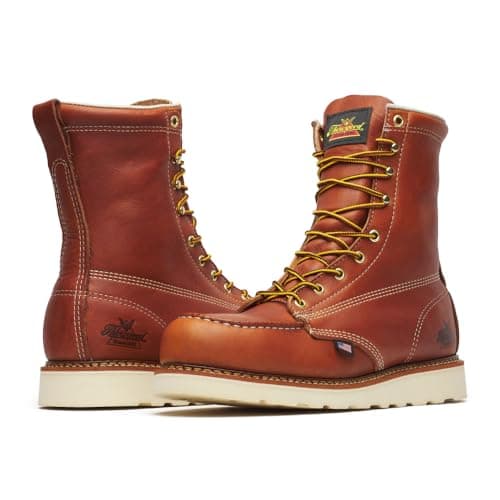 Thorogood American Heritage 8" Steel ToeA steel toe on a resoleable welted platform - the long-term pick. | Buying once and resoling | 8.5 | |
| 2 | 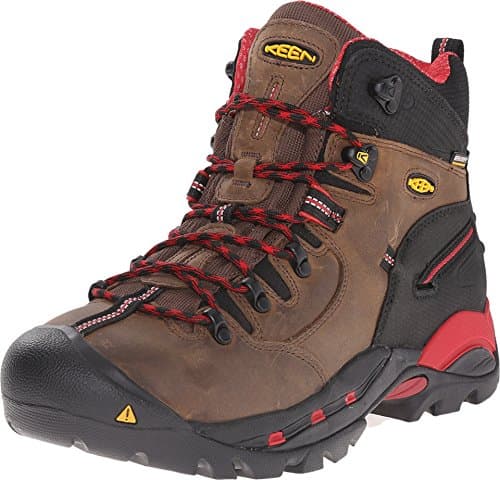 KEEN Utility Pittsburgh 6" Steel Toe WaterproofAsymmetrical steel caps - the widest real toe room you can get with a steel toe. | Wide feet in a steel toe | 8.6 | |
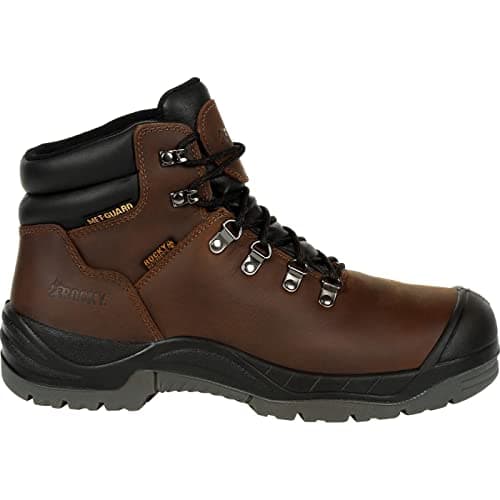
| 3 | 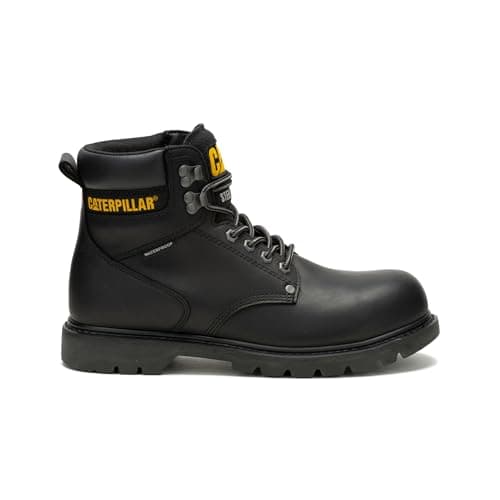 Caterpillar Second Shift Waterproof Steel ToeWelted, waterproof, steel toe - a lot of boot for the money. | Waterproof on a mid-market budget | 8.3 | |
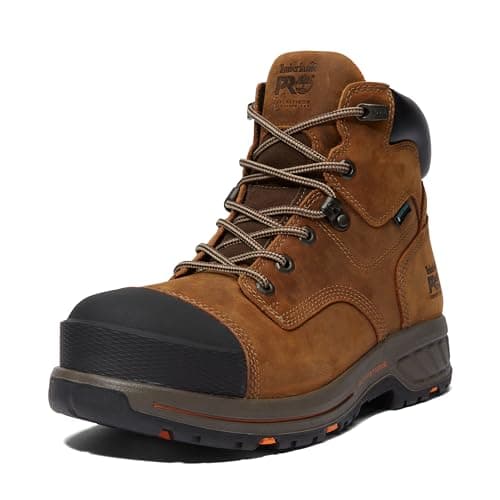
| 4 | 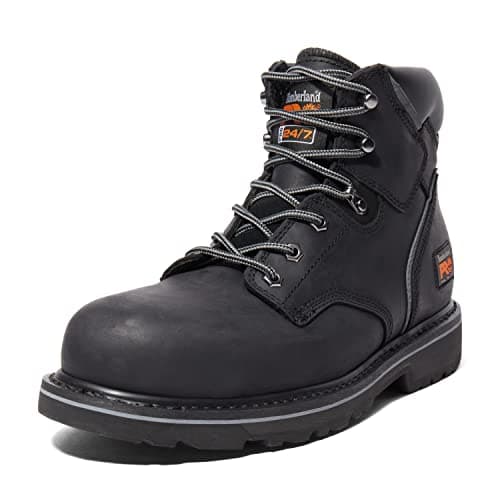 Timberland PRO Pit Boss 6" Steel ToeEH rated, roomy and inexpensive - the default first safety boot for a reason. | The cheapest steel toe worth buying | 7.9 |
#ad Prices pulled from Amazon and stamped as of October 6, 2026; they change, and we show no number we cannot verify. How we are funded.
Top pick · Buying once and resoling
Thorogood American Heritage 8" Steel Toe
A steel toe on a resoleable welted platform - the long-term pick.
Most steel-toe boots are cemented, which means when the outsole wears out the boot is finished. A Goodyear storm welt means a cobbler can replace the sole, and since the sole is almost always what fails first, that changes the economics completely.
Full-grain leather, an 8-inch shaft for debris, and the MAXwear wedge. The wedge is the limitation on ladders and loose ground, and steel is cold in winter.
Specs that matter
- Toe:
- Steel toe, ASTM F2413 rated
- Height:
- 8 inch
- Sole:
- MAXwear wedge
- Build:
- Goodyear storm welt
Our scoring
- Protection
- 8.4
- Durability
- 9.6
- Comfort
- 8.0
- Weight
- 6.4
- Value
- 8.2
What works
- Safety toe plus resoleable welt construction in one boot
- Taller shaft keeps debris out on demolition and dirt work
- Full-grain leather that takes conditioner and keeps going
What to know
- Steel conducts cold in winter — composite is warmer
- 8 inch shaft takes longer to break in across the ankle
- Heavier than the composite-toe competition
No. 2 · Wide feet in a steel toe
KEEN Utility Pittsburgh 6" Steel Toe Waterproof
Asymmetrical steel caps - the widest real toe room you can get with a steel toe.
The usual complaint about steel toes is that the cap pinches, and that is a geometry problem rather than a material one. KEEN makes its caps left-and-right specific rather than symmetrical, so the shape follows your foot instead of wasting room on the outside and squeezing the inside.
Waterproof and welted as well. It runs large - size down a half - and the waterproof-plus-steel combination is heavy.
Specs that matter
- Toe:
- Asymmetrical steel toe, ASTM F2413
- Height:
- 6 inch
- Waterproof:
- Yes, KEEN.DRY membrane
- Build:
- Goodyear welt
Our scoring
- Protection
- 8.6
- Durability
- 8.8
- Comfort
- 9.2
- Weight
- 6.0
- Value
- 7.6
What works
- Left and right specific toe caps, so the toe box is shaped like a foot
- Welted, so it can be resoled
- The go-to recommendation for wide feet in a safety toe
What to know
- Runs large — most buyers size down a half
- Steel toe in a waterproof boot is heavy
- Toe box looks bulky if that bothers you
No. 3 · Waterproof on a mid-market budget
Caterpillar Second Shift Waterproof Steel Toe
Welted, waterproof, steel toe - a lot of boot for the money.
This has been the sensible mid-market steel toe for years: a Goodyear welt and waterproofing at a price well under the heritage brands, with the ubiquity that means you can replace your size easily.
It is heavy and the stock footbed is minimal - budget for an insole - and the leather needs conditioning to stay supple.
Specs that matter
- Toe:
- Steel toe, ASTM F2413
- Height:
- 6 inch
- Waterproof:
- Yes
- Build:
- Goodyear welt
Our scoring
- Protection
- 8.6
- Durability
- 8.8
- Comfort
- 7.2
- Weight
- 5.8
- Value
- 9.0
What works
- Welted construction at a mid-market price
- Waterproof and safety-rated together
- Widely stocked, so sizing is easy to replace
What to know
- Heavy
- Stock footbed is minimal
- Leather needs conditioning or it stiffens
Best value · The cheapest steel toe worth buying
Timberland PRO Pit Boss 6" Steel Toe
EH rated, roomy and inexpensive - the default first safety boot for a reason.
If you need a compliant boot this week and cannot spend much, this is the honest answer. Steel toe, EH rated, roomy square toe box, oiled nubuck that survives real abuse, at a fraction of everything above it.
Not waterproof, thin stock insole, cement construction so no resoling. Add an insole on day one and it is genuinely good value rather than just cheap.
Specs that matter
- Toe:
- Steel toe, ASTM F2413
- Height:
- 6 inch
- Electrical hazard:
- EH rated
- Waterproof:
- No
Our scoring
- Protection
- 7.6
- Durability
- 7.2
- Comfort
- 7.4
- Weight
- 6.8
- Value
- 9.4
What works
- Among the cheapest genuinely EH-rated steel-toe boots sold
- Wide, square toe box suits thick socks and swollen feet
- Oiled nubuck shrugs off the abuse that kills cheaper uppers
What to know
- Not waterproof — wet trades will soak through
- Stock insole is thin and wants replacing on day one
- Cement construction, so it cannot be resoled
The black-toenail problem is a sizing problem
By far the most common complaint about steel toes is bruised or blackened toenails, and it is almost always a fit issue rather than a cap issue. In an ordinary boot, your toes can push into the upper and the leather gives. Under a steel cap there is no give at all: whatever space exists is all there will ever be.
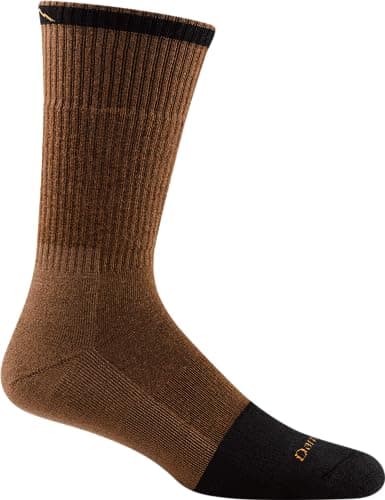
So length matters more in a safety boot than in any other footwear. You want roughly a thumb's width ahead of your longest toe, measured standing, late in the day, in your work socks - because feet swell. If the nail is already sore, also look at socks for steel toe boots, which pad exactly that contact point, and read work boot fit and sizing.
What we would skip
Skip steel if you work in sustained cold or around energized circuits - composite is simply better in both cases at the same protection. Skip the idea that a steel toe protects your whole foot: the metatarsals across the top are unprotected unless the boot is Mt rated, and nails go through the sole, which needs a PR plate. And skip buying a longer boot to escape a pinching cap, which trades a width problem for a length problem the cap will punish.
Frequently asked
Are steel toe boots safer than composite?
No, not at the same ASTM F2413 rating - the standard tests performance, not material, so an I/75 C/75 steel cap and an I/75 C/75 composite cap offer the same protection. Steel is thinner and cheaper; composite is lighter, warmer and non-metallic.
Why do steel toe boots hurt my toes?
Almost always because the boot is too short. The cap is rigid, so your toes cannot push into it the way they can in a soft shoe, and any shortness shows up as bruised nails. Size for length standing, late in the day, in your work socks - and consider a sock with a reinforced toe box.
Do steel toe boots make your feet cold?
Yes, noticeably, in sustained cold - steel conducts heat away from your toes far faster than composite does. It is one of the most common winter complaints about safety boots and a strong argument for composite if you work outdoors through winter.
How long do steel toe boots last?
The cap effectively lasts forever; the rest of the boot does not. Expect six to eighteen months of full-time use depending on surface and mileage, with the outsole and midsole going first. A welted boot can be resoled, which can double or triple its life.
Sources
Back to Work Boots, or see how we pick. Spotted something wrong? We publish corrections — see our editorial policy.