ASTM ratings decoded
ASTM F2413 Safety Ratings Explained
There is a code stamped inside your boot tongue that answers most of the questions people ask in forums.
Every safety boot sold in the United States carries a marking stamped or printed inside the tongue or shaft, and it tells you precisely what the boot has been tested to do. Almost nobody reads it, which is a shame, because it resolves most of the arguments people have about work boots - including whether the boot you already own meets the requirement your site just imposed.
What the marking looks like
A typical marking reads something like this, on two or three lines:
- `ASTM F2413-24` - the standard and its revision year.
- `M` or `F` - the last the boot is built on: M for male, F for female.
- `I/75 C/75` - impact resistance at 75 foot-pounds and compression resistance at 2,500 pounds.
- Then any additional codes: `EH`, `Mt`, `PR`, `SD`, `CD`.
The codes, one by one
| Code | Means | Who needs it |
|---|---|---|
| I/75 | Impact resistance tested at 75 ft-lbf - the standard level | Everyone with a safety-toe requirement |
| C/75 | Compression resistance tested at 2,500 lbf | Everyone with a safety-toe requirement |
| EH | Electrical hazard: sole and heel tested dielectrically, dry conditions, secondary protection only | Electricians, HVAC, linemen |
| Mt | Metatarsal protection for the bones on top of the foot - rated separately | Oilfield, welding, masonry, logging |
| PR | Puncture resistance: a plate resisting penetration from below | Framing, demolition, anywhere with nails on the floor |
| SD | Static dissipative: controlled resistance to drain static charge | Electronics assembly, some chemical plants |
| CD | Conductive: deliberately conducts static away | Explosives and munitions handling - not for electrical work |
The crucial structural point: I/75 and C/75 cover the toe only. Everything else is separate and optional, and a boot without an Mt marking has no metatarsal protection at all regardless of how substantial it looks.
Quick picks
Ranked by our published scoring rubric. Tap any row for the full write-up.
| # | Product | Best for | Score | Price |
|---|---|---|---|---|
| 1 | 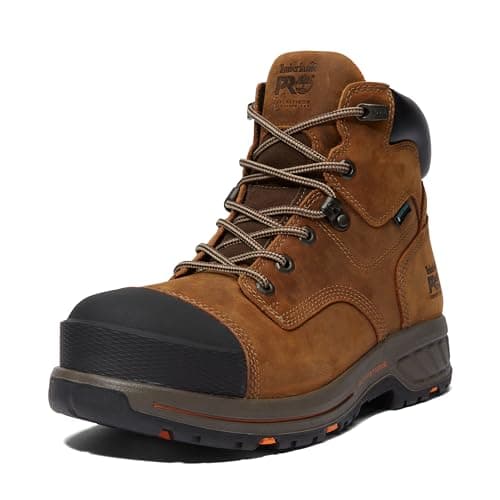 Timberland PRO Helix HD 6" Composite Toe WaterproofI/75 C/75 EH and fully non-metallic - the spec most trades should be looking for. | A boot that carries the common ratings | 8.4 | |
| 2 | 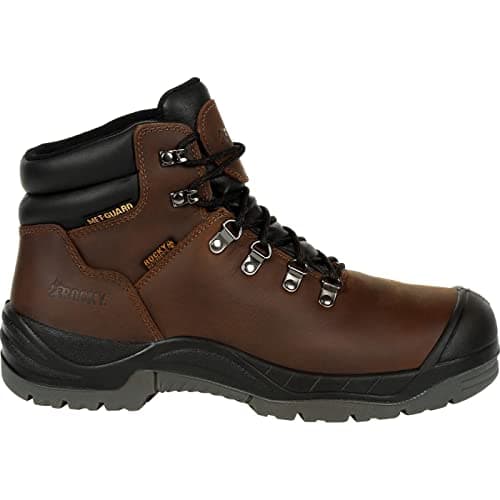 Rocky Worksmart Composite Toe Internal Met GuardAn Mt-rated internal metatarsal guard - the code most people miss. | When the marking needs to include Mt | 8.4 | |
| 3 | 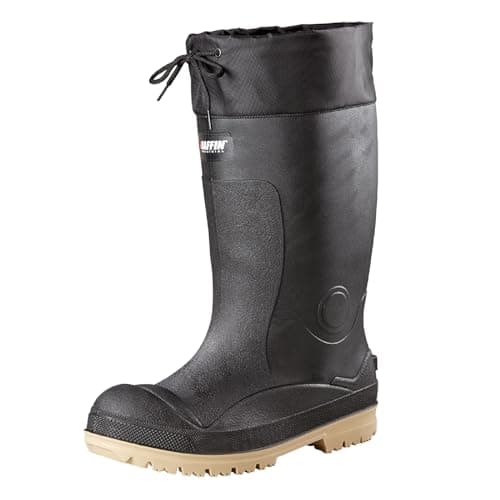 Baffin Titan Waterproof Steel Toe & Plate Slip-OnSteel toe plus a steel puncture plate - protection against what is on the floor. | A boot with an underfoot plate | 7.6 |
#ad Prices pulled from Amazon and stamped as of October 6, 2026; they change, and we show no number we cannot verify. How we are funded.
Common spec · A boot that carries the common ratings
Timberland PRO Helix HD 6" Composite Toe Waterproof
I/75 C/75 EH and fully non-metallic - the spec most trades should be looking for.
A useful worked example. This boot carries the impact and compression ratings at the standard level, plus an EH rating, and is non-metallic throughout - which is the combination most electrical, HVAC and general industrial work calls for.
What it does not carry is a metatarsal (Mt) or puncture-resistance (PR) rating. If your work needs either, you need a boot that states them specifically, which is exactly the point of reading the marking.
Specs that matter
- Toe:
- Composite toe, ASTM F2413
- Height:
- 6 inch
- Waterproof:
- Yes
- Electrical hazard:
- EH rated
Our scoring
- Impact / compression
- 9.0
- EH rating
- 9.5
- Non-metallic
- 9.5
- Met guard
- 2.0
- Puncture plate
- 2.0
What works
- Balances cushioning and support better than either Boondock or Hypercharge
- Wide platform feels stable on ladders and scaffold planks
- EH rated and non-metallic
What to know
- Middle-of-the-range in every dimension, best at nothing
- Membrane means warm feet in summer
- Cement construction, not resoleable
No. 2 · When the marking needs to include Mt
Rocky Worksmart Composite Toe Internal Met Guard
An Mt-rated internal metatarsal guard - the code most people miss.
If your employer's policy says metatarsal protection, only an Mt marking satisfies it - a heavy boot, a tall boot or thick leather over the instep does not, however protective it feels. This boot carries it, with the guard built internally rather than as an external bib.
Also composite toe and waterproof. No puncture-resistance plate, and the guard stiffens the instep so expect a break-in week.
Specs that matter
- Toe:
- Composite toe, ASTM F2413
- Met guard:
- Internal metatarsal guard, ASTM Mt rated
- Waterproof:
- Yes
- Height:
- 6 inch
Our scoring
- Impact / compression
- 8.6
- EH rating
- 7.0
- Non-metallic
- 9.0
- Met guard
- 9.4
- Puncture plate
- 2.0
What works
- Internal met guard is far less bulky than the external bib style
- Met protection at a price most met-guard boots do not touch
- Non-metallic toe and guard
What to know
- The guard stiffens the instep — expect pressure at first
- Heavier than a plain composite-toe boot
- Fit runs narrow through the midfoot
No. 3 · A boot with an underfoot plate
Baffin Titan Waterproof Steel Toe & Plate Slip-On
Steel toe plus a steel puncture plate - protection against what is on the floor.
The third rating people overlook. A toe cap does nothing about a nail through the sole, and the code for that protection is PR. This boot has a steel plate underfoot alongside the steel toe, which is the combination framing and demolition work benefits from.
It is a heavy insulated industrial boot, far more than most trades need, and far too warm above freezing. Included here to show what the plate looks like in practice - lighter PR-rated options exist.
Specs that matter
- Toe:
- Steel toe, ASTM F2413
- Underfoot:
- Steel puncture plate
- Liner:
- Removable multi-layer insulation
- Style:
- Slip-on
Our scoring
- Impact / compression
- 9.2
- EH rating
- 6.0
- Non-metallic
- 2.0
- Met guard
- 6.0
- Puncture plate
- 9.4
What works
- Toe, plate and deep insulation in one boot — rare combination
- Removable liner dries overnight
- Built for genuine extreme cold, not just a cold morning
What to know
- Heavy and bulky; not a boot for agility
- Far too warm above freezing
- Expensive
What EH does not mean
This is the most misunderstood code in the standard, and it is worth stating its limits precisely. An EH rating means the sole and heel passed a dielectric test under dry conditions and provide secondary protection against accidental contact with live circuits.
All three qualifiers matter. It is tested dry, so a wet or contaminated sole is not providing it. It is secondary, meaning a backstop behind the real controls. And it is for accidental contact, not for deliberate work on energized equipment - which requires rubber insulating gloves tested to ASTM D120, arc-rated clothing and the procedures in NFPA 70E. It also degrades: a worn-through outsole or one with metal embedded in it has lost the protection while the label still says EH. Electrical hazard boots goes into this at length.
Toe material is not in the marking
Notice what is absent: the standard does not record whether the cap is steel, composite or alloy, because it tests performance rather than material. A steel I/75 C/75 cap and a composite I/75 C/75 cap have passed the same test and protect identically.
So any argument about which is safer is answered by the standard itself: neither, at the same rating. The real differences are weight, cold conduction, metal detection and price - composite toe vs steel toe.
How to use this when buying
- Get your employer's written footwear policy. It will specify the codes required, and that is what you are shopping for.
- Check the marking on any boot you are considering, not the marketing copy. Retail listings frequently say "safety toe" without stating the ratings.
- Check the boots you already own. Plenty of people discover their current boots already meet a new requirement, or that they do not.
- Note that EH does not imply non-metallic. If the policy says non-metallic, confirm the shank and eyelets too: composite toe work boots.
- Replace boots when the outsole is finished, because EH, PR and slip resistance all depend on it - how long work boots last.
One more note on employer payment: under OSHA's PPE rules, employers must generally pay for required protective equipment, with specific exceptions for non-specialty safety-toe footwear that employees are allowed to wear off the jobsite. Worth knowing before you assume the cost is yours.
Frequently asked
What do the letters inside my work boot mean?
They are the ASTM F2413 marking. A typical line reads ASTM F2413-24 M I/75 C/75 EH: M for a male last, I/75 and C/75 for impact resistance at 75 foot-pounds and compression at 2,500 pounds, then optional codes like EH for electrical hazard, Mt for metatarsal and PR for puncture resistance.
What does I/75 C/75 mean on work boots?
Impact resistance tested at 75 foot-pounds and compression resistance tested at 2,500 pounds - the standard protection level for safety-toe footwear in the US. Both ratings cover the toe cap only; protection for the metatarsals or the sole requires separate Mt and PR markings.
Does an EH rating mean boots are safe for electrical work?
No. EH means the sole and heel passed a dielectric test in dry conditions and provide secondary protection against accidental contact. It is not insulation. Live work requires rubber insulating gloves tested to ASTM D120, arc-rated clothing and NFPA 70E procedures.
Does the ASTM marking say whether the toe is steel or composite?
No - the standard tests performance rather than material, so a steel and a composite cap with the same I/75 C/75 rating protect identically. The material affects weight, cold conduction and metal detection, not the protection level.
Who pays for safety boots at work?
Under OSHA's PPE payment rules employers must generally pay for required protective equipment, with a specific exception for non-specialty safety-toe footwear that employees are permitted to wear off the jobsite. Check the rule and your employer's policy rather than assuming.
Sources
Back to Guides, or see how we pick. Spotted something wrong? We publish corrections — see our editorial policy.