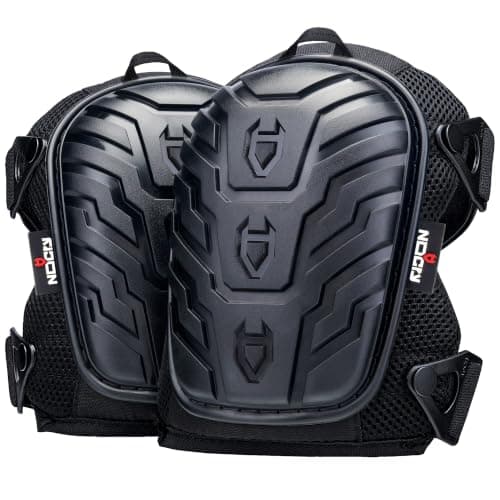
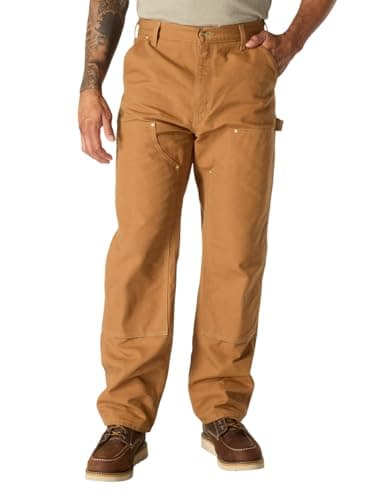
Best women's knee pads
Best Knee Pads for Women
The pads are not the problem - the straps are. Most will not cinch down far enough to stay put.
There is no women's knee-pad market to speak of, and in fairness a knee pad has less anatomical specificity than a boot or a glove. But there is a real and specific fit problem, and it is worth naming precisely rather than vaguely: almost every pad on the market is strapped for an average male leg circumference, so on a slimmer leg the straps run out of adjustment before the pad is tight - and a pad that is not tight rotates off your knee within minutes.
Why rotation is the failure mode
Two forces act on a knee pad. Gravity pulls it down your leg, and the rolling motion of your knee as you shuffle and pivot twists it round. Straps resist both, and the amount of resistance depends on how tight they are and how much mass the pad has trying to swing.
On a leg the pad was designed for, properly tightened straps hold it. On a slimmer leg with the straps at their limit, the pad has enough freedom to start rotating, and once it begins it accelerates - it ends up on the outside of your calf, protecting nothing. People experiencing this usually conclude knee pads do not work for them, when the actual issue is adjustment range.
What to look for
- Adjustment range, stated. Some manufacturers publish the minimum and maximum circumference the straps accommodate. Where they do, that is the single most useful number.
- Two straps rather than one. A single strap cannot resist rotation at all - it is a pivot. Two straps above and below the joint create a couple that holds the pad square.
- A lighter pad. Less mass means less rotational force. The heavy thigh-support designs are the hardest to keep put on a slim leg.
- A flatter base. It resists rolling geometrically, independent of the straps.
- Elastic sleeve designs, where available, bypass the strap problem entirely by gripping the leg over a wider area.
Quick picks
Ranked by our published scoring rubric. Tap any row for the full write-up.
| # | Product | Best for | Score | Price |
|---|---|---|---|---|
| 1 | 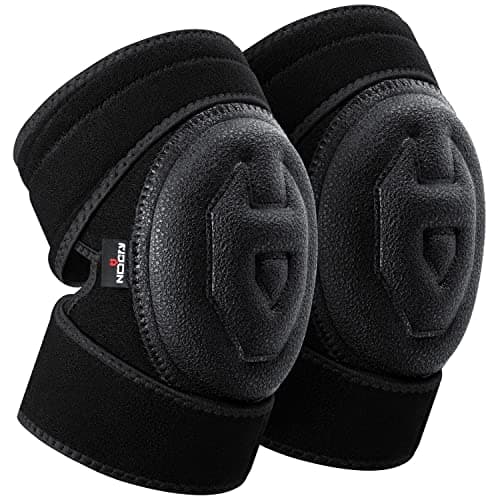 NoCry Gel Knee Pads with Soft Foam CushionA wide adjustment range and a lighter pad body - which is most of the problem solved. | Adjusting small enough to stay put | 8.6 | |
| 2 | 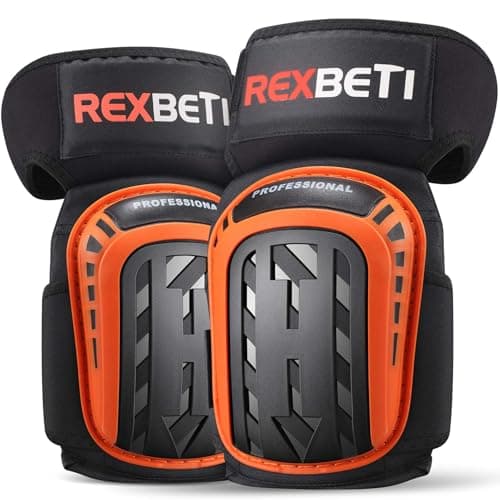 REXBETI Anti-Slip Construction Gel Knee PadsDual straps and real gel cheaply - worth trying before paying more. | Trying the cheap option first | 8.0 | |
| 3 | 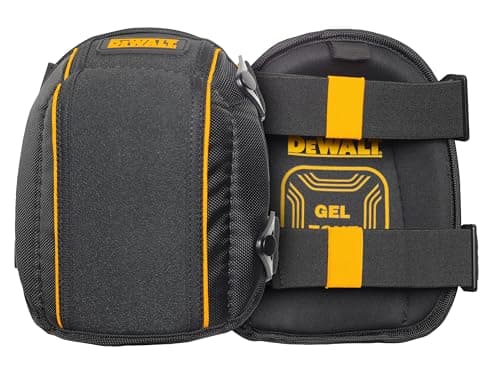 DEWALT Flooring Knee Pads with GelA flat broad base is more stable on a slimmer leg than a domed cap is. | Flooring and finish work | 8.2 |
#ad Prices pulled from Amazon and stamped as of October 6, 2026; they change, and we show no number we cannot verify. How we are funded.
Top pick · Adjusting small enough to stay put
NoCry Gel Knee Pads with Soft Foam Cushion
A wide adjustment range and a lighter pad body - which is most of the problem solved.
The fit problem with knee pads is almost entirely about strap adjustment range and pad mass: a heavy pad on straps that cannot cinch tight will rotate round a slimmer leg no matter how carefully you set it.
This is the lighter NoCry with a generous adjustment range, which addresses both. The waterproof anti-slip cap is well suited to flooring and finish work. Softer foam bottoms out on gravel and rubble, and the buckles are a wear point.
Specs that matter
- Cushion:
- Soft foam with gel insert
- Cap:
- Waterproof, anti-slip
- Straps:
- Easy-release buckles
- Use:
- Flooring, tiling, finish work
Our scoring
- Adjustment range
- 8.8
- Low pad mass
- 8.8
- Strap comfort
- 8.2
- Cushioning
- 7.6
- Value
- 8.6
What works
- Anti-slip cap stays put on tile and sheet goods, where hard caps skate
- Softer and lighter than the Professional model
- Waterproof shell survives wet mortar and thinset
What to know
- Softer foam bottoms out on gravel and rubble
- Less protection from sharp debris
- Buckles are a wear point
No. 2 · Trying the cheap option first
REXBETI Anti-Slip Construction Gel Knee Pads
Dual straps and real gel cheaply - worth trying before paying more.
Since fit is the uncertainty here and nobody can tell you in advance whether a given pad's straps will cinch to your leg, trying an inexpensive dual-strap pad first is a sensible approach rather than a compromise.
It has the essentials: two straps, a genuine gel layer, an anti-slip cap. The sizing suits average legs, which is exactly the caveat - and the straps and buckles are the first thing to fail.
Specs that matter
- Cushion:
- Gel over foam
- Cap:
- Anti-slip textured
- Straps:
- Dual adjustable
- Use:
- General construction
Our scoring
- Adjustment range
- 7.4
- Low pad mass
- 8.0
- Strap comfort
- 7.0
- Cushioning
- 7.8
- Value
- 9.5
What works
- Cheapest pad here that still has a real gel layer
- Anti-slip cap performs better than the price suggests
- Fine as a spare pair to leave in the truck
What to know
- Straps and buckles are the first thing to fail
- Thinner cap than premium pads
- Sizing suits average legs only
No. 3 · Flooring and finish work
DEWALT Flooring Knee Pads with Gel
A flat broad base is more stable on a slimmer leg than a domed cap is.
A less obvious fit advantage: a broad flat base is inherently more stable against rotation than a domed cap, because it does not want to roll. For anyone whose pads keep migrating round their leg, that geometry helps independently of the straps.
Non-marking and built for smooth floors. The flat base is poor on uneven ground, and the gel layer is thinner than a heavy construction pad's.
Specs that matter
- Cushion:
- Gel
- Base:
- Broad flat, non-marking
- Straps:
- Adjustable
- Use:
- Flooring and tile
Our scoring
- Adjustment range
- 7.8
- Low pad mass
- 8.4
- Strap comfort
- 8.0
- Cushioning
- 7.4
- Value
- 8.6
What works
- Flat broad base is right for flooring, where a domed cap rocks
- Non-marking on finished surfaces
- Pivots smoothly, so you shuffle rather than stand up
What to know
- Flat base is poor on uneven ground and rubble
- Less edge protection than a capped pad
- Gel is thinner than the NoCry Professional's
Workarounds, which genuinely help
If the pads you have nearly work, these are worth trying before buying different ones. Wear the pads over a double-knee pant rather than against bare skin or thin fabric - the extra fabric adds circumference and friction, and it stops the straps chafing. Shorten the straps permanently if there is excess: cut and re-stitch or heat-seal the end, which removes the dangling tail as well.
And consider the alternative that has no straps at all: a pant with built-in knee-pad pockets holds a foam insert exactly where it belongs and cannot rotate. For intermittent kneeling that is often the better solution entirely, and women's work pants covers which women's pants have the pockets - noting that double-front women's pants are genuinely scarce, which is a real gap.
Fit is a safety requirement, not a preference
Worth stating because it is easy to treat this as a comfort complaint. PPE that does not fit does not protect, and OSHA's PPE standard requires equipment to be of safe design and condition for the work it is used in. A knee pad that has rotated onto the side of your calf is not knee protection, and given that occupational kneeling is associated with higher rates of knee osteoarthritis, the thing it is failing to protect is not trivial.
The same pattern - equipment sized for an average male body, with the fit problem treated as the wearer's inconvenience - runs through women's work boots and women's work gloves.
What we would skip
Skip single-strap pads entirely. Skip the heaviest thigh-support designs unless you have confirmed the straps cinch to your leg. Skip wearing pads against bare skin or thin fabric, which is both chafing and less secure. And skip persevering with pads that rotate - they are not protecting you, and the fix is usually a different pad rather than more effort.
Frequently asked
Are there knee pads made for women?
Very few are marketed as such, and the real issue is not pad shape but strap adjustment range - most pads are strapped for an average male leg and will not cinch small enough on a slimmer one. Look for pads with a wide stated adjustment range, two straps, and a lighter pad body.
Why do my knee pads keep rotating round my leg?
Because the straps cannot tighten enough for your leg, so the pad has freedom to twist as your knee rolls - and once it starts, it accelerates. A single-strap pad cannot resist rotation at all. Two straps, less pad mass and a flatter base all help.
How do you make knee pads fit better?
Wear them over a double-knee pant rather than bare skin, which adds circumference and friction and stops chafing. Shorten over-long straps permanently. If they still rotate, switch to a lighter pad with a flat base, or use a pant with built-in knee-pad pockets instead.
Are knee-pad pants a good alternative?
For intermittent kneeling, often better - the insert sits in a pocket over the knee, cannot rotate and never chafes. The inserts are thinner than strap-on pads, so for a full day of kneeling they are not enough on their own. Double-front women's pants are unfortunately scarce.
Sources
Back to Knee Pads, or see how we pick. Spotted something wrong? We publish corrections — see our editorial policy.