Best composite toe boots
Best Composite Toe Work Boots
Same protection as steel, less weight, far less cold, and nothing to set off a metal detector.
Composite safety toes are made from non-metallic materials - usually fiberglass, carbon fiber, Kevlar or a plastic composite - and they have quietly become the default choice in several trades. The reason is not that they are safer, because at the same rating they are not. It is that the secondary properties matter a great deal in daily use, and steel loses on most of them.
The four reasons people switch
- Weight. A composite cap is lighter than steel, and over a long shift on your feet that is real. The arithmetic is in boots for standing all day.
- Cold. Steel conducts heat away from your toes; composite does not. This is the single most common winter footwear complaint, and the fix is a material change - see winter work boots.
- Electrical work. Non-metallic construction removes conductive material from the boot entirely, which is why many utilities and contractors now specify it. Boots for electricians covers the reasoning.
- Metal detectors. Airports, secure facilities, foundries with metal detection, and some food plants. A steel toe means a search every single time.
Quick picks
Ranked by our published scoring rubric. Tap any row for the full write-up.
| # | Product | Best for | Score | Price |
|---|---|---|---|---|
| 1 | 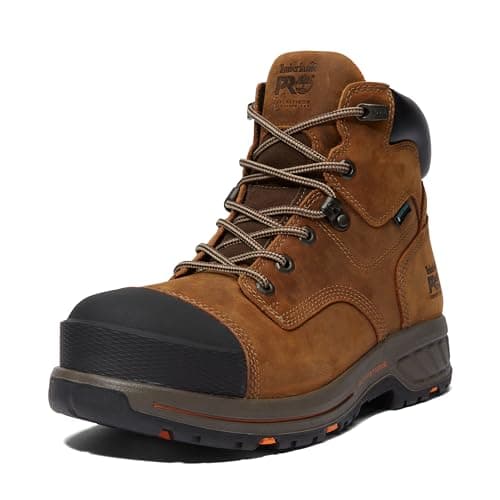 Timberland PRO Helix HD 6" Composite Toe WaterproofFully non-metallic, waterproof, EH rated, and comfortable enough for a full week. | An all-round non-metallic boot | 8.6 | |
| 2 | 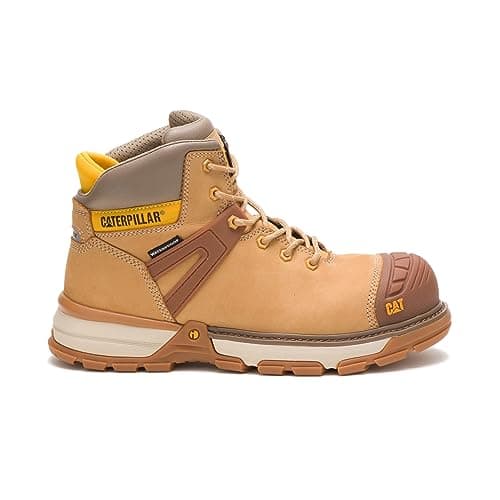 Caterpillar Excavator Superlite Waterproof Composite ToeCarbon composite, waterproof, and lighter than everything else on this page. | The lightest and cheapest here | 8.6 | |
| 3 | 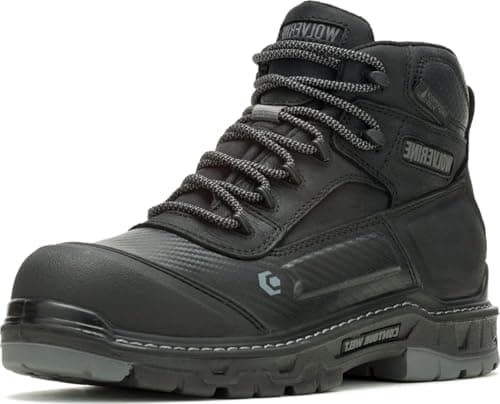 Wolverine Overpass 6" Composite Toe WaterproofComposite protection in the most flexible boot here. | Climbing, kneeling and moving | 8.5 | |
| 4 | 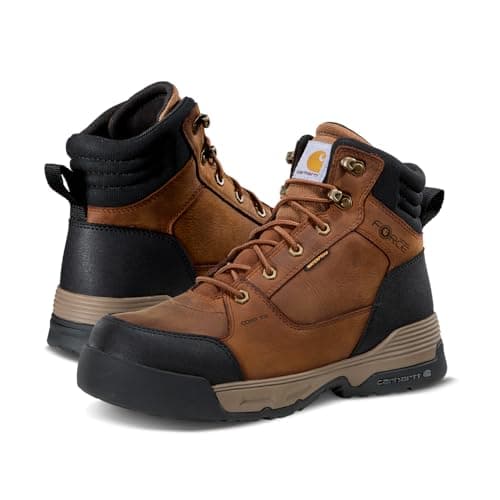 Carhartt Force HD 6" Composite Toe WaterproofThe toughest composite boot here, with oil-tanned leather and wide sizing. | Heavy-duty non-metallic, in wide | 8.3 |
#ad Prices pulled from Amazon and stamped as of October 6, 2026; they change, and we show no number we cannot verify. How we are funded.
Top pick · An all-round non-metallic boot
Timberland PRO Helix HD 6" Composite Toe Waterproof
Fully non-metallic, waterproof, EH rated, and comfortable enough for a full week.
The reason to buy composite is usually a combination of reasons: you want the weight saving, you work around electricity, you pass through a metal detector, or you work in cold. The Helix HD covers all of them in one boot, with a wide stable platform and a waterproof membrane.
Middle of the Timberland PRO range, which is the point - it is not specialized at anything and good at everything a mixed job needs. Not resoleable.
Specs that matter
- Toe:
- Composite toe, ASTM F2413
- Height:
- 6 inch
- Waterproof:
- Yes
- Electrical hazard:
- EH rated
Our scoring
- Protection
- 8.6
- Low weight
- 8.2
- Warmth
- 8.6
- Comfort
- 8.4
- Value
- 7.8
What works
- Balances cushioning and support better than either Boondock or Hypercharge
- Wide platform feels stable on ladders and scaffold planks
- EH rated and non-metallic
What to know
- Middle-of-the-range in every dimension, best at nothing
- Membrane means warm feet in summer
- Cement construction, not resoleable
Best value · The lightest and cheapest here
Caterpillar Excavator Superlite Waterproof Composite Toe
Carbon composite, waterproof, and lighter than everything else on this page.
If the reason you want composite is weight, this is the one to look at: a carbon composite cap in a deliberately light waterproof boot, at a price below most steel-toe waterproof boots.
The light construction means less underfoot protection and an outsole that wears sooner. For clean work it is an excellent buy; for debris-strewn industrial sites it is under-built.
Specs that matter
- Toe:
- Carbon composite toe, ASTM F2413
- Height:
- 6 inch
- Waterproof:
- Yes
- Weight:
- Lightweight construction
Our scoring
- Protection
- 7.6
- Low weight
- 9.4
- Warmth
- 8.4
- Comfort
- 8.4
- Value
- 9.2
What works
- Genuinely light for a waterproof safety boot
- Non-metallic throughout — no metal detector problems
- Cheaper than most composite-toe waterproof boots
What to know
- Light build means the outsole wears sooner
- Less underfoot protection than a heavier boot
- Not resoleable
No. 3 · Climbing, kneeling and moving
Wolverine Overpass 6" Composite Toe Waterproof
Composite protection in the most flexible boot here.
Composite caps are often paired with stiff industrial boots, which wastes the weight advantage. The Overpass is the opposite: a light composite-toe boot built around a welt that lets the forefoot flex, so ladders and kneeling feel natural.
Flexibility costs some underfoot protection, so it is the wrong boot for walking a demolition floor and the right one for mechanical and vertical work.
Specs that matter
- Toe:
- Composite toe, ASTM F2413
- Height:
- 6 inch
- Waterproof:
- Yes
- Build:
- Contour Welt, flexible forefoot
Our scoring
- Protection
- 7.8
- Low weight
- 8.4
- Warmth
- 8.4
- Comfort
- 8.8
- Value
- 8.4
What works
- Flexes at the forefoot, so climbing and kneeling feel natural
- Light for a waterproof composite-toe boot
- Good ankle hold without an 8-inch shaft
What to know
- Flexibility costs some underfoot protection on rebar and rubble
- Outsole wears faster than a stiffer boot's
- Not a cold-weather boot
No. 4 · Heavy-duty non-metallic, in wide
Carhartt Force HD 6" Composite Toe Waterproof
The toughest composite boot here, with oil-tanned leather and wide sizing.
Most composite-toe boots are built light, which leaves a gap for people who need non-metallic protection and also destroy boots. Oil-tanned full-grain leather, waterproof, available in wide widths, and considerably more robust than the lighter picks.
Heavy for a 6-inch boot and it needs a genuine break-in. Oil-tanned leather is the standout feature if you work around chemicals - see boots for mechanics.
Specs that matter
- Toe:
- Composite toe, ASTM F2413
- Height:
- 6 inch
- Waterproof:
- Yes
- Upper:
- Oil-tanned full-grain leather
Our scoring
- Protection
- 8.8
- Low weight
- 6.8
- Warmth
- 8.6
- Comfort
- 7.6
- Value
- 8.0
What works
- Oil-tanned leather resists the chemical splash that cracks cheaper uppers
- Non-metallic toe keeps the cold out better than steel
- Available in wide widths from stock
What to know
- Heavy for a 6-inch boot
- Break-in is real — expect a week
- Cement construction, not resoleable
Composite toe is not the same as non-metallic
This catches people out when a site specifies non-metallic footwear. A boot can have a composite toe cap and still contain a steel shank in the midsole, steel eyelets or hooks, and sometimes a steel puncture plate. If the requirement is genuinely non-metallic - for metal detection or electrical reasons - you need to confirm the whole boot, not just the cap.
Manufacturers generally state this clearly when the boot is fully non-metallic, because it is a selling point. If the spec sheet does not say so, assume there is metal in the shank. Where a puncture-resistant plate is needed, non-metallic composite plates do exist and are marked PR under ASTM F2413 like their steel equivalents.
The real trade: toe box bulk
Composite materials need more thickness than steel to achieve the same impact rating, so the cap is physically bulkier. Two consequences: the boot looks more pronounced at the toe, which some people dislike, and in a narrow boot the extra cap thickness eats into forefoot room. If your feet are wide, that interacts badly - which is why toe cap *geometry* matters as much as material, and why boots for wide feet leans on brands that shape their caps properly.
The other honest cost is price: composite boots generally carry a premium over the equivalent steel model, though the gap has narrowed considerably.
What we would skip
Skip composite if you specifically want the slimmest possible toe box and you work in a warm, non-electrical environment - steel does that job better and cheaper. Skip assuming your composite boot is non-metallic without checking the shank. And skip paying a premium for composite for reasons that do not apply to you: if you work indoors in a warm plant with no metal detection, the weight saving is the only benefit you are buying.
Frequently asked
Is a composite toe as strong as a steel toe?
At the same ASTM F2413 rating, yes - the standard certifies impact and compression performance rather than material, so an I/75 C/75 composite cap and an I/75 C/75 steel cap protect identically. Composite needs more thickness to get there, which is why the toe box is bulkier.
Are composite toe boots non-metallic?
The cap is, but the boot may not be. Many composite-toe boots still have a steel shank, steel eyelets or a steel puncture plate. If a site requires non-metallic footwear, check the full specification and look for boots explicitly described as fully non-metallic.
Why are composite toe boots more expensive?
The cap materials - fiberglass, carbon fiber, Kevlar and plastic composites - cost more to produce than a stamped steel cap, and the boots are often built with other lightweight components. The premium has narrowed in recent years but generally still exists.
Are composite toe boots warmer than steel?
Considerably, in sustained cold. Steel conducts heat away from your toes far faster than a composite material does, which is the most commonly reported winter complaint about safety boots. For outdoor winter work, composite is the better choice.
Sources
Back to Work Boots, or see how we pick. Spotted something wrong? We publish corrections — see our editorial policy.