Best insoles for heel pain
Best Insoles for Work Boots and Heel Pain
A deep heel cup and a supported arch. Those two features do the work; the gel pad does not.
Heel pain is the most common foot complaint among people who work on hard floors, and the insole aisle is where most of them go first. It is a reasonable instinct - the right insole genuinely helps - but the product most people reach for is the wrong one, for a mechanical reason worth understanding.
Why gel does not work for this
The plantar fascia is a thick band of tissue running from your heel to the ball of your foot, acting as a tie-rod that holds up your arch. Plantar fasciitis is a strain of that band, typically at its heel attachment, and what aggravates it is the arch flattening repeatedly under load - each flattening stretches the injured tissue.
A gel pad cushions the impact of your heel striking the ground. That is a different thing entirely, and it does nothing to limit the arch flattening that is causing the strain. Which is why people with heel pain buy a gel insole, feel a brief improvement from the padding, and then find the pain unchanged a fortnight later.
The two features that do matter
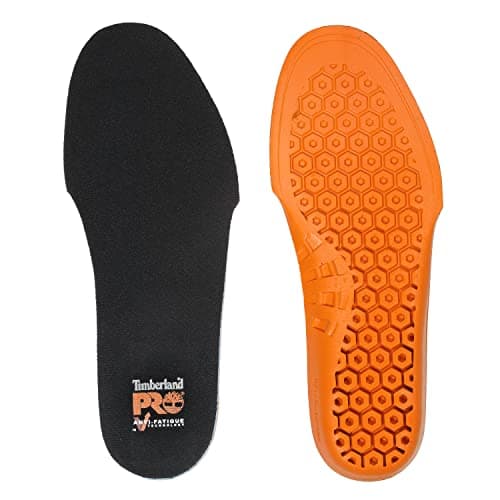
- A deep heel cup. It cups and supports the fat pad under your heel and limits the heel rolling inward, which reduces the pull on the fascia's attachment point. Depth is the specific property - a flat insole with a soft heel area is not the same thing.
- Genuine arch support. Rigid or semi-rigid, so it physically resists the arch flattening. Test it with your thumb: if the arch area compresses easily, it is not supporting anything.
Quick picks
Ranked by our published scoring rubric. Tap any row for the full write-up.
| # | Product | Best for | Score | Price |
|---|---|---|---|---|
| 1 | 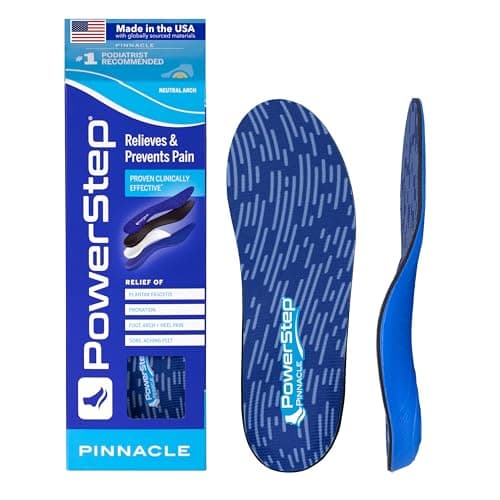 PowerStep Pinnacle Orthotic InsolesSemi-rigid shell, deep heel cup, cushioned top - the combination usually recommended first. | Most people with heel pain | 8.8 | |
| 2 | 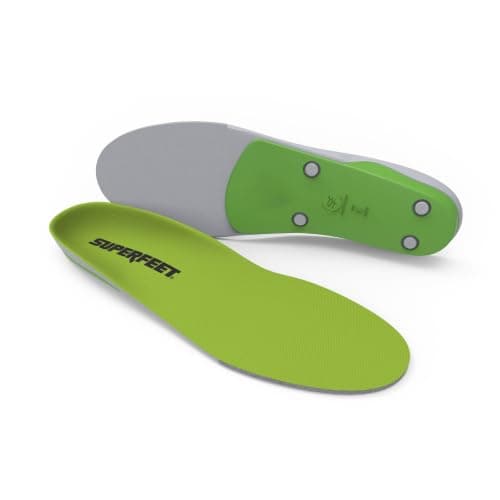 Superfeet All-Purpose High Arch Support InsolesThe most structural option - maximum control, with a real adaptation period. | Severe arch collapse with heel pain | 8.6 | |
| 3 | 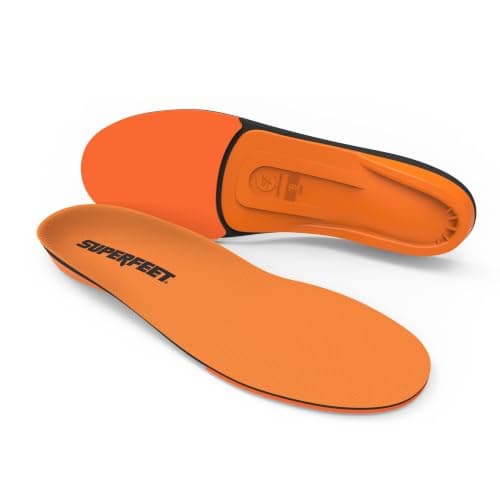 Superfeet All-Purpose High Impact Support InsolesRigid support with forefoot cushioning - for the people who have both problems. | Heel pain plus standing on concrete | 8.6 |
#ad Prices pulled from Amazon and stamped as of October 6, 2026; they change, and we show no number we cannot verify. How we are funded.
Top pick · Most people with heel pain
PowerStep Pinnacle Orthotic Insoles
Semi-rigid shell, deep heel cup, cushioned top - the combination usually recommended first.
This is the most commonly recommended over-the-counter insole for heel pain, and the construction explains why: a semi-rigid shell that limits arch flattening, a deep heel cup that controls heel movement and cradles the fat pad, and a cushioned top layer so it is tolerable from day one.
That last point matters more than it sounds - an insole you can wear a full shift in week one is an insole you will still be wearing in month three. Less support than a fully rigid shell, and the top cover wears before the shell does.
Specs that matter
- Type:
- Semi-rigid shell plus dual-layer cushion
- Arch:
- Neutral to moderate
- Volume:
- Moderate
- Made in:
- USA
Our scoring
- Arch support
- 8.4
- Heel cup depth
- 9.0
- Comfort now
- 8.4
- Longevity
- 8.0
- Value
- 8.8
What works
- Support and cushioning balanced, so adaptation is easy
- Fits a wider range of boots than Superfeet
- Most commonly recommended for heel pain by podiatry sources
What to know
- Less support than a full rigid shell for severe arch collapse
- Top cover wears through before the shell does
- Needs trimming to fit
No. 2 · Severe arch collapse with heel pain
Superfeet All-Purpose High Arch Support Insoles
The most structural option - maximum control, with a real adaptation period.
When heel pain comes with a significantly collapsed arch, the semi-rigid options may not provide enough control, and this is the step up: a genuinely rigid stabilizer cap with a deep heel cup, which limits arch flattening more firmly than anything else here.
Expect one to two weeks of adaptation and build up gradually. It is high volume, so it needs a roomy boot, and it is minimally cushioned by design - which is the point, not a flaw.
Specs that matter
- Type:
- Rigid stabilizer cap
- Arch:
- High arch profile
- Volume:
- High — needs a roomy boot
- Cushioning:
- Minimal by design
Our scoring
- Arch support
- 9.4
- Heel cup depth
- 9.2
- Comfort now
- 6.0
- Longevity
- 9.4
- Value
- 7.6
What works
- Structural support is what actually helps a collapsing arch
- Shell keeps its shape for a year or more of daily wear
- Heel cup genuinely controls heel movement
What to know
- Not a cushion — people expecting softness are disappointed
- Takes up real volume; a snug boot will become too tight
- Needs a one-to-two week adaptation period
No. 3 · Heel pain plus standing on concrete
Superfeet All-Purpose High Impact Support Insoles
Rigid support with forefoot cushioning - for the people who have both problems.
Heel pain and hard-floor standing very often arrive together, and they want slightly different things. This is the compromise that works: the rigid shell and deep heel cup for the fasciitis, plus high-density forefoot foam for the slab.
The highest-volume insole on this page, which rules out a lot of boots once the factory footbed is out. Expensive, and still firmer than most buyers expect.
Specs that matter
- Type:
- Rigid cap plus high-density foam
- Arch:
- High arch profile
- Volume:
- High
- Cushioning:
- Moderate, forefoot focused
Our scoring
- Arch support
- 9.0
- Heel cup depth
- 9.0
- Comfort now
- 7.0
- Longevity
- 9.2
- Value
- 7.4
What works
- Support plus cushioning rather than one or the other
- Extra forefoot foam helps on concrete and from ladder impact
- Same durable shell as the high-arch model
What to know
- Highest-volume insole here — many boots cannot take it
- Expensive
- Still firmer than most people expect
The boot matters too
An insole in a very flexible boot is working against the boot. A stiff midsole limits how much the whole foot flexes and therefore how much the fascia is stretched with each step, which is why orthopedic guidance on footwear for heel pain consistently favors a firm, supportive sole over a flexible one. Boots for plantar fasciitis covers which boots have that stiffness and enough depth to take a support insole.
And if you stand on concrete, that static load is a direct aggravator in its own right - the measures on boots for standing on concrete are worth reading alongside this page.
What helps more than any insole
Worth saying plainly, because we would rather you got better than bought things. The interventions with the best support behind them for plantar fasciitis are calf and plantar fascia stretching done consistently, managing the load that aggravates it, and avoiding walking barefoot on hard floors - which is a commonly reported aggravator and completely free to change. Insoles and supportive footwear help, and they sit alongside those rather than replacing them.
What we would skip
Skip gel heel cups and soft foam insoles for this problem. Skip heel-only inserts, which ignore the arch where the mechanical problem is. Skip stacking an insole on the factory footbed. And skip buying a third insole before getting assessed - persistent heel pain that has not responded to a reasonable attempt at self-management is a clinician's question, not a shopping question.
Frequently asked
What insoles are best for plantar fasciitis in work boots?
Semi-rigid or rigid insoles with a deep heel cup and genuine arch support. The deep heel cup controls heel movement and cradles the fat pad; the arch support limits the arch flattening that stretches the injured tissue. Soft gel insoles address neither mechanism.
Do gel insoles help plantar fasciitis?
Generally not. Gel cushions heel impact, which is a different problem from the arch flattening that aggravates the plantar fascia. People often feel a brief improvement from the padding and find the underlying pain unchanged. Support, not cushioning, is what helps.
Should I use heel cups or full-length insoles for heel pain?
Full-length, in most cases. A heel-only cup pads the sore spot but does nothing about the arch, which is where the mechanical cause sits. The combination that helps is a deep heel cup plus arch support in one full-length insole.
How long do insoles take to help plantar fasciitis?
Support insoles usually feel unfamiliar for one to two weeks while your foot adapts, and any genuine improvement in the condition is measured in weeks rather than days. If there has been no progress after several weeks of consistent use alongside stretching, that is the point to see a clinician.
Sources
Back to Insoles & Work Socks, or see how we pick. Spotted something wrong? We publish corrections — see our editorial policy.