Best for mechanics
Best Work Boots for Mechanics
A shop floor is a chemistry problem. Oil-resistant soles and oil-tanned leather are the whole spec.
Mechanics are the trade whose boots are attacked chemically rather than mechanically. On a construction site boots die from abrasion; in a shop they die from oil, diesel, brake cleaner, coolant and whatever else ends up on the floor. That changes which specs matter, and it is why a boot that excels on a building site can fall apart in a workshop inside a year. The broader shortlists are on the work boots hub; this page is about the chemistry.
Oil resistant and slip resistant are two different claims
They get used interchangeably in marketing and they mean separate things. Oil resistant describes the sole compound's ability to resist chemical degradation - an oil-resistant rubber does not swell, soften and break down when it sits in oil. Slip resistant describes the coefficient of friction on a contaminated surface. A sole can be one without the other, and for a shop you genuinely need both: the first so the sole survives, the second so you stay upright.
- Look for both claims stated separately on the spec sheet - not just "oil/slip resistant" as a single marketing phrase.
- Fine siping, the small cuts across a sole's contact surface, channels fluid away and matters more on a wet shop floor than lug depth does.
- A worn-smooth outsole has lost its slip resistance even if the compound is still intact. That is your replacement trigger.
- Work boot sole types covers compounds and slip ratings in detail.
Quick picks
Ranked by our published scoring rubric. Tap any row for the full write-up.
| # | Product | Best for | Score | Price |
|---|---|---|---|---|
| 1 | 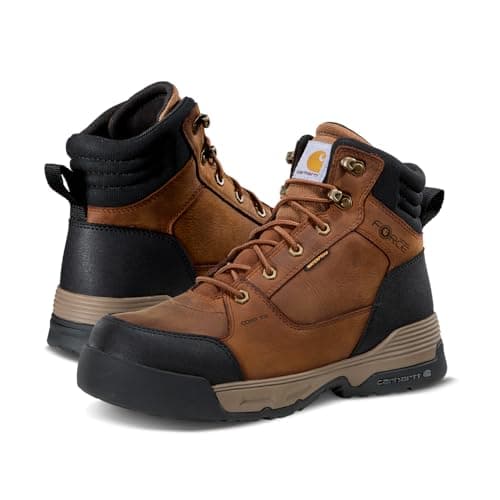 Carhartt Force HD 6" Composite Toe WaterproofOil-tanned leather is the detail that matters when your floor is a chemistry set. | Daily shop work | 8.7 | |
| 2 | 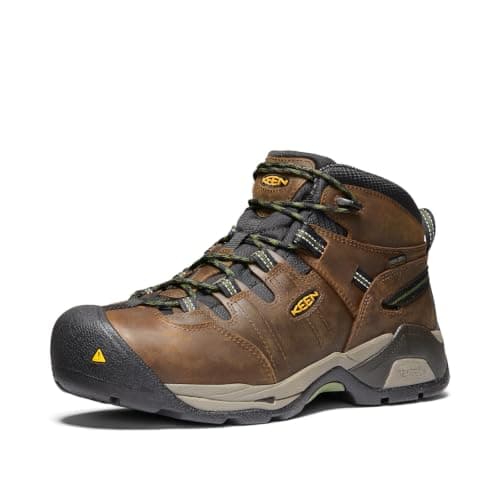 KEEN Utility Detroit XT Mid Steel Toe WaterproofFlexible and low-profile, so you can actually work on a creeper. | Getting under vehicles | 8.4 | |
| 3 | 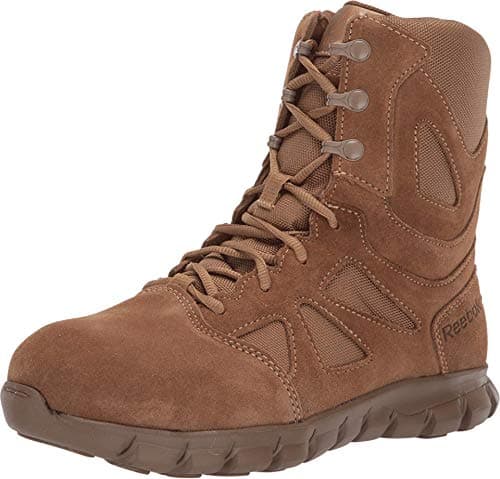 Reebok Work Sublite Cushion 8" Safety Toe Side-ZipAthletic weight with a side zip, for techs who cover ground all day. | Walking a big shop or dealership | 8.0 | |
| 4 | 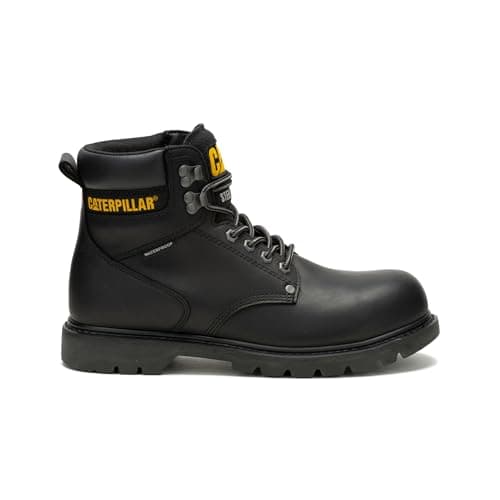 Caterpillar Second Shift Waterproof Steel ToeWelted, waterproof, and cheap enough to accept that the shop will destroy it. | Heavy equipment and diesel | 8.4 |
#ad Prices pulled from Amazon and stamped as of October 6, 2026; they change, and we show no number we cannot verify. How we are funded.
Top pick · Daily shop work
Carhartt Force HD 6" Composite Toe Waterproof
Oil-tanned leather is the detail that matters when your floor is a chemistry set.
A mechanic's boots fail differently from everyone else's. The upper does not wear out so much as get chemically attacked - oil, diesel, brake cleaner, coolant - and ordinary chrome-tanned leather dries, cracks and splits at the flex crease once that happens. Oil-tanned leather is impregnated with oils from the start, so it absorbs more and cracks far less.
Add a composite toe, a waterproof membrane that keeps spilled fluid out as well as water, and a genuinely oil- and slip-resistant outsole, and you have the right spec for a shop. It is heavy for a 6-inch boot, which is the cost of the leather.
Specs that matter
- Toe:
- Composite toe, ASTM F2413
- Height:
- 6 inch
- Waterproof:
- Yes
- Upper:
- Oil-tanned full-grain leather
Our scoring
- Oil resistance
- 9.2
- Slip resistance
- 8.8
- Chemical durability
- 9.2
- Comfort
- 7.6
- Value
- 8.0
What works
- Oil-tanned leather resists the chemical splash that cracks cheaper uppers
- Non-metallic toe keeps the cold out better than steel
- Available in wide widths from stock
What to know
- Heavy for a 6-inch boot
- Break-in is real — expect a week
- Cement construction, not resoleable
No. 2 · Getting under vehicles
KEEN Utility Detroit XT Mid Steel Toe Waterproof
Flexible and low-profile, so you can actually work on a creeper.
Shop work involves positions no other trade adopts: on a creeper, kneeling at a wheel, standing on a bumper, foot braced against a frame rail. A stiff boot fights all of those. The Detroit XT flexes out of the box, has a lower profile than most safety boots, and comes in a true EE wide for anyone whose feet get squeezed.
It is steel toe rather than composite and the leather is softer than the Carhartt's, so it will show solvent damage sooner. For a tech who values mobility over upper longevity, that is a reasonable trade.
Specs that matter
- Toe:
- Steel toe, ASTM F2413
- Height:
- Mid / 6 inch
- Waterproof:
- Yes
- Widths:
- D and EE
Our scoring
- Oil resistance
- 8.4
- Slip resistance
- 8.6
- Chemical durability
- 7.4
- Comfort
- 9.0
- Value
- 8.2
What works
- Actually stocked in EE wide, not just a roomy D
- Flexes out of the box rather than demanding a break-in
- Lighter than the Pittsburgh at the same protection
What to know
- Cement construction — no resoling
- Softer upper creases and scuffs quickly
- Less ankle support than a true 8-inch boot
No. 3 · Walking a big shop or dealership
Reebok Work Sublite Cushion 8" Safety Toe Side-Zip
Athletic weight with a side zip, for techs who cover ground all day.
If your day is less about one vehicle and more about walking a large shop, a parts department and a lot of hard floor, the weight of a traditional work boot is the thing you feel. This is an athletic-build safety boot, and the difference over nine hours is substantial.
The side zip means you keep your lace tension and still get in and out quickly, which matters more than it sounds if you remove boots to drive customer vehicles. The textile panels are the weakness - they will not survive much solvent exposure, so this is a clean-shop boot rather than a heavy-equipment one.
Specs that matter
- Toe:
- Safety toe, ASTM F2413
- Height:
- 8 inch
- Closure:
- Laces plus side zipper
- Weight:
- Athletic-shoe construction
Our scoring
- Oil resistance
- 7.6
- Slip resistance
- 8.4
- Chemical durability
- 6.4
- Comfort
- 9.2
- Value
- 8.0
What works
- Among the lightest 8-inch safety boots sold
- Side zip means you keep the lace tension and still get out quickly
- Cushioning suited to miles of walking on hard floors
What to know
- Zipper is the obvious failure point
- Textile panels tear on rough material handling
- Little underfoot puncture protection
Best value · Heavy equipment and diesel
Caterpillar Second Shift Waterproof Steel Toe
Welted, waterproof, and cheap enough to accept that the shop will destroy it.
Heavy-equipment and diesel work is harder on boots than automotive: more weight, more fluid, more climbing on machinery. The Second Shift is a Goodyear-welted waterproof steel toe at a mid-market price, which means it both resists the abuse and can be resoled rather than binned when the outsole goes.
It is heavy and the stock footbed is minimal, so budget for an insole. The payoff is a boot you are not precious about.
Specs that matter
- Toe:
- Steel toe, ASTM F2413
- Height:
- 6 inch
- Waterproof:
- Yes
- Build:
- Goodyear welt
Our scoring
- Oil resistance
- 8.8
- Slip resistance
- 8.2
- Chemical durability
- 8.6
- Comfort
- 7.0
- Value
- 9.0
What works
- Welted construction at a mid-market price
- Waterproof and safety-rated together
- Widely stocked, so sizing is easy to replace
What to know
- Heavy
- Stock footbed is minimal
- Leather needs conditioning or it stiffens
Why oil-tanned leather is the upper to look for
Leather is a natural material held supple by its oils. Repeated solvent exposure strips those oils out, and once the leather dries it cracks - first at the flex crease across the toe, which is exactly where a mechanic's boot bends constantly. Oil-tanned leather starts with far more oil content, so it tolerates that cycle much better. Conditioning any leather boot regularly helps substantially too, which is the single most useful thing in boot care and conditioning.
Metal in the toe, and the brake-rotor problem
One mechanic-specific consideration: a steel toe is a large chunk of metal directly against the front of your foot, and a shop is full of things that get cold and hot. In an unheated winter shop a steel cap is noticeably colder than composite; near exhaust and brake work it conducts heat. Composite avoids both and meets the same ASTM impact rating - see composite toe vs steel toe.
The other half of the shop kit is hands, and it has the same chemistry logic: nitrile-coated gloves give you the feel to run a fastener and resist oil far better than leather does. See gloves for mechanics, and work pants for mechanics for the fabric side.
What we would skip
Skip suede and nubuck uppers. They look good and they absorb oil permanently, going hard and dark within months. Skip mesh and textile panels if you work around solvents - they wick fluid straight to your foot. And skip the instinct to buy the heaviest boot available: a shop floor is flat and hard, which means fatigue is your real enemy, and the logic on boots for standing on concrete applies to a workshop as much as to a slab.
Frequently asked
What is the difference between oil-resistant and slip-resistant boots?
Oil resistant describes the sole compound's ability to resist chemical breakdown when exposed to oil - it stops the sole swelling and degrading. Slip resistant describes grip on a contaminated surface. They are separate properties and you want both in a workshop; a spec sheet should state each one.
Why do my work boots crack in the shop?
Solvents and oil strip the natural oils out of leather, and dry leather cracks at the flex crease. Oil-tanned leather resists this far better than ordinary chrome-tanned leather, and regular conditioning slows it dramatically on any leather boot.
Should mechanics wear steel toe or composite toe?
Composite, generally. It meets the same ASTM impact rating, weighs less, and does not conduct heat from brake and exhaust work or cold from an unheated winter shop the way a steel cap does. Steel is cheaper and the toe box is slightly slimmer.
Are slip-resistant boots enough on an oily shop floor?
They help substantially, but no outsole makes a fluid-covered floor safe. Fine siping that channels fluid away performs better than deep lugs, and a sole worn smooth has lost its slip resistance regardless of the original rating - that is when to replace the boots.
Sources
Back to Work Boots, or see how we pick. Spotted something wrong? We publish corrections — see our editorial policy.