Best EH-rated boots
Best Electrical Hazard (EH) Work Boots
What an EH rating actually certifies is narrower than most buyers think. Worth five minutes before you buy.
Electrical hazard rating is the most misunderstood specification in work footwear. It appears on a great many boots, it is cheap for manufacturers to add, and almost nobody selling it explains what it certifies. The gap between what buyers assume and what the standard actually tests is wide enough to be dangerous, so this page leads with the standard rather than the products.
What the rating certifies, precisely
Under ASTM F2413, footwear marked EH has had its sole and heel assembly tested to withstand a specified voltage without current passing through, under dry conditions. The standard describes this as secondary protection against the hazard of incidental contact with live electrical circuits.
Three qualifiers carry all the weight:
- Dry. The test is conducted dry. Water, sweat, conductive dust and slurry all defeat it. A wet sole is not EH protection in any meaningful sense.
- Secondary. It is a backstop behind the actual safety system, not a layer of that system. Primary protection is de-energizing the circuit.
- Accidental / incidental contact. It is for the moment something goes wrong - not for deliberate work on energized equipment.
It is also a wearing part. A worn-through outsole, or one with a nail, staple or metal swarf embedded in it, provides a conductive path straight through the boot. The label does not stop saying EH when that happens, which is precisely the problem.
Quick picks
Ranked by our published scoring rubric. Tap any row for the full write-up.
| # | Product | Best for | Score | Price |
|---|---|---|---|---|
| 1 | 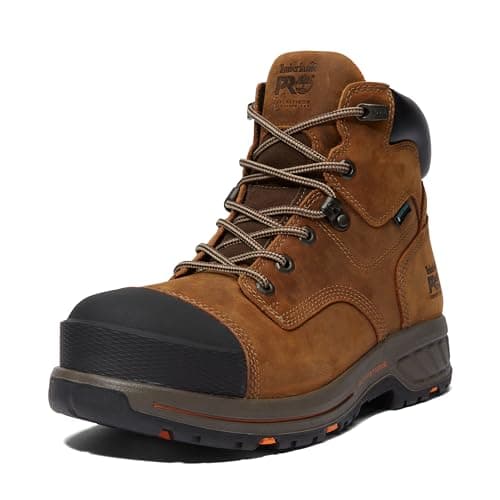 Timberland PRO Helix HD 6" Composite Toe WaterproofEH rated and fully non-metallic, waterproof, and stable to stand on all day. | Daily EH-rated wear | 9.0 | |
| 2 | 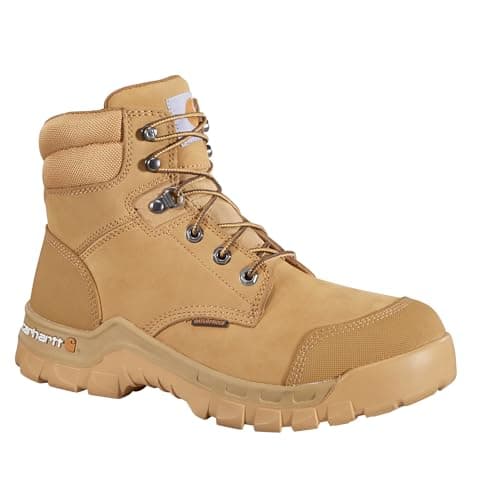 Carhartt Rugged Flex 6" Composite Toe WaterproofThe least boot-like option here - non-metallic, waterproof and no break-in. | Light, flexible EH protection | 8.7 | |
| 3 | 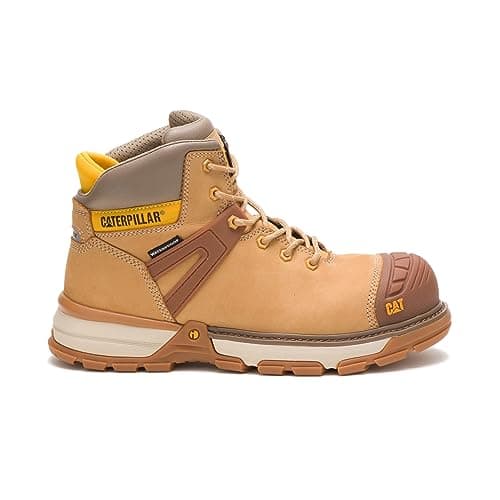 Caterpillar Excavator Superlite Waterproof Composite ToeCarbon composite, waterproof, EH rated, and the lightest here. | The cheapest non-metallic EH boot | 8.6 | |
| 4 | 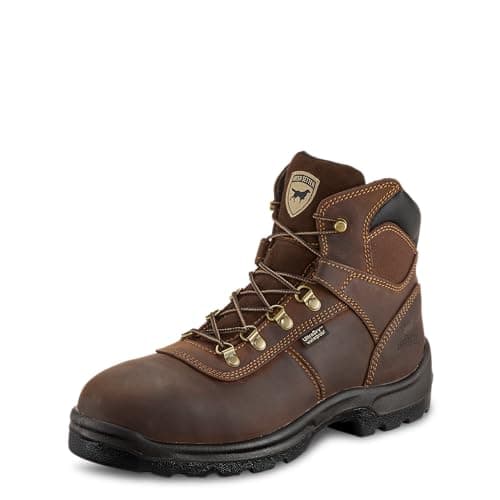 Irish Setter Ely 6" Steel ToeEH rated with proper leather and nothing clever - comfortable out of the box. | A simple EH-rated leather boot | 7.8 |
#ad Prices pulled from Amazon and stamped as of October 6, 2026; they change, and we show no number we cannot verify. How we are funded.
Top pick · Daily EH-rated wear
Timberland PRO Helix HD 6" Composite Toe Waterproof
EH rated and fully non-metallic, waterproof, and stable to stand on all day.
For an EH boot the two things to confirm are the EH marking and whether the boot contains metal elsewhere - a steel shank and steel eyelets are conductive paths the dielectric test does not cover. This one is non-metallic throughout, which is the cleaner spec.
Waterproof and built on a wide stable platform, which matters for ladder and lift work. The membrane runs warm, and it is not resoleable.
Specs that matter
- Toe:
- Composite toe, ASTM F2413
- Height:
- 6 inch
- Waterproof:
- Yes
- Electrical hazard:
- EH rated
Our scoring
- EH compliance
- 9.5
- Non-metallic build
- 9.5
- Stability
- 8.8
- Comfort
- 8.2
- Value
- 7.8
What works
- Balances cushioning and support better than either Boondock or Hypercharge
- Wide platform feels stable on ladders and scaffold planks
- EH rated and non-metallic
What to know
- Middle-of-the-range in every dimension, best at nothing
- Membrane means warm feet in summer
- Cement construction, not resoleable
No. 2 · Light, flexible EH protection
Carhartt Rugged Flex 6" Composite Toe Waterproof
The least boot-like option here - non-metallic, waterproof and no break-in.
For service and residential work where you are in and out of a van and walking finished floors, a light flexible boot that still carries the EH rating is the sensible choice. This one is non-metallic, waterproof and comfortable from the first wear.
The cushioned EVA midsole compresses over a year of daily use, and the softer upper will not stand up to heavy industrial work.
Specs that matter
- Toe:
- Composite toe, ASTM F2413
- Height:
- 6 inch
- Waterproof:
- Yes
- Midsole:
- Cushioned EVA
Our scoring
- EH compliance
- 8.8
- Non-metallic build
- 9.5
- Stability
- 7.6
- Comfort
- 9.0
- Value
- 8.6
What works
- Flexes immediately — close to no break-in
- Lighter than the Force HD with the same toe protection
- Cushioned midsole helps on hard floors
What to know
- EVA midsole compresses over a year of daily wear
- Softer upper than the Force HD
- Membrane runs hot in summer
Best value · The cheapest non-metallic EH boot
Caterpillar Excavator Superlite Waterproof Composite Toe
Carbon composite, waterproof, EH rated, and the lightest here.
An apprentice buying a first compliant boot, or anyone who wants the EH and non-metallic specs without paying for a premium brand, should start here. It is light, waterproof and priced well below the field.
Light construction means less protection underfoot and faster outsole wear. Fine for clean commercial work, under-built for debris-heavy sites.
Specs that matter
- Toe:
- Carbon composite toe, ASTM F2413
- Height:
- 6 inch
- Waterproof:
- Yes
- Weight:
- Lightweight construction
Our scoring
- EH compliance
- 8.6
- Non-metallic build
- 9.5
- Stability
- 7.4
- Comfort
- 8.4
- Value
- 9.2
What works
- Genuinely light for a waterproof safety boot
- Non-metallic throughout — no metal detector problems
- Cheaper than most composite-toe waterproof boots
What to know
- Light build means the outsole wears sooner
- Less underfoot protection than a heavier boot
- Not resoleable
No. 4 · A simple EH-rated leather boot
Irish Setter Ely 6" Steel Toe
EH rated with proper leather and nothing clever - comfortable out of the box.
Plenty of boots at this price are not EH rated at all, and a lot of buyers assume they are. This one is, with a genuine full-grain upper and an oil- and slip-resistant outsole, and it is unusually comfortable from new for a steel-toe boot.
It is steel toe rather than composite, so it has conductive mass in it - if your site specifies non-metallic, take one of the picks above. Not waterproof.
Specs that matter
- Toe:
- Steel toe, ASTM F2413
- Height:
- 6 inch
- Electrical hazard:
- EH rated
- Sole:
- Oil and slip resisting rubber
Our scoring
- EH compliance
- 8.4
- Non-metallic build
- 5.0
- Stability
- 8.0
- Comfort
- 8.4
- Value
- 8.4
What works
- Comfortable out of the box by the standards of steel-toe boots
- EH rated, which many boots at this price are not
- Simple construction with little to go wrong
What to know
- Not waterproof
- Unremarkable outsole on loose ground
- No wide-width depth in stock
What the real protection looks like
Worth stating plainly, because a page selling EH boots has an obligation to. Protection for electrical work comes from the hierarchy of controls and the procedures in NFPA 70E and OSHA 1910.269 and 1910.333: establish an electrically safe working condition, lock out and tag out, verify de-energization, respect approach boundaries, and where live work is genuinely unavoidable, use rubber insulating gloves and sleeves tested to ASTM D120 and D1051 with leather protectors, plus arc-rated clothing selected on an incident-energy analysis.
Your boots are not on that list. They are what might save you from a mistake someone else made. Buy them, wear them, and do not let them change your decisions. Boots for electricians and boots for linemen cover the trade-specific choices.
Non-metallic is the spec that pairs with EH
A boot can be EH rated and still contain a steel toe, a steel shank and steel eyelets. None of that is tested by the dielectric procedure, which examines the sole and heel. For electrical trades, removing metal from the boot entirely is the sensible complement to the rating, and it is why many utilities and contractors now specify non-metallic footwear outright. Composite toe work boots is the shortlist, and composite toe vs steel toe covers the trade.
What we would skip
Skip relying on an EH rating in wet conditions. Skip boots whose outsoles are worn thin, regardless of the label. Skip steel toes and exposed metal eyelets for electrical work where you have a choice. And skip any product page - including any other page that sells these boots - that implies an EH rating makes you safe around live circuits. It does not, and the standard itself says so.
Frequently asked
What does EH mean on work boots?
Electrical hazard rated under ASTM F2413: the sole and heel passed a dielectric test under dry conditions and provide secondary protection against accidental contact with live circuits. It is a backstop if something goes wrong - not insulation, and not a license to work energized equipment.
Do EH boots protect against electric shock?
Only incidentally, in dry conditions, as a last line of defense. They are explicitly secondary protection. Real protection comes from de-energizing, lockout/tagout, approach boundaries, rubber insulating gloves tested to ASTM D120, and arc-rated clothing per NFPA 70E.
Does an EH rating wear out?
Effectively, yes. The rating depends on the integrity of the sole and heel, so a worn-through outsole or one with a nail or metal fragment embedded in it no longer provides the protection - even though the marking inside the boot still says EH. Water also defeats it.
Can EH boots have steel toes?
Yes - the dielectric test covers the sole and heel, not the toe cap, so plenty of EH boots have steel toes. But a steel toe, shank and eyelets add conductive material, which is why many electrical employers specify fully non-metallic footwear alongside the EH rating.
Sources
Back to Work Boots, or see how we pick. Spotted something wrong? We publish corrections — see our editorial policy.