Best cut-resistant gloves
Best Cut-Resistant Work Gloves
The jump from A1 to A5 is enormous, and the gloves look identical on a shelf. Here is how to tell.
Cut-resistant gloves are the one glove category with a real, measurable standard behind them, and that makes them unusually easy to shop well - once you know the scale. The problem is that a huge proportion of gloves sold as cut resistant are A1, the lowest level, and on a shelf they look identical to an A5. The rating is the only thing that tells you apart, which is why this page spends as much time on the standard as on the products.
The A1-A9 scale, in plain terms
ANSI/ISEA 105 rates cut resistance using the ASTM F2992 test method: a blade is drawn across the material under increasing load, and the rating reflects the gram load required to cut through at a fixed distance. The levels are not evenly spaced, and the practical bands are:
| Level | Protection | Typical use |
|---|---|---|
| A1 | Minimal | General handling, scrapes. Most nitrile-coated work gloves |
| A2-A3 | Light | Light assembly, small parts, packaging |
| A4-A5 | Medium - the practical band | Glass, sheet metal, banding, blade handling, HVAC duct work |
| A6-A7 | High | Heavy glass and metal fabrication, meat processing |
| A8-A9 | Highest | Blade changing, severe laceration risk |
Note how large the real-world gap is between A1 and A5 despite being four steps on a nine-step scale. Someone wearing an A1 coated glove to handle sheet metal has, functionally, no cut protection. The full breakdown is in ANSI cut levels explained.
Quick picks
Ranked by our published scoring rubric. Tap any row for the full write-up.
| # | Product | Best for | Score | Price |
|---|---|---|---|---|
| 1 | 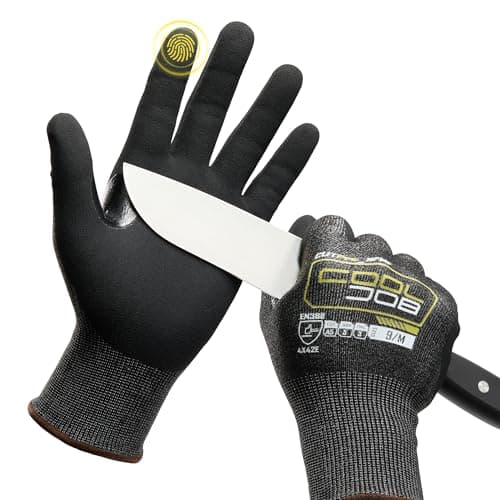 COOLJOB A5 Cut-Resistant Gloves (Fiberglass-Free)An honest ANSI A5 rating without fiberglass in the yarn - the sensible default. | Real A5 protection, cheaply | 8.8 | |
| 2 | 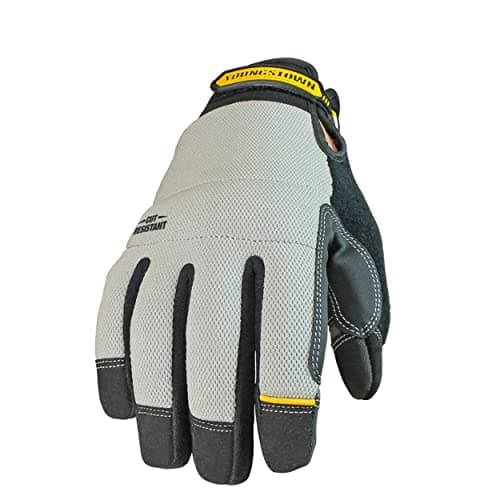 Youngstown Glove General Utility Lined with KevlarKevlar-lined utility glove - more protection than coated, more feel than a cut sleeve. | Cut resistance in a normal-feeling glove | 7.8 | |
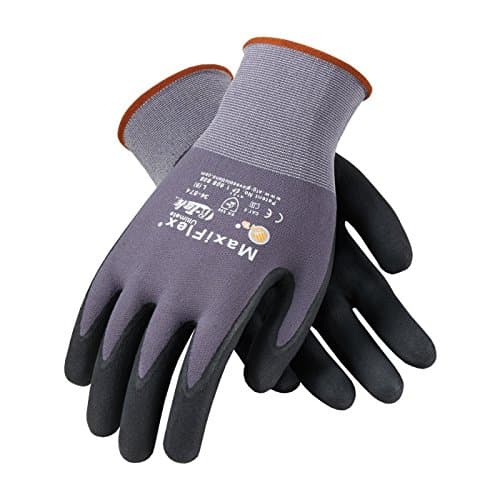
| 3 | 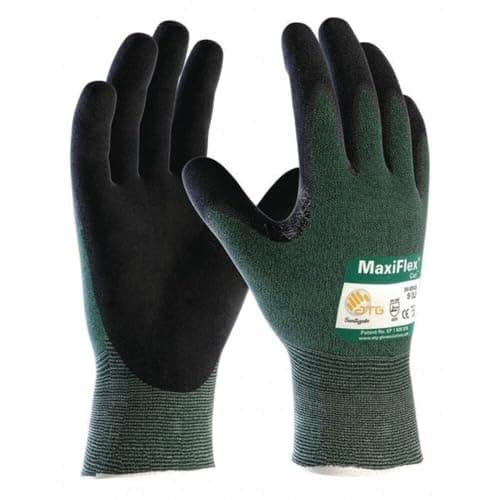 MaxiFlex Cut Level A2 Nitrile-Coated Gloves (34-8743)A rated cut glove thin enough to keep on for ordinary work. | Light cut protection with good feel | 8.0 | |
| 4 | 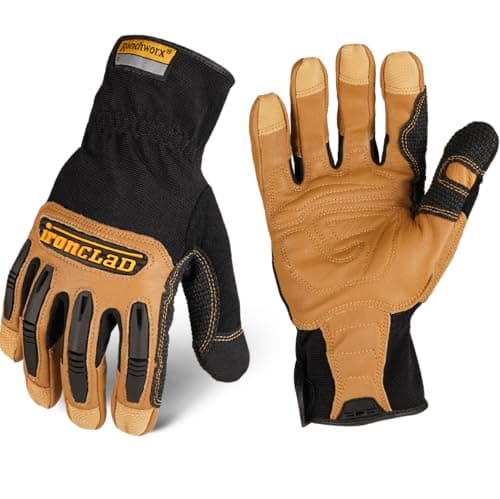 Ironclad Ranchworx Leather Work GlovesNo cut rating - but heavy reinforced leather that survives banding and wire. | Sharp material where leather is the better answer | 7.2 |
#ad Prices pulled from Amazon and stamped as of October 6, 2026; they change, and we show no number we cannot verify. How we are funded.
Top pick · Real A5 protection, cheaply
COOLJOB A5 Cut-Resistant Gloves (Fiberglass-Free)
An honest ANSI A5 rating without fiberglass in the yarn - the sensible default.
A5 is genuine cut protection - several levels above the A1 coated gloves most people wear - and getting it at this price is the reason this is the top pick. If you handle glass, sheet metal, banding or blades, this is the level you actually want rather than hoping a general glove covers it.
Fiberglass-free yarn matters more than it sounds: many cheap cut gloves use fiberglass in the blend, and the fibers cause skin irritation that makes people stop wearing them. A cut rating is not a puncture rating, and these are thicker than nitrile gloves, so dexterity drops.
Specs that matter
- Cut rating:
- ANSI/ISEA 105 level A5
- Yarn:
- Fiberglass-free HPPE blend
- Grip:
- Coated palm
- Pack:
- Multi-pair
Our scoring
- Cut protection
- 9.2
- Dexterity
- 7.0
- Grip
- 7.8
- Comfort
- 8.0
- Value
- 9.5
What works
- A5 is genuine cut protection, two full levels above a typical coated glove
- Fiberglass-free yarn avoids the skin irritation cheap cut gloves cause
- Cheap enough to keep several pairs around
What to know
- Cut rating is not impact or puncture protection — different hazard
- Thicker than a nitrile glove, so dexterity drops
- No warmth and no waterproofing
No. 2 · Cut resistance in a normal-feeling glove
Youngstown Glove General Utility Lined with Kevlar
Kevlar-lined utility glove - more protection than coated, more feel than a cut sleeve.
A middle path: a Kevlar liner inside an otherwise conventional utility glove, so you get meaningful cut resistance without moving to a dedicated cut glove's thickness. For trades with occasional rather than constant cut exposure, that is often the right trade.
The important caveat: no published ANSI level. If your employer specifies a documented cut level, this will not satisfy it - buy a rated glove.
Specs that matter
- Liner:
- Kevlar lined
- Palm:
- Synthetic leather, reinforced
- Cut resistance:
- Kevlar liner; ANSI level not published for this model
- Made in:
- Designed in USA
Our scoring
- Cut protection
- 7.4
- Dexterity
- 7.4
- Grip
- 8.2
- Comfort
- 8.0
- Value
- 7.8
What works
- Kevlar lining adds real cut resistance to a normal-feeling glove
- Durable enough for utility and lineman work
- Good wrist coverage
What to know
- No published ANSI cut level, so you cannot spec it to a standard
- Warmer than an uncoated glove in summer
- Costs more than a plain utility glove
No. 3 · Light cut protection with good feel
MaxiFlex Cut Level A2 Nitrile-Coated Gloves (34-8743)
A rated cut glove thin enough to keep on for ordinary work.
The practical problem with cut gloves is that people take them off, because the high-level ones are thick. A lower-rated cut glove that stays on all day protects you more over a week than an A6 glove in your pocket.
This is a thin, nitrile-dipped glove with a stated cut level, which is the honest middle ground. Do not mistake it for high-level protection - for glass and blade work, step up to A4 or A5.
Specs that matter
- Cut rating:
- ANSI/ISEA 105 level A2
- Coating:
- Microporous nitrile palm
- Liner:
- Seamless knit, 15 gauge
- Pack:
- Sold as 12 pairs
Our scoring
- Cut protection
- 6.4
- Dexterity
- 8.6
- Grip
- 8.4
- Comfort
- 8.4
- Value
- 8.8
What works
- A stated cut rating in a glove thin enough for fine work
- Same micro-foam grip and breathable knit back as the uncoated MaxiFlex
- Dozen packs make per-pair cost low enough to replace them properly
What to know
- A2 is light cut protection - not enough for glass or blade handling
- No impact protection
- Coating wears quickly on abrasive work
No. 4 · Sharp material where leather is the better answer
Ironclad Ranchworx Leather Work Gloves
No cut rating - but heavy reinforced leather that survives banding and wire.
Included deliberately as the alternative approach. Cut-resistant gloves work by resisting a slicing blade; heavy leather works by mass and toughness, and against steel banding, barbed wire and rough sheet stock it often lasts longer than an engineered cut glove.
No ANSI rating, so it will not satisfy a specified requirement, and it is bulky. Worth knowing about because for some material it is genuinely the more durable choice.
Specs that matter
- Palm:
- Reinforced leather with double stitching
- Protection:
- Padded knuckle and impact zones
- Cut rating:
- None published
- Care:
- Machine washable
Our scoring
- Cut protection
- 6.6
- Dexterity
- 5.6
- Grip
- 8.0
- Comfort
- 7.0
- Value
- 8.2
What works
- Survives barbed wire and sharp sheet stock that destroy nitrile gloves
- Reinforced fingertips are where cheap gloves blow out first
- Washable, unusually for a leather glove
What to know
- Bulky — poor for fine work
- Stiff until broken in
- No published cut rating despite the heft
Do not over-specify
It is tempting to buy the highest level available, and it is usually the wrong call. Higher cut levels mean thicker, stiffer gloves, which cost dexterity - and a glove you remove to do the delicate part is not protecting you during the delicate part. That is not a theoretical trade-off; it is the most common way cut gloves fail in practice.
Buy the level your actual hazard requires. For most trades handling sheet metal, glass or banding, A4 or A5 is right. Going to A7 because it sounds safer typically produces a glove that lives in a toolbox.
Three things cut gloves do not do
- Puncture. Rated separately under the same standard. A nail, needle or spike goes through a high-level cut glove, because the yarn resists slicing rather than piercing.
- Impact. No cut glove protects your knuckles from a hammer or a pinch - that is impact gloves.
- Heat. Cut yarns are not heat resistant. For hot work you need welding gloves.
And one material note worth knowing: many budget cut gloves use fiberglass in the yarn blend because it is cheap and cuts well. Loose fiberglass fibers cause genuine skin irritation, and it is a common reason people abandon cut gloves. Fiberglass-free blends cost slightly more and get worn.
What we would skip
Skip any glove described as cut resistant without a stated ANSI level - assume A1. Skip over-specifying the level, which costs you the dexterity that keeps gloves on your hands. Skip fiberglass-blend yarns if you have a choice. And skip treating a cut glove as general-purpose protection: it is one hazard, well covered, and three others not covered at all.
Frequently asked
What ANSI cut level do I need?
A1 to A3 for general handling where the risk is scrapes and nicks. A4 to A5 for glass, sheet metal, banding and blade work - the band most people who think they need cut protection actually need. A6 and above for heavy glass, metal fabrication and blade changing.
Are cut-resistant gloves cut proof?
No. The rating reflects the gram load required for a blade to cut through at a fixed distance, so every level can be cut with enough force. They turn a severing injury into a scratch and buy you reaction time; they are not armor.
Do cut-resistant gloves protect against punctures?
Not reliably. ANSI/ISEA 105 rates cut and puncture resistance separately, and the yarns that resist a slicing blade do little against a nail or needle, which pushes between the fibers. If puncture is your hazard, buy a glove rated for it specifically.
Why do my cut-resistant gloves irritate my skin?
Most likely fiberglass in the yarn blend - it is cheap and cuts well, and loose fibers cause itching and irritation. It is a common reason people stop wearing cut gloves. Fiberglass-free HPPE blends cost a little more and are far more wearable.
Sources
Back to Work Gloves, or see how we pick. Spotted something wrong? We publish corrections — see our editorial policy.