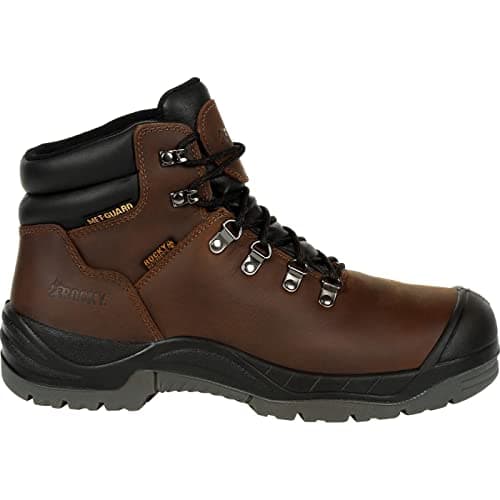
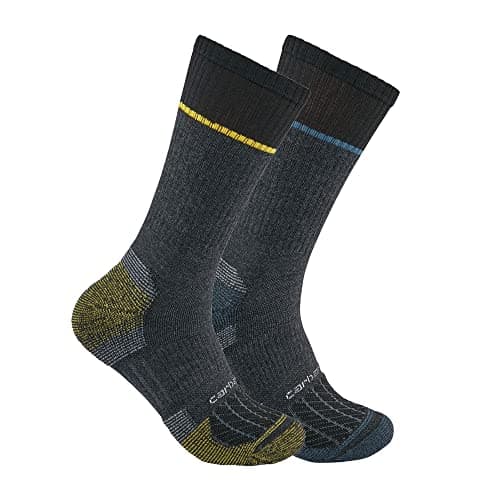
Best for roofing
Best Work Boots for Roofing
Grip on a slope beats every other feature. A deep lug sole is usually the wrong answer up there.
Roofers get worse footwear advice than any other trade, because most of it is written by people applying general-construction logic to a surface where that logic does not hold. The surface is hard, granular, sloped and often hot, and all four of those change what a good sole looks like.
Why a deep lug sole is the wrong answer on a roof
Traction on soft ground works by mechanical interlock: lugs sink into dirt or mud and push against it. Traction on a hard surface works by friction, which depends on the rubber compound and on how much of it is actually touching the surface. A deep aggressive lug pattern deliberately removes rubber to create those lugs - excellent in a trench, counterproductive on a shingle where the granules are already a loose layer between you and the deck.
Hence the roofer's traditional preference for a flat wedge: more rubber down, more friction, no lugs to roll on. The full comparison is in wedge sole vs heel, and work boot sole types covers compounds and slip-resistance ratings.
Quick picks
Ranked by our published scoring rubric. Tap any row for the full write-up.
| # | Product | Best for | Score | Price |
|---|---|---|---|---|
| 1 | 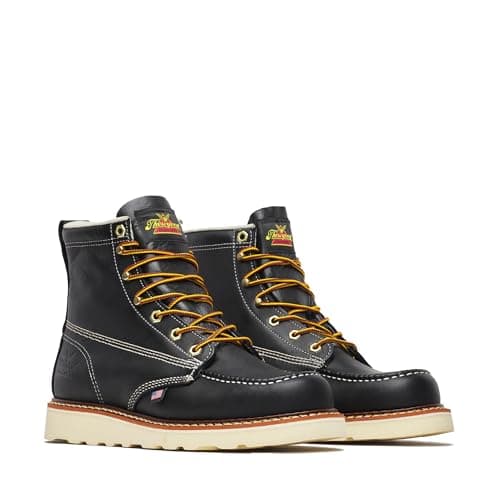 Thorogood American Heritage 6" Moc ToeA flat wedge puts maximum rubber on the slope, which is exactly what roofing wants. | Shingle and flat-roof work | 8.6 | |
| 2 | 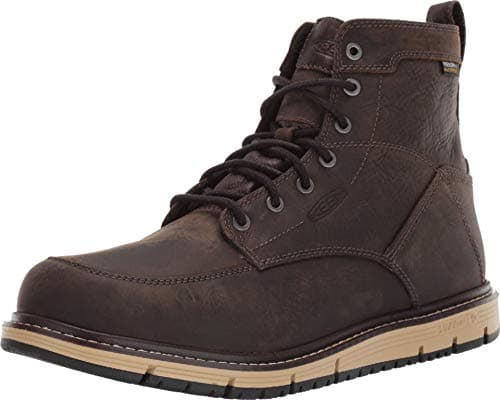 KEEN Utility San Jose 6" Soft Toe WaterproofThe wedge grip story with a waterproof membrane and a roomy toe box. | Wet mornings and a wide forefoot | 8.0 | |
| 3 | 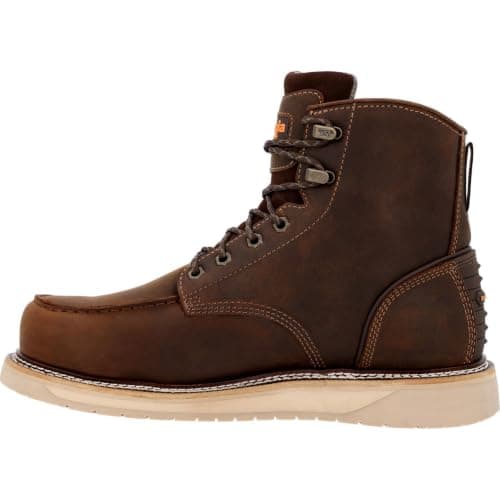 Georgia Boot AMP LT Wedge Waterproof Composite ToeA waterproof composite-toe wedge - the compliant version of the roofer's boot. | When the site requires a safety toe | 8.0 | |
| 4 | 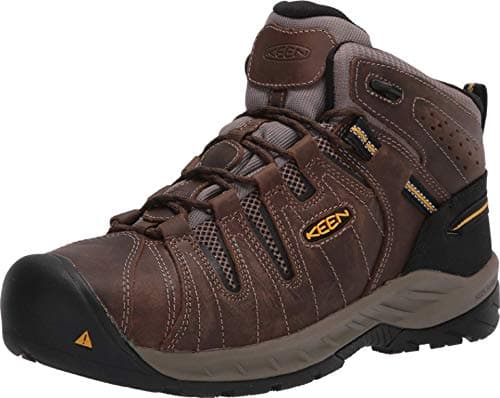 KEEN Utility Flint II Mid Steel ToeNo membrane, so it actually breathes - the pick for August roofs. | Summer heat | 7.9 |
#ad Prices pulled from Amazon and stamped as of October 6, 2026; they change, and we show no number we cannot verify. How we are funded.
Top pick · Shingle and flat-roof work
Thorogood American Heritage 6" Moc Toe
A flat wedge puts maximum rubber on the slope, which is exactly what roofing wants.
Roofing is the trade where the usual boot logic inverts. On the ground, an aggressive lug sole grips best because the lugs bite into soft material. On a shingle roof there is nothing to bite into - the surface is hard and granular - so grip comes from the area of rubber in contact and the compound's friction, not from tread depth. A flat wedge maximizes both.
That is why moc-toe wedge boots have been the traditional roofer's boot for decades, and why this one still earns the top spot. It is a soft toe, which is fine for most residential roofing but will not pass on sites requiring a safety toe - check first, and see the hub for rated alternatives.
Specs that matter
- Toe:
- Soft toe (no safety rating)
- Height:
- 6 inch
- Sole:
- MAXwear wedge, slip-resisting
- Build:
- Goodyear storm welt, resoleable
Our scoring
- Grip on slope
- 9.4
- Heat tolerance
- 8.0
- Durability
- 9.0
- Ankle support
- 7.0
- Value
- 8.0
What works
- Welt construction means a cobbler can resole it instead of you rebuying
- Flat wedge does not pack mud and does not scuff finished floors
- Removable footbed, so an aftermarket insole drops straight in
What to know
- Soft toe only — not legal where a safety toe is required
- Wedge sole gives up grip on wet steel and ladder rungs
- Premium price for a boot with no safety rating
No. 2 · Wet mornings and a wide forefoot
KEEN Utility San Jose 6" Soft Toe Waterproof
The wedge grip story with a waterproof membrane and a roomy toe box.
The weak point of a traditional wedge boot is water: unlined leather wets through, and a wet morning roof is both the most dangerous and the most common condition roofers deal with. The San Jose keeps the flat wedge sole and adds a waterproof membrane, which is a genuinely uncommon combination.
It is also a wide boot, which matters on a slope where your foot is constantly pressed against the front of the boot. Soft toe again, so check your site's requirements.
Specs that matter
- Toe:
- Soft toe (no safety rating)
- Height:
- 6 inch
- Waterproof:
- Yes
- Sole:
- Flat wedge
Our scoring
- Grip on slope
- 8.8
- Heat tolerance
- 6.6
- Durability
- 8.2
- Ankle support
- 7.2
- Value
- 7.6
What works
- Wedge sole spreads load — easier on concrete than a heeled lug
- Waterproof soft-toe boots are genuinely rare
- Wide toe box carries over from the rest of the KEEN line
What to know
- Soft toe, so it fails any steel/composite requirement
- Wedge is poor on ladder rungs
- Membrane plus wedge runs warm
No. 3 · When the site requires a safety toe
Georgia Boot AMP LT Wedge Waterproof Composite Toe
A waterproof composite-toe wedge - the compliant version of the roofer's boot.
Commercial roofing and most new-build sites require a safety toe, which rules out the traditional soft-toe wedge. This is the answer: the same flat wedge geometry and load spreading, with a composite toe and a waterproof membrane, in a light enough package that you are not fighting it up a ladder.
Composite rather than steel is the right call on a roof for a reason people underrate - a steel cap sitting in direct summer sun gets genuinely hot, and composite does not conduct the same way.
Specs that matter
- Toe:
- Composite toe, ASTM F2413
- Sole:
- Flat wedge
- Waterproof:
- Yes
- Height:
- 6 inch
Our scoring
- Grip on slope
- 8.6
- Heat tolerance
- 7.4
- Durability
- 7.8
- Ankle support
- 7.0
- Value
- 8.0
What works
- Waterproof, safety-rated wedge is a genuinely uncommon spec
- Light enough to wear on a long standing shift
- Better stock insole than most boots at the price
What to know
- Wedge sole is wrong for ladders and loose ground
- Less durable upper than the heritage brands
- Not resoleable
No. 4 · Summer heat
KEEN Utility Flint II Mid Steel Toe
No membrane, so it actually breathes - the pick for August roofs.
A roof in summer is one of the hottest work surfaces there is, with radiant heat coming off the deck as well as down from the sun. A waterproof membrane makes that worse by trapping sweat, and sweat on a slope means your foot moving inside the boot, which is a safety problem rather than a comfort one.
The Flint II is unlined and genuinely breathable, light, steel toe and EH rated. It has a lug-pattern sole rather than a wedge, so it gives up some flat-surface contact area - a real trade against the cooling. Pair it with socks for hot weather rather than cotton.
Specs that matter
- Toe:
- Steel toe, ASTM F2413
- Height:
- Mid
- Waterproof:
- No — unlined for airflow
- Electrical hazard:
- EH rated
Our scoring
- Grip on slope
- 7.4
- Heat tolerance
- 9.2
- Durability
- 7.6
- Ankle support
- 6.6
- Value
- 8.4
What works
- No membrane, so it genuinely breathes in summer
- One of the lighter steel-toe boots on the market
- KEEN's wide toe box without the waterproof weight penalty
What to know
- Zero water resistance beyond the leather itself
- Low shaft offers little ankle protection
- Thin stock footbed
Heat is the factor nobody specs for
A dark roof in summer can run far hotter than the air temperature, and you are standing on it for hours. Two implications for boot choice. First, avoid a waterproof membrane unless you genuinely need it - it traps sweat, and a wet foot slides inside the boot, which on a slope is a slip you feel through the whole leg. Second, prefer composite to steel: a metal cap in direct sun conducts that heat straight to your toes. Hot weather work boots covers the broader case.
Socks are not a detail here. Cotton socks hold sweat against the skin, lose their cushioning when wet, and are the direct cause of most blisters on hot roofs. A merino or synthetic blend manages moisture far better - see socks for sweaty feet.
The rest of the roofing kit
Roofing is also a kneeling trade, and kneeling on a hot gritty slope is the specific case where a pad that slides is dangerous rather than merely annoying: see knee pads for roofing, where grip on the cap outranks cushioning. Hands take a beating from shingle granules and metal edges, which makes gloves for construction worth reading, and if you handle metal roofing or flashing, step up to cut-resistant gloves.
What we would skip
Skip insulated boots entirely for roofing - you will be on roofs in summer and the insulation has nowhere to go. Skip 8-inch and taller boots unless you need them for another reason; the extra shaft restricts ankle movement, and on a slope you want your ankle to articulate. And skip any boot whose outsole is already worn smooth at the forefoot, regardless of how good the rest looks. On a roof, that is the part doing the work.
Frequently asked
What kind of boots do roofers wear?
Most roofers prefer a flat wedge sole over an aggressive lug, because grip on shingles comes from rubber contact area and compound friction rather than tread depth. Soft-toe moc-toe wedge boots are the traditional choice in residential roofing; commercial sites that require a safety toe need a composite-toe wedge instead.
Are wedge sole boots better for roofing?
On shingles and flat roofs, yes - a wedge puts the maximum amount of rubber in contact with a hard surface, which is where friction comes from. The exception is a steep metal or wet surface, where sole compound matters more than geometry, and where no boot substitutes for fall protection.
Should roofing boots be waterproof?
Only if you regularly start on wet roofs. A membrane traps heat and sweat, and a sweaty foot slides inside the boot - which on a slope is a genuine safety issue rather than a comfort one. For summer work, an unlined breathable boot is usually safer.
Do I need steel toe boots for roofing?
It depends on your site. Many residential roofing crews work in soft-toe wedge boots; most commercial and new-build sites require an ASTM F2413 safety toe. Where a safety toe is required, choose composite over steel - a metal cap in direct summer sun conducts heat straight to your toes.
Sources
Back to Work Boots, or see how we pick. Spotted something wrong? We publish corrections — see our editorial policy.