Best leather work boots
Best Leather Work Boots
"Leather upper" on a listing tells you almost nothing. The grade of the hide, the tannage and how the sole is attached are what decide whether the boot lasts two years or ten.
The phrase "leather work boots" has been emptied out by retail listings. Almost every boot in the category says leather somewhere in its title, and the word covers everything from a thick full-grain hide that will outlive three outsoles to a sheet of shredded leather fiber glued to a backing. So this page is organized around the two things that actually decide whether a leather boot is worth buying: what grade the hide is, and how the sole is attached to it. Get those two right and the boot lasts. Get either one wrong and no amount of brand or styling saves it.
The leather grades, from best to worst
- Full-grain. The outer layer of the hide with the grain intact. The tightest, strongest fiber structure in the skin, it develops a patina instead of wearing through, and it is the only grade worth paying for in a work boot. If a listing does not say full-grain, assume it is not.
- Top-grain. The same outer layer, but sanded to remove blemishes and then finished. Slightly thinner and less durable than full-grain, more uniform to look at. Perfectly serviceable; a small step down.
- Corrected-grain. Top-grain sanded heavily and then embossed with an artificial grain pattern and sealed with pigment. It looks flawless in photographs and cracks at the flex crease sooner than anything above it, because the sealed surface cannot flex with the leather underneath.
- Split (suede, some nubuck). The lower layers of the hide left after the top grain is sliced off. Fibrous, absorbent and much weaker. Common on cheap boots described simply as "leather".
- Bonded or "genuine" leather. Leather scraps ground up and glued to a backing. It is legally leather and it behaves like cardboard. It has no place in a work boot.
The practical upshot is a single reading habit: look for the words full-grain or top-grain, and treat "leather upper", "genuine leather" and "premium leather" as the absence of a claim rather than a claim. That is the same logic the ASTM F2413 guide applies to safety marks - a specific standard named is information, and a warm adjective is not.
Tannage: why two full-grain boots age differently
Two boots can both be full-grain and still behave nothing alike, because tanning decides how the hide handles water, oil and flexing. Oil-tanned leather has fats and waxes driven into the fiber structure; it is heavier and darker, it resists repeated wetting and chemical splash, and it scuffs rather than cracking. Chrome-tanned leather - the majority of the market - is lighter, more uniform and cheaper to produce, and it is more prone to drying out and cracking at the flex crease if it is not conditioned. Vegetable-tanned leather is firmer and molds beautifully to the foot over months, which is why heritage boots use it, and it is slower to break in.
None of those is wrong. They suit different work. If your day involves oil, solvents, concrete slurry or constant wetting, oil-tanned is the one to look for, and it is the main reason the Carhartt pick above punches above its price. If your boots live indoors on a shop floor, a vegetable-tanned heritage upper will outlast you with occasional conditioning. Boot care and conditioning covers the routine, and it matters: leather that is never conditioned cracks, and that is the most common way a good leather boot dies before its time.
Quick picks
Ranked by our published scoring rubric. Tap any row for the full write-up.
| # | Product | Best for | Score | Price |
|---|---|---|---|---|
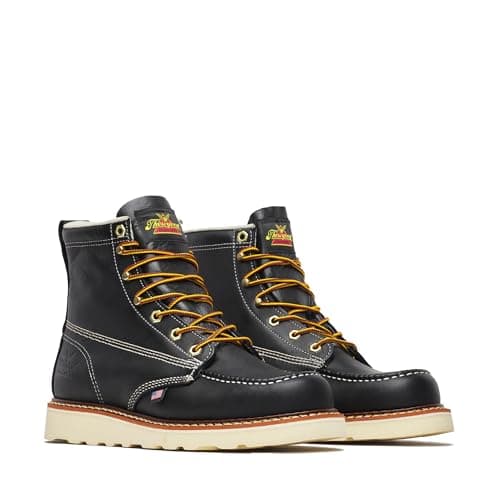
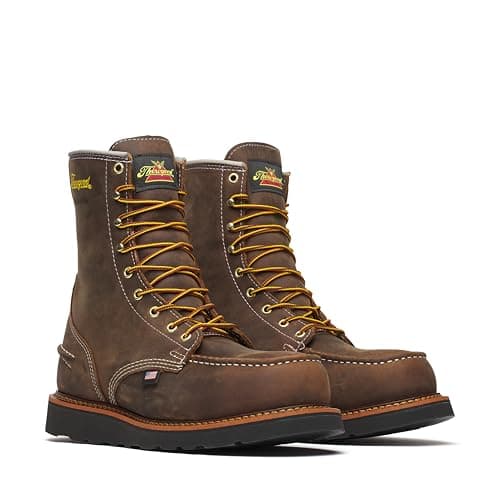
| 1 | 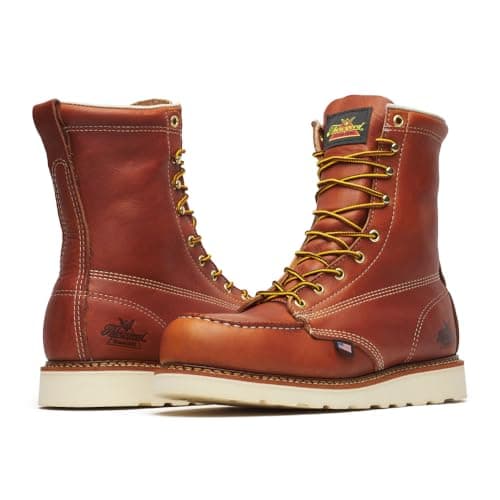 Thorogood American Heritage 8" Steel ToeFull-grain leather on a Goodyear storm welt with a rated steel toe - the complete version of a leather work boot. | One leather boot that does everything | 9.7 | |
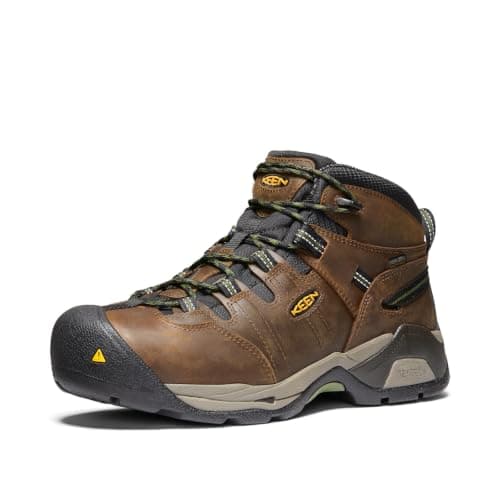
| 2 | 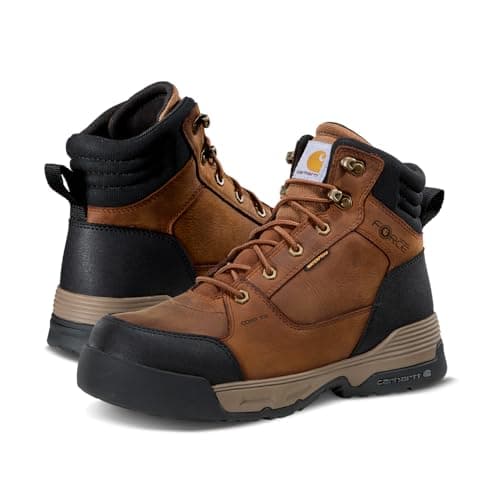 Carhartt Force HD 6" Composite Toe WaterproofOil-tanned full-grain with a waterproof membrane, a composite toe and real wide widths from stock. | Oil-tanned leather with a modern safety spec | 9.4 | |
| 3 | 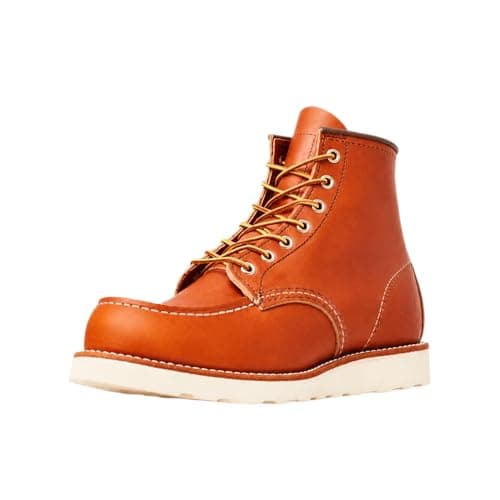 Red Wing Heritage Classic Moc 875US-made full-grain oiled leather on a Goodyear leather welt - the leather benchmark, with nothing on the spec sheet for a jobsite. | The best hide on this page, and no safety toe | 9.4 | |
| 4 | 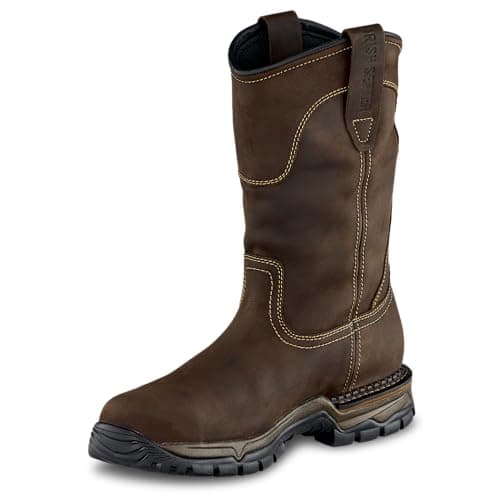 Irish Setter Two Harbors 11" Steel ToeEleven inches of full-grain leather with a steel toe, EH rating and no laces to burn through. | Spatter, grain and mud - height first | 9.3 | |
| 5 | 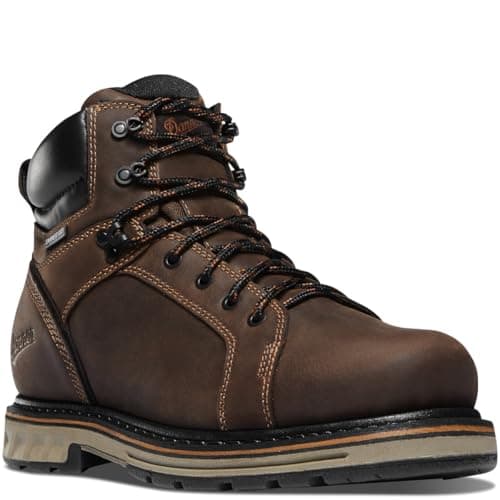 Danner Steel Yard 6" Steel ToeThe budget pick: waterproof full-grain leather, a steel toe and a steel shank at a mainstream price. | Waterproof full-grain with a rated toe, for the least money | 9.4 | |
| 6 | 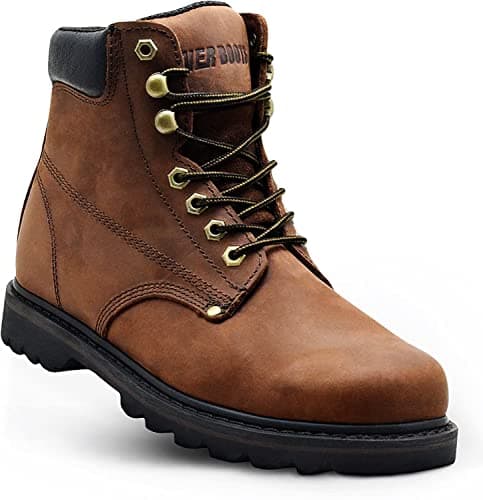 EVER BOOTS Tank Soft Toe Full-GrainFull-grain and Goodyear-welted for well under a hundred dollars - which is remarkable, and comes with no safety rating at all. | A first pair of real leather boots | 9.2 |
#ad Prices pulled from Amazon and stamped as of November 19, 2026; they change, and we show no number we cannot verify. How we are funded.
Top pick · One leather boot that does everything
Thorogood American Heritage 8" Steel Toe
Full-grain leather on a Goodyear storm welt with a rated steel toe - the complete version of a leather work boot.
#ad Price as of November 19, 2026. How we are funded
- Our score
- 9.7/10
Category-defining
This is what a leather work boot is supposed to be. The upper is full-grain - the outermost layer of the hide with its grain intact rather than sanded off and reprinted - which is the part that matters, because full grain is where the hide's tightest, strongest fiber structure lives. It is built on a Goodyear storm welt, so the sole is stitched to the boot and a cobbler can replace it instead of you buying another pair, and it carries a steel toe rated to ASTM F2413, which the famous soft-toe version of this boot does not. Eight inches of shaft keeps debris out on demolition and dirt work, and the leather takes conditioner and keeps going for years rather than cracking at the flex crease.
The cons are the price of all that. Steel conducts cold, so in a January outdoor job a composite cap is the warmer choice. An eight-inch shaft takes roughly a fortnight to stop feeling stiff across the ankle, and it is heavier than the composite-toe competition - leather this thick weighs what it weighs. Order your measured length rather than sizing up. Thorogood work boots sorts the rest of the range, and Goodyear welt vs direct attach explains why the construction is the expensive part.
Specs that matter
- Toe:
- Steel toe, ASTM F2413 rated
- Height:
- 8 inch
- Sole:
- MAXwear wedge
- Build:
- Goodyear storm welt
Rubric profile
Raw per-criterion marks out of 10, before weighting — this is the shape of the pick, not its published score. A low mark is a scope limit, not a fault: how we score.
- Leather grade
- 9.4
- Construction
- 9.6
- Protection
- 8.6
- Comfort
- 8.0
- Value
- 8.2
Why we picked it
- Safety toe plus resoleable welt construction in one boot
- Taller shaft keeps debris out on demolition and dirt work
- Full-grain leather that takes conditioner and keeps going
Good to know: Order your measured length, not a size up — and expect the 8-inch shaft to need about two weeks before it stops feeling stiff across the ankle.
Best value leather · Oil-tanned leather with a modern safety spec
Carhartt Force HD 6" Composite Toe Waterproof
Oil-tanned full-grain with a waterproof membrane, a composite toe and real wide widths from stock.
#ad Price as of November 19, 2026. How we are funded
- Our score
- 9.4/10
Outstanding
If you want leather quality without heritage pricing, this is the pick. The upper is oil-tanned full-grain, and the tannage is the detail worth understanding: oil-tanning drives fats and waxes into the fiber structure, which keeps the leather supple and makes it far more resistant to the chemical splash and repeated wetting that crack a dry, chrome-tanned upper at the flex crease. Behind it sits a waterproof membrane and a non-metallic composite toe, so you get the modern safety spec with the better hide, and it is stocked in wide as well as standard widths, which most leather boots at this price are not.
It is a substantial boot and you feel that. Heavy for a six-inch, with a genuine week of break-in before the upper gives, and it is cement-constructed, so it is a replace-it rather than a rebuild-it boot - which is the direct trade against the welted pick above. If the weight is what puts you off, lightweight work boots ranks the field that goes the other way, and Carhartt work boots covers the rest of the lineup.
Specs that matter
- Toe:
- Composite toe, ASTM F2413
- Height:
- 6 inch
- Waterproof:
- Yes
- Upper:
- Oil-tanned full-grain leather
Rubric profile
Raw per-criterion marks out of 10, before weighting — this is the shape of the pick, not its published score. A low mark is a scope limit, not a fault: how we score.
- Leather grade
- 8.8
- Construction
- 7.2
- Protection
- 8.4
- Comfort
- 7.8
- Value
- 9.0
Why we picked it
- Oil-tanned leather resists the chemical splash that cracks cheaper uppers
- Non-metallic toe keeps the cold out better than steel
- Available in wide widths from stock
Good to know: A substantial boot: allow a week of break-in, and expect real weight in exchange for the protection.
Best leather quality · The best hide on this page, and no safety toe
Red Wing Heritage Classic Moc 875
US-made full-grain oiled leather on a Goodyear leather welt - the leather benchmark, with nothing on the spec sheet for a jobsite.
#ad Price as of November 19, 2026. How we are funded
- Our score
- 9.4/10
Outstanding
If the question is purely about leather, this is the answer on this page. The 875 is made in the United States from full-grain oiled leather on a Goodyear leather welt with Puritan triple stitching, which means it can be resoled essentially indefinitely - people wear these for a decade and send them back for new soles. The No. 23 last is roomy through the forefoot and instep, so it suits feet that other boots pinch, and the leather develops a patina rather than wearing out: scuffs burnish back, the color deepens, and the upper molds to the shape of your foot over months.
Be clear about what it is not. It is a soft toe, so it fails any ASTM safety-toe requirement outright - that is a rule, not a preference, and nothing else about the boot changes it. The flat Traction Tred wedge gives up grip on wet rungs and loose ground. And you are paying heritage pricing for a boot with no jobsite features at all: no membrane, no EH rating, no cap. Buy it for shop work, finish carpentry, or any trade where nobody is checking your toe caps. Red Wing work boots sorts the heritage line from the industrial one, and soft toe work boots covers when going without is the right call.
Specs that matter
- Toe:
- Soft moc toe (no rating)
- Height:
- 6 inch
- Build:
- Goodyear leather welt, Puritan triple stitch
- Sole:
- Traction Tred wedge
Rubric profile
Raw per-criterion marks out of 10, before weighting — this is the shape of the pick, not its published score. A low mark is a scope limit, not a fault: how we score.
- Leather grade
- 9.8
- Construction
- 9.8
- Protection
- 4.6
- Comfort
- 8.6
- Value
- 7.0
Why we picked it
- Goodyear leather welt, so it can be resoled indefinitely
- No. 23 last is roomy through the forefoot and instep
- Made in the USA from full-grain oiled leather
Good to know: Soft toe and a flat wedge, so it suits shop and finish work rather than ladders or a site with a cap requirement.
Tallest leather · Spatter, grain and mud - height first
Irish Setter Two Harbors 11" Steel Toe
Eleven inches of full-grain leather with a steel toe, EH rating and no laces to burn through.
#ad Price as of November 19, 2026. How we are funded
- Our score
- 9.3/10
Outstanding
Sometimes the reason to buy leather is simply that there is a lot of it. The Two Harbors is an eleven-inch full-grain pull-on from Red Wing's work brand, and the shaft is the product: that much leather between your shin and a shower of welding spatter, grain dust, slurry or mud is protection no six-inch boot offers, and a pull-on has no laces to burn through or fill with debris. It carries a steel toe rated to ASTM F2413 and an EH rating, so it is site-legal as well as tall, and the leather is from the same family that makes the heritage boots.
The honest cons follow from the same fact. Eleven inches of leather does not breathe, so this boot is hot - that is by design and no amount of sock choice fixes it. It is heavy. And the fit is driven by your calf rather than your foot, which makes it genuinely hard to size if your calves are large or small, and a pull-on offers no adjustment to rescue a near miss. Pull-on work boots covers the shape across brands, and boots for welding explains why height beats almost every other feature there.
Specs that matter
- Toe:
- Steel toe, ASTM F2413
- Height:
- 11 inch pull-on
- Electrical hazard:
- EH rated
- Upper:
- Full-grain leather
Rubric profile
Raw per-criterion marks out of 10, before weighting — this is the shape of the pick, not its published score. A low mark is a scope limit, not a fault: how we score.
- Leather grade
- 9.0
- Construction
- 7.6
- Protection
- 9.0
- Comfort
- 6.4
- Value
- 7.8
Why we picked it
- 11 inches of leather is real protection against spatter and debris
- No laces to burn through when welding
- Red Wing-family leather quality
Good to know: An 11-inch shaft is a hazard requirement, not a comfort feature — hot and heavy by design, and calf size drives the fit.
Budget pick · Waterproof full-grain with a rated toe, for the least money
Danner Steel Yard 6" Steel Toe
The budget pick: waterproof full-grain leather, a steel toe and a steel shank at a mainstream price.
#ad Price as of November 19, 2026. How we are funded
- Our score
- 9.4/10
Outstanding
This is the cheapest boot on the page that gets everything important right at once: the upper is full-grain, it is waterproof, the toe is a steel cap rated to ASTM F2413, and underneath there is a PU midsole with a steel shank rather than a bare footbed over a flat board. The shank matters more than people expect - it is what keeps the boot from flexing into a question mark when you stand on a ladder rung or the edge of a trench, and it is one of the first things cheaper boots delete. Danner's Comfort System platform gives it a better out-of-box ride than most boots at this money.
It is also Danner's plainest build and the listing does not pretend otherwise: no Vibram outsole, no GORE-TEX, and it is not recraftable like the stitchdown models further up the brand's range, so this is a replace-it boot. The steel cap is the heavy option in a waterproof boot. If you want the full-grain upper for less again, the next pick is the cheapest honest route to it - at the cost of the safety toe. Danner work boots sorts the range, and work boots under $150 shows what else the same money buys.
Specs that matter
- Toe:
- Steel toe, ASTM F2413
- Height:
- 6 inch
- Waterproof:
- Yes
- Midsole:
- PU with a steel shank
Rubric profile
Raw per-criterion marks out of 10, before weighting — this is the shape of the pick, not its published score. A low mark is a scope limit, not a fault: how we score.
- Leather grade
- 8.4
- Construction
- 7.4
- Protection
- 8.4
- Comfort
- 8.2
- Value
- 9.4
Why we picked it
- Waterproof full-grain leather at an entry price for the brand
- Steel shank and PU midsole give real underfoot support
- Danner Comfort System platform rather than a bare footbed
Good to know: Danner's plainest build and its best value: not recraftable like the stitchdown models, and a steel cap adds weight.
Cheapest full-grain · A first pair of real leather boots
EVER BOOTS Tank Soft Toe Full-Grain
Full-grain and Goodyear-welted for well under a hundred dollars - which is remarkable, and comes with no safety rating at all.
#ad Price as of November 19, 2026. How we are funded
- Our score
- 9.2/10
Outstanding
This boot exists to make a point this page keeps returning to: full-grain leather is not a luxury material. The Tank is full-grain on a Goodyear welt at a price that normally buys a synthetic upper on a glued sole, and both of those features are real - the leather breaks in to the shape of your foot rather than staying rigid, and the welt means the sole can be replaced. As a first pair of real leather boots for someone who wants to find out whether they prefer them, it is the easiest recommendation on the page.
The compromises are explicit. No safety toe, no EH rating, no waterproofing - if your site requires protective footwear, this boot is not an option. Quality control varies noticeably between pairs at this price, so inspect what arrives rather than assuming. And the stock insole is poor; budget for a replacement on day one and the boot gets materially better. Insole types explained covers which one to buy, and work boots under $100 is the wider shortlist at this price.
Specs that matter
- Toe:
- Soft toe
- Height:
- 6 inch
- Build:
- Goodyear welt
- Upper:
- Full-grain leather
Rubric profile
Raw per-criterion marks out of 10, before weighting — this is the shape of the pick, not its published score. A low mark is a scope limit, not a fault: how we score.
- Leather grade
- 8.6
- Construction
- 8.8
- Protection
- 4.2
- Comfort
- 7.6
- Value
- 9.6
Why we picked it
- Welted and full-grain for well under a hundred dollars
- Breaks in to the foot rather than staying rigid
- Easy to recommend as a first pair of real leather boots
Good to know: The cheapest full-grain boot we would recommend, with no rated toe and a stock insole you should plan to replace.
How we picked
- The hide grade had to be stated. Every pick above has full-grain or oil-tanned full-grain named by the manufacturer, not inferred from a photograph. Boots described only as "leather" did not make the page.
- Construction is on every card. Goodyear welt, direct-attach or cemented decides whether a worn outsole is a service visit or the end of the boot, and it changes the cost per year more than the purchase price does.
- Each pick earns a different job. An all-rounder, a value boot with a modern safety spec, a leather benchmark with no cap, an eleven-inch shaft, a budget rated boot and the cheapest full-grain there is.
- Safety rating stated plainly, including its absence. Two of these six have no safety toe. Both say so in their first line, because that is a compliance question and not a preference.
- Tannage where the manufacturer names it. Oil-tanned is a meaningful durability claim against chemical splash, so we flag it where it is published rather than assuming it.
- Cons that would change your mind. The heritage pick says it has no jobsite features; the tall pick says it is hot; the cheapest says quality control varies pair to pair.
Leather versus synthetic, honestly
Synthetic and textile uppers are not a scam - they are lighter, they need no conditioning, they dry faster and they cost less, and for warehouse picking, facilities rounds or any job where you cover distance on clean ground they are often the better tool. Where they lose is abrasion. Mesh and synthetic panels cut and wear through at the flex crease and around the toe far faster than full-grain leather when you are handling rough timber, scrap, block or sheet metal, and that is usually what kills them - not the sole, not the cap, the upper.
So the honest rule is about what your work does to the outside of the boot. If your boots come home scraped, oily and gouged, leather is worth the weight and the maintenance. If they come home dusty, it probably is not. Leather vs rubber work boots covers the other end of that spectrum for genuinely wet work, and hot weather work boots is the page to read if breathability is the deciding factor, because a thick leather upper is the warmest thing you can put on your foot.
What a leather boot needs from you
Leather is the one upper material that gets better with maintenance and materially worse without it, and the whole routine is about twenty minutes a quarter. Brush the dirt off before it dries, because grit ground into the flex crease is abrasive from the inside. Let wet boots dry at room temperature and never next to a heater or in front of a space heater - heat drives the oils out of the hide and that is exactly what causes the cracking people blame on quality. Condition two to four times a year, or whenever the leather looks dull and feels dry rather than supple, and use a conditioner suited to the tannage.
Rotate two pairs if you can. A boot worn every day never dries out fully inside, and damp leather stretches, loses shape and grows the bacteria responsible for the smell. Two pairs on alternate days outlast the same money spent on one pair worn daily, which is the least intuitive true thing about work boots. Boot care and conditioning has the full routine, how to waterproof work boots at home covers treatments, and how long work boots last covers when to resole rather than replace.
What we would skip
Skip anything described only as "leather upper", "genuine leather" or "premium leather" with no grade named - at best it is corrected-grain, at worst it is bonded. Skip corrected-grain boots if your work flexes the toe box constantly, because the sealed surface is what cracks. Skip a heavy leather boot for a job spent walking on clean floors, where you will pay the weight penalty daily for abrasion resistance you never use. Skip buying full-grain and then never conditioning it, which wastes the one advantage you paid for. And skip assuming a leather upper implies a resoleable boot - most leather work boots sold today are cemented, and the upper will long outlive the sole it is glued to.
The summary is short. Buy full-grain, check how the sole is attached, match the tannage to what your work splashes on your feet, and condition it a few times a year. A leather boot bought on those four points will be the longest-lasting thing in your gear; one bought on the word leather alone will crack at the flex crease in a season and teach you nothing except that leather boots are overrated.
Frequently asked
What is the best leather for work boots?
Full-grain leather, and ideally oil-tanned full-grain if your work involves oil, solvents or constant wetting. Full-grain keeps the hide's strongest fiber structure intact, and oil-tanning drives fats into it so it stays supple and resists chemical splash instead of cracking at the flex crease.
Is full-grain leather worth it in a work boot?
Yes, and it is one of the few upgrades that is not price-dependent - one boot on this page is full-grain and Goodyear-welted for well under a hundred dollars. Full-grain resists abrasion far better than corrected-grain or split leather and develops a patina rather than wearing through.
What does "genuine leather" mean on a boot?
In practice, that no better claim could be made. It is a legal description rather than a grade, and it commonly covers split or bonded leather - ground-up leather fiber glued to a backing. Look for the words full-grain or top-grain instead; if neither appears, assume the leather is a lower grade.
Are leather work boots better than synthetic ones?
For abrasion they are clearly better - leather survives rough timber, scrap and sheet metal in a way mesh and synthetic panels do not, and the upper is usually what fails on a synthetic boot. Synthetics win on weight, drying time, price and needing no maintenance, which makes them the better choice for distance walking on clean ground.
How often should leather work boots be conditioned?
Two to four times a year for normal use, or whenever the leather looks dull and feels dry rather than supple. Also condition after any soaking, because water pulls the oils out of the hide. Never dry wet boots next to a heater - that is the fastest way to crack good leather.
Do leather work boots stretch?
They mold rather than stretch. Full-grain leather conforms to the shape of your foot over weeks of wear, so a boot that is snug in the right places will improve - but a boot that is too short or too narrow across the ball will not become the right size. Buy the correct length and width and let the leather do the rest.
Can all leather work boots be resoled?
No, and this is the most common mistake buyers make. Resoling depends on the construction, not the upper: a Goodyear-welted or stitchdown boot can be resoled, a cemented or direct-attach boot cannot, regardless of how good its leather is. Most leather work boots sold today are cemented.
Are leather work boots hot in summer?
Yes - a thick leather upper is the warmest thing you can put on your foot, and a waterproof membrane behind it makes that worse. For hot, dry work, an unlined leather boot or a lighter upper with real ventilation is the more comfortable choice; see our hot weather shortlist.
Our recommendation
If you read nothing else on this page, these are the two to look at — the one we would buy, and the one to take instead if its trade-off suits you better.
Top pick · One leather boot that does everything
Thorogood American Heritage 8" Steel Toe
Full-grain leather on a Goodyear storm welt with a rated steel toe - the complete version of a leather work boot.
#ad Price as of November 19, 2026. How we are funded
Runner-up · Oil-tanned leather with a modern safety spec
Carhartt Force HD 6" Composite Toe Waterproof
Oil-tanned full-grain with a waterproof membrane, a composite toe and real wide widths from stock.
#ad Price as of November 19, 2026. How we are funded
Prices are read live from Amazon and stamped with the date. How we pick.
Brands: want your product tested? For Brands.
Sources
Back to Work Boots, or see how we pick. Spotted something wrong? We publish corrections — see our editorial policy.