Insole types
Insole Types Explained
Cushioning and support are opposites, and the soft one that feels best in the shop is usually wrong.
Insoles are the highest-return purchase in work footwear and the most frequently mis-bought, and almost all of the mis-buying comes from one conceptual confusion. People experience foot pain, reach for the softest insole available because pain feels like it needs padding, and then conclude insoles do not work. Understanding one distinction fixes that.
The distinction that makes everything else clear
A cushioning insole is soft foam or gel. It absorbs impact, feels wonderful in the shop, and does nothing to control how your foot moves. A support insole is a rigid or semi-rigid shell. It feels hard and slightly strange at first, controls arch collapse and heel movement, and cushions relatively little.
These are not points on a spectrum of quality - they are different tools for different problems. Buying a gel pad for plantar fasciitis is like buying a hammer to turn a screw, and it is the single most common disappointed-insole-buyer story there is.
The types, concretely
| Type | Construction | Good for | Not for |
|---|---|---|---|
| Gel pad | Soft gel, no structure | A cheap immediate upgrade over factory foam | Arch or heel pain; anyone over about 200 lb for long |
| Cushioning foam | Dense or geometric foam | Standing fatigue on hard floors | Structural problems; expect 3-6 months |
| Air / gel hybrid | Encapsulated air plus a molded arch | Impact from ladders and steps; mild support | Significant overpronation |
| Semi-rigid shell | Firm shell with a cushioned top | Most people - heel pain, mild to moderate collapse | Severe collapse needing full control |
| Rigid shell | Hard stabilizer cap, deep heel cup | Arch collapse, overpronation, stubborn heel pain | Snug boots; anyone wanting softness |
| Custom orthotic | Prescribed, molded to your foot | Diagnosed conditions, under clinical guidance | A first attempt at self-managing |
Quick picks
Ranked by our published scoring rubric. Tap any row for the full write-up.
| # | Product | Best for | Score | Price |
|---|---|---|---|---|
| 1 | 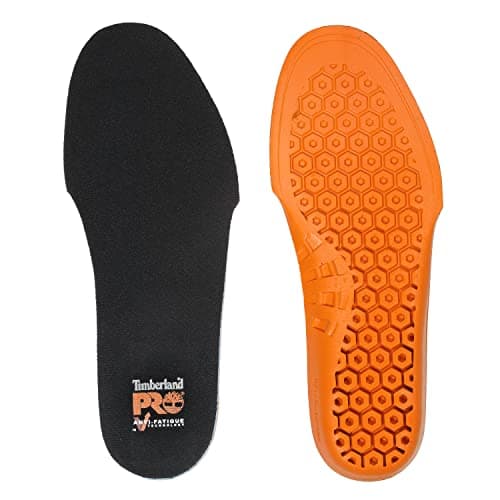 Timberland PRO Anti-Fatigue Technology Replacement InsoleThe cushioning archetype - foam geometry for sustained standing, no structure. | Cushioning: standing fatigue | 8.2 | |
| 2 | 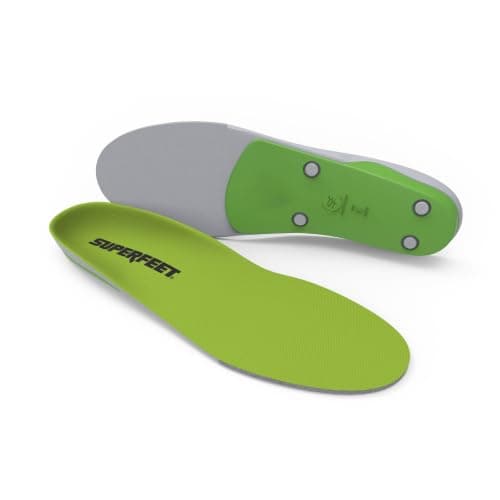 Superfeet All-Purpose High Arch Support InsolesThe support archetype - a rigid shell that controls movement rather than absorbing impact. | Support: arch collapse and overpronation | 8.2 | |
| 3 | 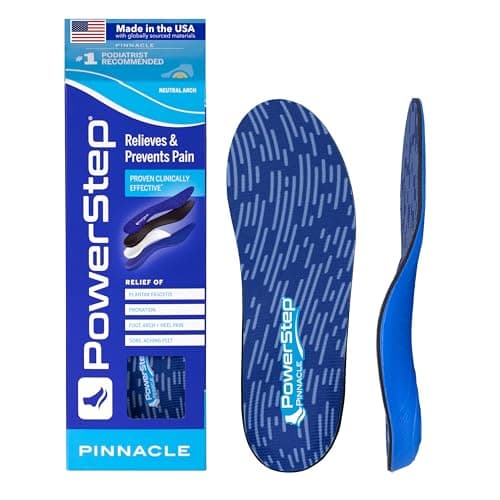 PowerStep Pinnacle Orthotic InsolesSemi-rigid shell with a cushioned top - the sensible starting point for most people. | Both, which is what most people need | 8.6 |
#ad Prices pulled from Amazon and stamped as of October 6, 2026; they change, and we show no number we cannot verify. How we are funded.
Cushioning archetype · Cushioning: standing fatigue
Timberland PRO Anti-Fatigue Technology Replacement Insole
The cushioning archetype - foam geometry for sustained standing, no structure.
A pure cushioning insole: cone geometry that compresses and rebounds under the heel and forefoot pressure points, designed for static standing rather than walking impact. For general aching from a hard floor, this is the right category.
Low volume, so it fits most boots, and cheap enough to replace every few months - which you should, since foam compresses permanently. It provides almost no arch support, so it will not help heel or arch pain.
Specs that matter
- Type:
- Cushioning insole with cone geometry
- Arch:
- Moderate contour
- Volume:
- Low to moderate
- Target:
- Standing fatigue
Our scoring
- Cushioning
- 9.2
- Structural support
- 4.0
- Low volume
- 8.6
- Longevity
- 6.4
- Value
- 9.2
What works
- Designed for static standing, which is the actual concrete problem
- Cheap enough to replace every few months
- Fits most boots without crowding the toe box
What to know
- Foam compresses within months of daily wear
- Little structural arch support
- Not an orthotic — will not fix plantar fasciitis alone
Support archetype · Support: arch collapse and overpronation
Superfeet All-Purpose High Arch Support Insoles
The support archetype - a rigid shell that controls movement rather than absorbing impact.
The opposite category. A rigid stabilizer cap under the arch and a deep heel cup physically resist the arch flattening and the heel rolling inward. It feels hard, it is supposed to, and it is what actually helps structural foot problems.
It holds its shape for a year or more where foam dies in months. High volume, so it needs a roomy boot, and it requires one to two weeks of adaptation.
Specs that matter
- Type:
- Rigid stabilizer cap
- Arch:
- High arch profile
- Volume:
- High — needs a roomy boot
- Cushioning:
- Minimal by design
Our scoring
- Cushioning
- 4.0
- Structural support
- 9.4
- Low volume
- 4.0
- Longevity
- 9.4
- Value
- 7.6
What works
- Structural support is what actually helps a collapsing arch
- Shell keeps its shape for a year or more of daily wear
- Heel cup genuinely controls heel movement
What to know
- Not a cushion — people expecting softness are disappointed
- Takes up real volume; a snug boot will become too tight
- Needs a one-to-two week adaptation period
No. 3 · Both, which is what most people need
PowerStep Pinnacle Orthotic Insoles
Semi-rigid shell with a cushioned top - the sensible starting point for most people.
The hybrid, and the one most people should actually buy first. A semi-rigid shell gives real motion control while a dual-layer cushion on top makes it tolerable from day one - so the adaptation period is days rather than a fortnight and people keep wearing it.
Moderate volume means it fits a wider range of boots than full Superfeet. Less support than a fully rigid shell for severe collapse, and the top cover wears before the shell.
Specs that matter
- Type:
- Semi-rigid shell plus dual-layer cushion
- Arch:
- Neutral to moderate
- Volume:
- Moderate
- Made in:
- USA
Our scoring
- Cushioning
- 7.8
- Structural support
- 8.2
- Low volume
- 7.0
- Longevity
- 8.0
- Value
- 8.6
What works
- Support and cushioning balanced, so adaptation is easy
- Fits a wider range of boots than Superfeet
- Most commonly recommended for heel pain by podiatry sources
What to know
- Less support than a full rigid shell for severe arch collapse
- Top cover wears through before the shell does
- Needs trimming to fit
Match the type to your symptom
- General aching and fatigue across the whole foot → cushioning: insoles for concrete.
- Arch pain, or arches that feel collapsed → support shell: insoles for flat feet.
- Sharp heel pain, worst on the first steps in the morning → semi-rigid shell with a deep heel cup: insoles for heel pain.
- Heavy, swollen, aching legs and calves → not an insole at all: compression socks.
- Sore or discoloured toenails → not an insole; a boot-length and sock problem: socks for steel toe boots.
Volume: the constraint that wastes money
An insole takes up space inside the boot, and this is where purchases get returned. A high-volume rigid insole in a boot that already fit snugly makes the boot too tight - and a too-tight boot is worse than a mediocre insole, especially under a safety toe where the rigid cap means your toes have nowhere to go.
- Always remove the factory insole first. Stacking is the most common error - it raises your foot, tightens the instep and reduces toe clearance.
- Use the old insole as a trimming template, cutting conservatively from the front.
- If the boot feels tight across the instep afterwards, buy a lower-volume insole rather than a bigger boot.
- Fit new boots with your intended insole in place: work boot fit and sizing.
Replacement, and a word on expectations
Foam cushioning insoles compress permanently and stop working within three to six months of daily wear while still looking fine - which is why people's foot comfort quietly degrades and gets blamed on everything but the insole. Rigid shells last a year or more, usually with the top cover wearing through before the shell fails.
And an honest limit: an over-the-counter insole is not a medical device. For diagnosed conditions, persistent pain, or anything that is worsening, a clinician's assessment is the right step rather than a third insole. Footwear and insoles support management; they do not substitute for diagnosis.
Frequently asked
What is the difference between cushioning and support insoles?
A cushioning insole is soft foam or gel that absorbs impact and does not control how your foot moves. A support insole is a rigid or semi-rigid shell that controls arch collapse and heel movement while cushioning relatively little. They are different tools for different problems.
Which insole should I buy for work boots?
Match the type to your symptom. General aching from standing on hard floors needs cushioning. Arch pain, collapsed arches or morning heel pain need a semi-rigid or rigid support shell - soft gel will not help those at all.
Should insoles be hard or soft?
It depends on the problem. For structural issues like arch collapse and plantar fasciitis, firm - a soft insole lets the arch flatten, which is what aggravates them. For pure standing fatigue, softer cushioning is correct. Comfort in the shop is a poor predictor for structural problems.
Do I remove the original insole before adding a new one?
Yes, almost always. Stacking a new insole on the factory one raises your foot, tightens the boot across the instep and reduces toe clearance under a safety cap. Pull the old one out first and use it as a template for trimming.
How often should insoles be replaced?
Foam cushioning insoles every three to six months of daily wear - they compress permanently and stop working long before they look worn. Rigid support shells last a year or more, usually with the top cover failing before the shell does.
Sources
Back to Guides, or see how we pick. Spotted something wrong? We publish corrections — see our editorial policy.