Best compression socks
Best Compression Socks for Standing All Day
For legs, not feet. If your arches hurt, this is the wrong page - and that distinction matters.
Compression socks are the one item on this site that is genuinely a medical device rather than a comfort product, and they are both more effective and more frequently mis-bought than anything else here. Used for the right problem at the right pressure, they work well. Bought for sore feet, they do nothing - and that is the most common mistake.
What they do, and what they do not
Standing still for hours allows blood and fluid to pool in the lower legs, because the calf-muscle pump - which normally pushes venous blood back up the leg as you move - is barely working. The result is the heavy, aching, swollen-feeling legs and ankles that anyone who stands all day recognizes, and over years it is associated with varicose veins and chronic venous insufficiency.
Graduated compression applies external pressure that is highest at the ankle and decreases up the leg, which supports venous return and reduces that pooling. That is the mechanism, and it is specifically about legs. It does nothing for plantar fascia strain, arch collapse, toe-cap contact or forefoot hot spots - those are footwear and insole problems, covered at insoles for concrete and boots for standing on concrete.
The two specs that matter
| Pressure | Description | Use |
|---|---|---|
| 8-15 mmHg | Light - effectively a snug sock | Minimal effect; most "compression" athletic socks |
| 15-20 mmHg | Mild | Travel, mild discomfort, a reasonable starting point |
| 20-30 mmHg | Moderate - the working band | Prolonged standing, leg swelling, varicose veins |
| 30-40 mmHg | Firm - medical | Prescribed for specific conditions; not a self-purchase |
The other spec is graduated, meaning the pressure genuinely decreases from ankle to calf. A uniformly tight sock is not the same thing and does not assist venous return the same way. Both specs should be stated on the packaging; if neither is, treat it as a snug sock.
Quick picks
Ranked by our published scoring rubric. Tap any row for the full write-up.
| # | Product | Best for | Score | Price |
|---|---|---|---|---|
| 1 | 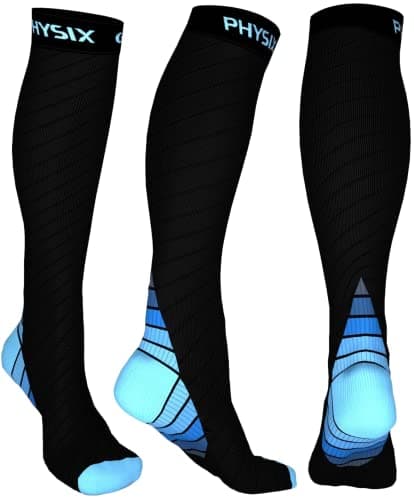 Physix Gear Compression Socks 20-30 mmHgCorrect graduated 20-30 mmHg construction, sized by calf circumference. | A single quality pair | 8.7 | |
| 2 | 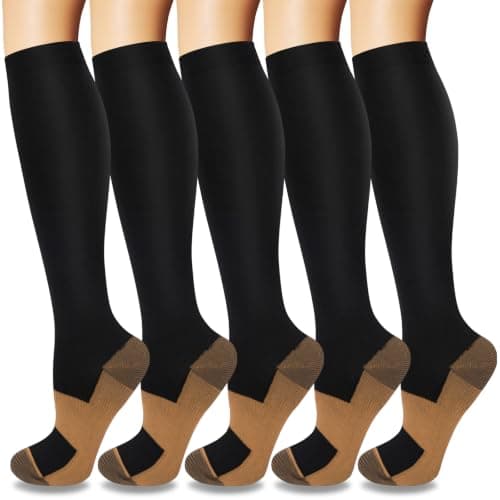 Copper Fit Compression Socks 20-30 mmHg (5-pack)The same 20-30 mmHg graduated construction in a multi-pack - ignore the copper claims. | Owning five pairs | 8.4 | |
| 3 | 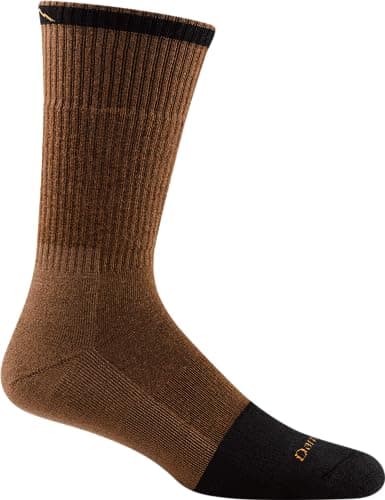 Darn Tough Steely Boot Midweight Cushion SockNot a compression sock - the right answer if your problem is actually your feet. | When compression is not what you need | 6.6 |
#ad Prices pulled from Amazon and stamped as of October 6, 2026; they change, and we show no number we cannot verify. How we are funded.
Top pick · A single quality pair
Physix Gear Compression Socks 20-30 mmHg
Correct graduated 20-30 mmHg construction, sized by calf circumference.
Two things make a compression sock work, and this gets both right. The pressure is in the 20-30 mmHg band, which is the range associated with reduced leg swelling rather than the token 8-15 mmHg of most athletic socks. And it is graduated - tightest at the ankle, decreasing up the calf - which is the construction that assists venous return.
Sized by calf circumference rather than shoe size, which is the correct way and worth measuring for. Hard to get on, especially over a sweaty foot, and hot in summer.
Specs that matter
- Compression:
- 20-30 mmHg, graduated
- Height:
- Knee high
- Fiber:
- Nylon-spandex blend
- Fit:
- Sized by calf circumference
Our scoring
- Compression accuracy
- 9.0
- Graduated profile
- 9.2
- Durability
- 8.0
- Comfort
- 7.4
- Value
- 8.6
What works
- 20-30 mmHg is a therapeutic band, not a token squeeze
- Graduated profile is the construction that matters for venous return
- Thin enough to wear under a work sock
What to know
- Hard to get on, especially over a sweaty foot
- Hot in summer
- Compression is a medical intervention — check with a clinician if you have circulatory or diabetic concerns
No. 2 · Owning five pairs
Copper Fit Compression Socks 20-30 mmHg (5-pack)
The same 20-30 mmHg graduated construction in a multi-pack - ignore the copper claims.
Five pairs for roughly the price of one premium pair, with correct graduated 20-30 mmHg construction. Having enough pairs matters here, because compression socks are worn daily and need washing daily.
To be direct about it: the copper antimicrobial claims are marketing and are not supported by good evidence. The compression is the part that works. The elastic degrades faster than premium medical hosiery, and the sizing runs small.
Specs that matter
- Compression:
- 20-30 mmHg, graduated
- Pack:
- 5 pairs
- Height:
- Knee high
- Copper:
- Marketing claim, no clinical support
Our scoring
- Compression accuracy
- 8.4
- Graduated profile
- 8.6
- Durability
- 6.8
- Comfort
- 7.4
- Value
- 9.4
What works
- Five pairs at roughly the price of one premium pair
- Correct graduated compression construction
- Thin profile under work socks
What to know
- Ignore the copper antimicrobial claims — they are not supported
- Elastic degrades faster than premium medical hosiery
- Sizing runs small
No. 3 · When compression is not what you need
Darn Tough Steely Boot Midweight Cushion Sock
Not a compression sock - the right answer if your problem is actually your feet.
Included deliberately, because a significant share of people searching for compression socks have a foot problem rather than a leg problem, and compression will not help them. If your arches or heels hurt, if your toenails are sore, or if you have hot spots on the ball of your foot, that is a footwear, insole and sock-padding issue.
This is the cushioned merino work sock that addresses those. If your calves and ankles are heavy and swollen at the end of a shift, take one of the compression picks instead.
Specs that matter
- Fiber:
- Merino wool blend
- Cushion:
- Midweight, full cushion
- Toe:
- Reinforced for safety-toe boots
- Guarantee:
- Unconditional lifetime
Our scoring
- Compression accuracy
- 2.0
- Graduated profile
- 2.0
- Durability
- 9.2
- Comfort
- 9.0
- Value
- 8.0
What works
- Full-cushion toe box is the fix for a safety toe rubbing your toenails
- Merino regulates temperature and resists odor
- Lifetime guarantee makes the price rational over years
What to know
- Most expensive sock here per pair
- Midweight is too warm for genuine summer heat
- Merino needs gentler washing than synthetics
Sizing and wearing them
- Measure your calf circumference at its widest point, and your ankle just above the bone. Compression socks are sized on those, not on shoe size - this is the step people skip and it determines whether the pressure is right.
- Put them on first thing in the morning, before any swelling has developed. Getting them on over an already swollen leg is much harder and less effective.
- Wear them through the shift and take them off at the end of the day - they are not meant to be worn overnight unless a clinician says so.
- Replace them every three to six months of daily wear. The elastic degrades and the pressure drops below the therapeutic range while the sock looks fine.
- Stop and seek advice if you get numbness, tingling, color changes or skin breakdown.
Can you wear them with work socks?
Yes, and many people do: a thin compression sock underneath and a cushioned work sock over it. The compression handles the legs, the work sock handles the padding and the safety-toe interface. The combined thickness changes boot fit, though, so fit your boots with both on - see best work socks and work boot fit and sizing.
What we would skip
Skip 8-15 mmHg socks sold as compression - that is a snug sock. Skip copper, bamboo and antimicrobial claims; the compression is what works. Skip buying compression for foot pain, which is the wrong product for that problem. And skip self-prescribing above 30 mmHg, or wearing any compression at all if you have arterial disease or an undiagnosed swelling in one leg.
Frequently asked
Do compression socks help if you stand all day?
For heavy, aching, swollen legs and ankles, yes - graduated 20-30 mmHg compression supports venous return and reduces the pooling that prolonged standing causes. They do not help arch or heel pain, which is a footwear and insole problem.
What mmHg compression socks do I need for work?
20-30 mmHg graduated compression is the band generally used for prolonged standing and leg swelling. Below about 15 mmHg has minimal effect. Above 30 mmHg is medical-grade and should be prescribed rather than self-selected.
Who should not wear compression socks?
Anyone with peripheral arterial disease, and with caution in diabetes, peripheral neuropathy, skin infections and some heart conditions. If you have a circulatory diagnosis, or swelling in one leg only, speak to a clinician first - sudden one-sided swelling with pain or warmth needs urgent assessment.
Can you wear compression socks under work socks?
Yes, and it is a common arrangement: a thin compression sock for the legs with a cushioned work sock over it for padding and the safety-toe interface. The combined thickness changes boot fit, so fit your boots wearing both.
How often should compression socks be replaced?
Every three to six months of daily wear. The elastic degrades and the pressure falls below the therapeutic range long before the sock looks worn out, which means people often wear them for a year believing they are still working.
Sources
Back to Insoles & Work Socks, or see how we pick. Spotted something wrong? We publish corrections — see our editorial policy.