Best for construction
Best Work Gloves for Construction
The best glove on site is the one you keep on. That rules out more options than any hazard rating does.
General construction is the hardest glove brief because the work is so varied: you handle lumber, fasteners, sheet goods, wire, block and tools, sometimes all in one hour. No single glove is right for all of it, which is why the realistic answer on most sites is two pairs - a thin one you wear most of the time and a heavy one for the material that would destroy it.
Dexterity first, and here is why
The most common reason tradespeople work bare-handed is not laziness, it is that their gloves are too clumsy for the task at hand. So they pull them off to start a screw or feel a connection - which is frequently the moment the hand is most exposed. A thin, grippy glove you keep on through the whole task protects you more than a heavy glove you remove for the critical parts.
That is the main argument for the nitrile-coated gloves at the top of this list, despite their almost nonexistent protection ratings. It is not that protection does not matter; it is that worn protection beats unworn protection.
Quick picks
Ranked by our published scoring rubric. Tap any row for the full write-up.
| # | Product | Best for | Score | Price |
|---|---|---|---|---|
| 1 | 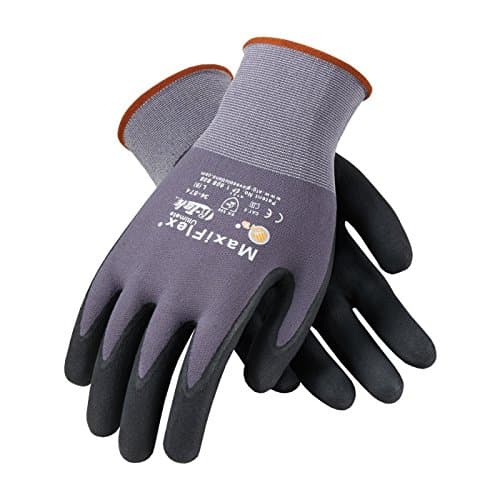 MaxiFlex Ultimate 34-874 Nitrile-Coated GlovesThe glove almost every trade agrees on, and the per-pair cost is the hidden feature. | Everyday handling, bought by the dozen | 8.4 | |
| 2 | 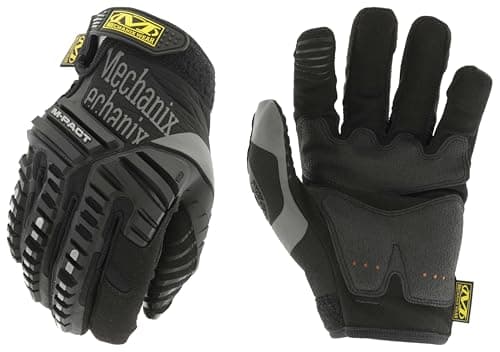 Mechanix Wear M-Pact Impact-Resistant GlovesTPR knuckle armor addresses the most common hand injury on a site. | Impact and crush protection | 8.0 | |
| 3 | 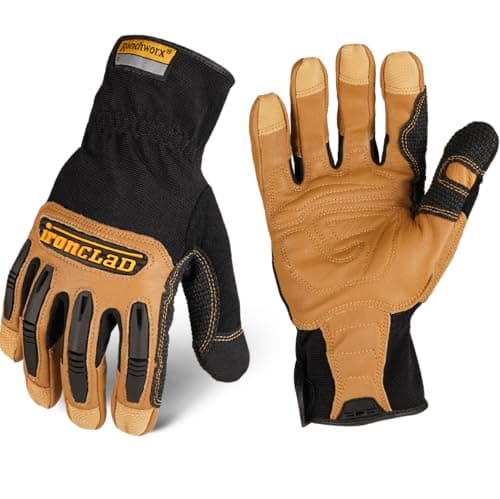 Ironclad Ranchworx Leather Work GlovesHeavy reinforced leather for banding, wire, rebar and sharp sheet stock. | Material that destroys coated gloves | 7.8 | |
| 4 | 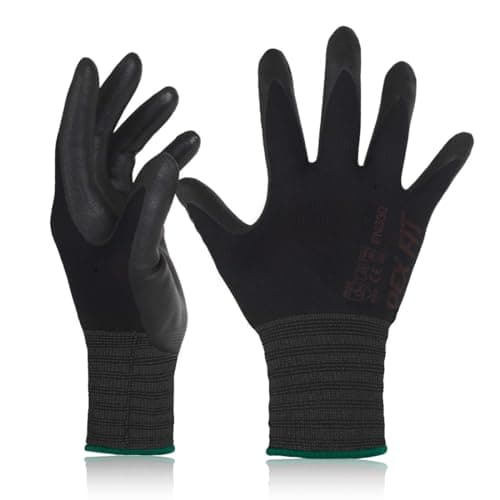 DEX FIT FN330 Nitrile Work GlovesNot as durable as MaxiFlex, cheap enough that it does not need to be. | The cheapest coated glove worth buying | 7.8 |
#ad Prices pulled from Amazon and stamped as of October 6, 2026; they change, and we show no number we cannot verify. How we are funded.
Top pick · Everyday handling, bought by the dozen
MaxiFlex Ultimate 34-874 Nitrile-Coated Gloves
The glove almost every trade agrees on, and the per-pair cost is the hidden feature.
Micro-foam nitrile on a thin 15-gauge liner gives you something close to bare-hand feel - you can pick up a washer, start a fastener, feel a thread. That is why these end up in every van: they are the gloves people actually keep on instead of pulling off for the fiddly bit.
Buying by the dozen is the point. At that price per pair you replace them the moment the coating wears instead of nursing a worn glove for weeks. They offer almost no cut protection (ANSI A1) and no impact protection at all.
Specs that matter
- Coating:
- Micro-foam nitrile, palm and fingers
- Liner:
- 15-gauge seamless knit
- Pack:
- Sold as 12 pairs
- Cut rating:
- ANSI A1 — minimal
Our scoring
- Dexterity
- 9.5
- Grip
- 9.0
- Durability
- 6.0
- Protection
- 4.5
- Value
- 9.4
What works
- Dexterity close to bare hands — you can pick up a washer
- Breathable back, so hands do not swim in sweat
- Buying by the dozen drops the per-pair cost dramatically
What to know
- Almost no cut protection and no impact protection
- Nitrile coating fails within weeks on abrasive work
- Not waterproof and no warmth
No. 2 · Impact and crush protection
Mechanix Wear M-Pact Impact-Resistant Gloves
TPR knuckle armor addresses the most common hand injury on a site.
Crushed and pinched hands are the single most common hand injury in construction, and no cut glove or coated glove does anything about them. Thermoplastic rubber over the knuckles, fingers and thumb does.
The padded palm also takes the sting out of vibration from hammers and demo tools. You lose dexterity on small fasteners, and there is no published cut rating - this is an impact glove, not a cut glove.
Specs that matter
- Impact protection:
- TPR knuckle, finger and thumb guards
- Palm:
- Synthetic leather with padding
- Cut rating:
- None published for this model
- Touchscreen:
- Yes
Our scoring
- Dexterity
- 6.8
- Grip
- 8.0
- Durability
- 8.0
- Protection
- 8.6
- Value
- 8.0
What works
- Knuckle armor stops the single most common hand injury on site
- Padded palm takes the sting out of vibration
- Fit is consistent and well documented across sizes
What to know
- No published cut rating — not a cut glove
- The armor costs you dexterity on small fasteners
- Synthetic palm wears through faster than leather
No. 3 · Material that destroys coated gloves
Ironclad Ranchworx Leather Work Gloves
Heavy reinforced leather for banding, wire, rebar and sharp sheet stock.
There is a category of site material that eats nitrile-coated gloves in an afternoon: steel banding, rebar tie wire, sharp sheet goods, broken block. For that work you want leather with reinforced fingertips, which is where cheap gloves blow out first.
Bulky and stiff until broken in, so poor for fine work - which is why most people carry these alongside a thin pair rather than instead of them. No published cut rating despite the heft.
Specs that matter
- Palm:
- Reinforced leather with double stitching
- Protection:
- Padded knuckle and impact zones
- Cut rating:
- None published
- Care:
- Machine washable
Our scoring
- Dexterity
- 5.6
- Grip
- 8.0
- Durability
- 9.2
- Protection
- 7.4
- Value
- 8.2
What works
- Survives barbed wire and sharp sheet stock that destroy nitrile gloves
- Reinforced fingertips are where cheap gloves blow out first
- Washable, unusually for a leather glove
What to know
- Bulky — poor for fine work
- Stiff until broken in
- No published cut rating despite the heft
Best value · The cheapest coated glove worth buying
DEX FIT FN330 Nitrile Work Gloves
Not as durable as MaxiFlex, cheap enough that it does not need to be.
A nitrile-dipped glove at roughly a third of the premium price, with a better fit than most budget gloves and touchscreen-compatible fingertips. The coating separates sooner than MaxiFlex, which at this price is a reasonable trade.
No published cut rating, and the sizing runs small. A sensible choice if you lose gloves as often as you wear them out.
Specs that matter
- Coating:
- Nitrile palm dip
- Liner:
- Knit, 3D fit
- Cut rating:
- None published
- Touchscreen:
- Yes
Our scoring
- Dexterity
- 8.8
- Grip
- 8.2
- Durability
- 5.4
- Protection
- 4.0
- Value
- 9.4
What works
- Lowest cost per pair of any coated glove here
- Fit is better than most budget gloves
- Machine washable
What to know
- Coating separates sooner than the premium brands
- No cut rating published
- Sizing runs small
The hazards you actually face, in order
- Impact and pinch - the most common. Addressed by TPR knuckle armor: impact gloves.
- Abrasion - constant, cumulative, and the thing that wears gloves out rather than injuring you.
- Cuts - from sheet metal, banding, glass and blades. Needs a real ANSI rating, usually A4 or above: cut-resistant gloves and ANSI cut levels explained.
- Vibration - from demo tools and hammers, and a genuine long-term risk. Padded palms help somewhat.
- Cold - its own category: cold weather work gloves.
The dozen-pack maths
This is the single most useful practical point on the page. Coated gloves are sold both as single pairs at retail and in packs of twelve, and the per-pair price difference is large. The behavioral effect matters more than the money: when a pair costs very little, you bin it the moment the coating wears through on the fingertips, which is exactly when the glove stops gripping and starts letting things through. When a pair feels expensive, people keep wearing a worn-out glove for weeks.
Buy the box. Keep spares in the truck. Treat coated gloves as a consumable rather than equipment, and keep one good leather or impact pair as the actual equipment.
Fit, briefly
Too big and the glove bunches in the palm, which costs grip and causes blisters. Too small and your fingertips are pulled out of the tips, which is exactly where you need feel. Most brands publish a hand-circumference chart - measure once around the knuckles, excluding the thumb, and stop guessing. If blisters rather than injuries are your problem, gloves for blister prevention addresses it directly.
What we would skip
Skip bulky gloves as your only pair - they will come off and stay off. Skip any glove marketed as cut resistant without a stated ANSI level, which usually means A1. Skip leather gloves for wet work, since wet leather stiffens and shrinks. And skip the assumption that gloves cover the electrical hazard: nothing here is an insulating glove, which gloves for electricians explains properly.
Frequently asked
What are the best work gloves for construction?
For most of the day, a thin nitrile-coated glove with high dexterity, bought by the dozen so you replace them when they wear. Alongside that, one impact glove with TPR knuckle armor for demo and heavy handling, or a reinforced leather pair for banding, wire and sharp stock.
Do construction gloves need to be cut resistant?
Only if you handle cutting hazards - sheet metal, glass, banding, blades. Most coated site gloves are ANSI A1, which is minimal. If cuts are your real risk, buy a glove rated A4 or above rather than hoping a general-purpose glove covers it.
How often should you replace work gloves?
Coated gloves: as soon as the coating wears through at the fingertips, which is when grip and protection both fail - often a few weeks of heavy use. Leather gloves last far longer but should be replaced once the palm or fingertips are worn through. Buying by the dozen makes timely replacement realistic.
Can you wash construction work gloves?
Most coated and synthetic gloves are machine washable cold and air dried, and washing often restores grip by clearing dust from the coating. Leather gloves generally should not be machine washed - they stiffen and shrink. Never wash welding gloves.
Sources
Back to Work Gloves, or see how we pick. Spotted something wrong? We publish corrections — see our editorial policy.