Best for roofing
Best Knee Pads for Roofing
On a slope with grit underfoot, grip on the cap outranks cushioning. This is a safety choice.
Roofing is the hardest case on this hub, because every factor works against you at once: the surface is sloped, it is covered in loose granules that act like ball bearings, it is often hot enough to soften materials, and the consequence of slipping is more serious than anywhere else. That changes the priority order - on a roof, how well the pad stays put matters more than how comfortable it is.
Why grip comes first here
On a flat floor, a pad that slides a little is annoying. On a slope, a pad that slides moves your center of mass downhill while you are reaching with both hands, and you correct it with your core and your other leg. Do that for an hour and you are exhausted; do it at the wrong moment near an edge and it is considerably worse.
Shingle granules make this worse by behaving like a dry lubricant between the cap and the roof - the same mechanism that makes sawdust slippery for carpenters. A textured anti-slip cap with a larger contact area is what counteracts it. The identical reasoning drives the sole recommendation in boots for roofing, where a flat wedge beats an aggressive lug for exactly this reason.
Quick picks
Ranked by our published scoring rubric. Tap any row for the full write-up.
| # | Product | Best for | Score | Price |
|---|---|---|---|---|
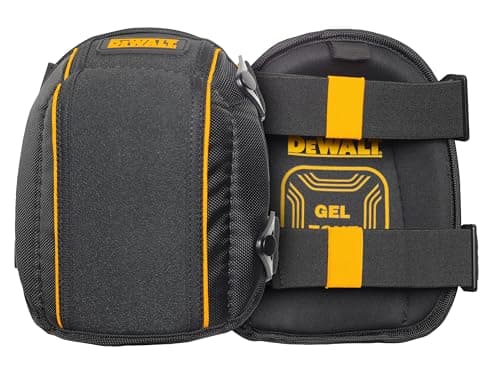
| 1 | 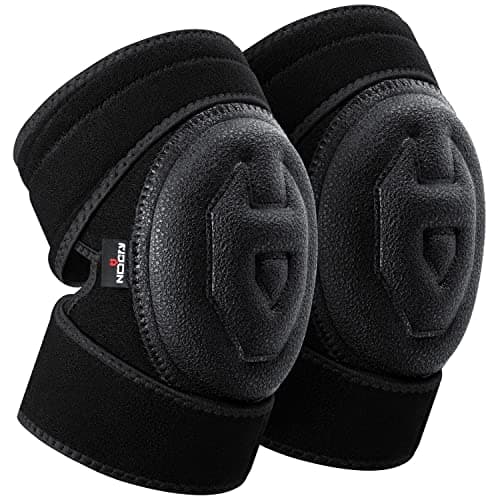 NoCry Gel Knee Pads with Soft Foam CushionAn anti-slip waterproof cap is the single most important property up there. | Shingle roofs | 8.7 | |
| 2 | 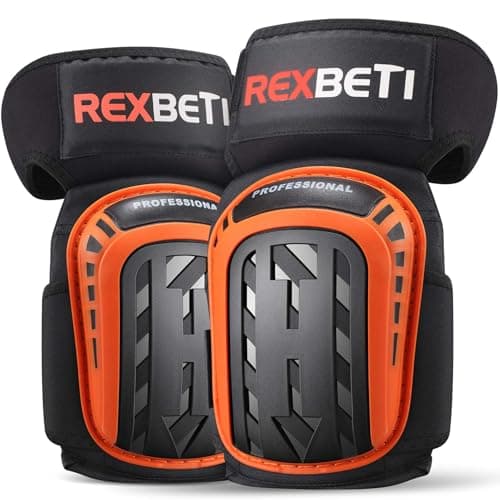 REXBETI Anti-Slip Construction Gel Knee PadsAnti-slip cap and real gel, at a price that suits gear roofing destroys. | A cheap pair you will replace often | 8.2 | |
| 3 | 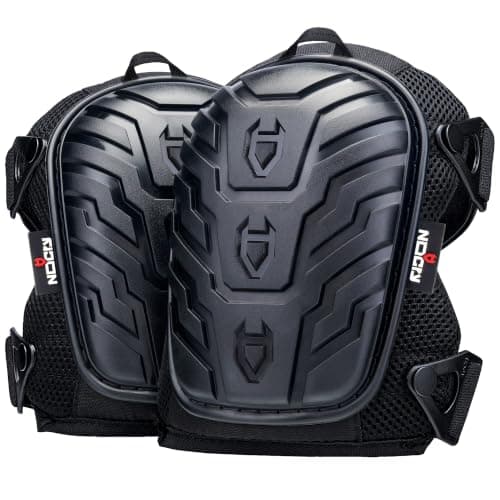 NoCry Professional Gel Knee PadsA reinforced cap for the sharp debris a tear-off puts under your knees. | Metal roofing and tear-offs | 8.0 |
#ad Prices pulled from Amazon and stamped as of October 6, 2026; they change, and we show no number we cannot verify. How we are funded.
Top pick · Shingle roofs
NoCry Gel Knee Pads with Soft Foam Cushion
An anti-slip waterproof cap is the single most important property up there.
On a sloped roof covered in loose granules, a pad that slides takes your balance with it, and that is a categorically different problem from a pad that is merely uncomfortable. The anti-slip textured cap is what earns this the top spot - grip before cushioning, deliberately.
The waterproof shell also survives the tar, sealant and damp mornings that come with roofing. The softer foam bottoms out on hard surfaces, which is the trade for a cap that stays put.
Specs that matter
- Cushion:
- Soft foam with gel insert
- Cap:
- Waterproof, anti-slip
- Straps:
- Easy-release buckles
- Use:
- Flooring, tiling, finish work
Our scoring
- Grip on slope
- 9.2
- Waterproofing
- 8.8
- Heat tolerance
- 7.4
- Cushioning
- 7.6
- Value
- 8.6
What works
- Anti-slip cap stays put on tile and sheet goods, where hard caps skate
- Softer and lighter than the Professional model
- Waterproof shell survives wet mortar and thinset
What to know
- Softer foam bottoms out on gravel and rubble
- Less protection from sharp debris
- Buckles are a wear point
Best value · A cheap pair you will replace often
REXBETI Anti-Slip Construction Gel Knee Pads
Anti-slip cap and real gel, at a price that suits gear roofing destroys.
Roofing is harder on pads than any other trade: grit abrades the caps, heat degrades the foam, and tar and sealant ruin the shells. That argues for a pad you replace annually without thinking rather than a premium pair you nurse.
It has the two things that matter - a textured anti-slip cap and a genuine gel layer - at roughly half the price of the name brands. Straps and buckles fail first, and the cap is thinner than premium pads.
Specs that matter
- Cushion:
- Gel over foam
- Cap:
- Anti-slip textured
- Straps:
- Dual adjustable
- Use:
- General construction
Our scoring
- Grip on slope
- 8.0
- Waterproofing
- 7.0
- Heat tolerance
- 7.0
- Cushioning
- 7.8
- Value
- 9.5
What works
- Cheapest pad here that still has a real gel layer
- Anti-slip cap performs better than the price suggests
- Fine as a spare pair to leave in the truck
What to know
- Straps and buckles are the first thing to fail
- Thinner cap than premium pads
- Sizing suits average legs only
No. 3 · Metal roofing and tear-offs
NoCry Professional Gel Knee Pads
A reinforced cap for the sharp debris a tear-off puts under your knees.
Tear-offs and metal roofing put genuinely sharp material under you - old nails, torn flashing, cut metal edges - and that is a puncture hazard a soft pad does not address. A reinforced cap does.
Gel over foam handles the sustained load. The harder cap has less grip on a smooth sloped surface than the anti-slip options, so this is the tear-off and flat-roof pad rather than the steep-shingle one.
Specs that matter
- Cushion:
- Gel core over foam
- Cap:
- Reinforced, non-marking
- Straps:
- Dual adjustable straps
- Use:
- General construction
Our scoring
- Grip on slope
- 7.0
- Waterproofing
- 7.4
- Heat tolerance
- 7.4
- Cushioning
- 8.8
- Value
- 8.8
What works
- Gel-over-foam spreads load better than foam alone
- Non-marking cap will not scar a finished floor
- Dual straps stop the pad rotating as you move
What to know
- Straps behind the knee chafe over a long day
- Bulky to walk in — you take them off between tasks
- Hard cap slides on smooth tile
Heat, which is the under-considered factor
A dark roof in summer runs far hotter than the air temperature, and you are kneeling directly on it. Two consequences for pads. First, the pad is also your thermal barrier - kneeling on hot shingle through a thin pad is genuinely painful, and a thicker gel layer helps with that as well as with load. Second, sustained heat degrades foam and softens adhesives, which is part of why roofing pads do not last.
Heat also makes the strapping less tolerable, because sweat plus a strap behind the knee is a chafing problem. Wider straps positioned above and below the joint crease help; this is one trade where it is worth paying attention to strap width specifically.
Tear-offs are a different hazard
Worth separating out. A tear-off puts old nails, torn flashing and cut metal under your knees, and that is a puncture hazard rather than a pressure one. A reinforced cap matters there in a way it does not on a clean shingle lay, and a soft grippy pad is the wrong tool. If your work includes both, two pairs is a reasonable answer - and the same puncture logic applies underfoot, which is why boots for carpenters and the PR rating come up in that context.
What we would skip
Skip hard domed caps on steep shingle - they slide. Skip thin foam pads, which both bottom out and transmit roof heat. Skip narrow single straps, which chafe and rotate when you are sweating. And skip premium pads you will be reluctant to retire; roofing gear wears out, and a worn anti-slip cap has lost the one property you bought it for.
Frequently asked
What knee pads are best for roofing?
Pads with a textured anti-slip cap and a waterproof shell. On a sloped, granule-covered roof, grip is the priority - a pad that slides moves your balance downhill while your hands are occupied. A reinforced cap is better for tear-offs, where sharp debris is the hazard.
Do knee pads help with roof safety?
They reduce slips while kneeling, which is worthwhile. They are not fall protection in any sense. OSHA requires fall protection for most roofing work at six feet and above, and no knee pad is part of that system.
Why do my knee pads slide on a roof?
Shingle granules act like a dry lubricant between the cap and the roof surface, and a hard domed cap has a small contact patch to begin with. A textured anti-slip cap with a broader contact area counteracts both. A worn cap has lost that texture and should be replaced.
How long do knee pads last in roofing?
Less than in any other trade - grit abrades the caps, roof heat degrades the foam, and tar and sealant ruin the shells. Treat them as an annual or seasonal consumable, and replace them as soon as the anti-slip texture on the cap is worn smooth.
Sources
Back to Knee Pads, or see how we pick. Spotted something wrong? We publish corrections — see our editorial policy.