Best for hot weather
Best Work Socks for Hot Weather
Counterintuitive but true: a thin cotton sock is hotter and worse than a midweight merino one.
Hot-weather socks are where the obvious answer is most often wrong. The instinct is to go as thin as possible, and the thinnest socks in most people's drawers are cotton - which is the single worst fiber for the job. The sock that keeps you coolest and most comfortable in heat is usually a midweight synthetic or merino, not a thin cotton one.
Why thin cotton is the worst option
Cotton absorbs sweat and holds it against your skin. In heat, when you are producing the most sweat, that means a permanently saturated layer between your foot and the boot. Three consequences, all bad: damp skin is far more susceptible to blistering under shear, saturated cotton loses its loft so what little cushioning it had disappears, and wet skin is the environment fungal infections need.
A midweight merino or synthetic sock in the same boot keeps the skin surface drier and more comfortable all day, despite being thicker. Thickness is not the variable that matters; moisture handling is.
The merino-in-heat case
This surprises people, so it is worth explaining. Merino's temperature regulation is not a one-directional insulation effect - the fiber buffers both temperature and humidity at the skin surface. It absorbs moisture vapor into its structure while the surface stays dry to the touch, and it keeps doing that in heat.
That is why outdoor workers and hikers frequently run merino through summer rather than switching. The honest limit is drying speed: merino is slow to dry, so if your strategy involves changing or rinsing socks during the day, a synthetic suits that better. Best work socks has the full fiber comparison.
Quick picks
Ranked by our published scoring rubric. Tap any row for the full write-up.
| # | Product | Best for | Score | Price |
|---|---|---|---|---|
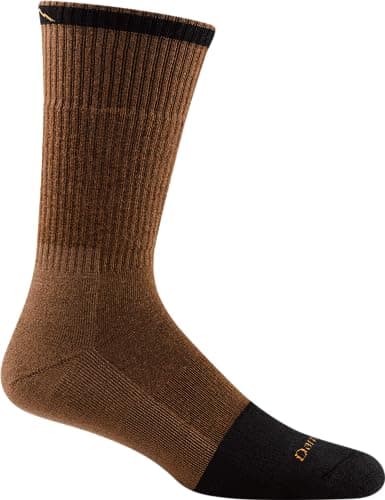
| 1 | 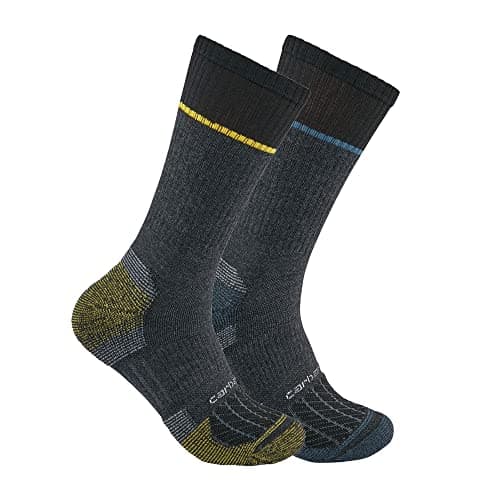 Carhartt Force Midweight Steel Toe Crew Sock (2-pack)Fast drying is the property that matters most in heat, and synthetics win it. | Hot and heavy sweating | 8.8 | |
| 2 | 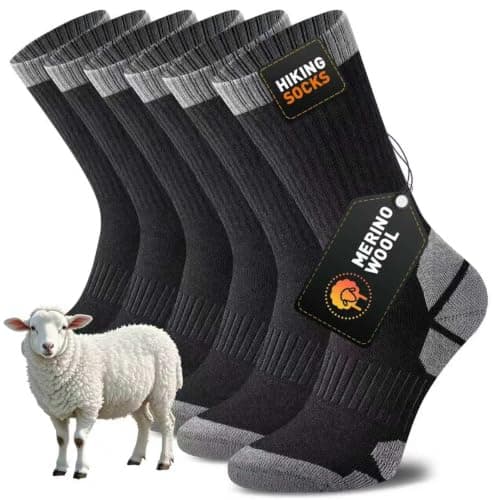 Niorasen Merino Wool Cushioned Crew SocksMerino genuinely works in heat - and this is the cheap way to find out. | Heat plus odor control, affordably | 8.2 | |
| 3 | 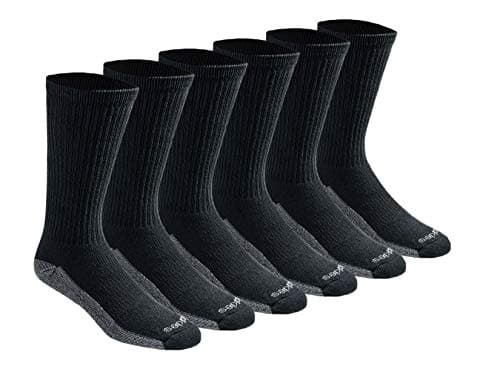 Dickies Dri-Tech Moisture Control Crew SocksLight, fast drying and cheap in bulk - which is what a hot-weather routine actually needs. | Changing socks twice a day | 8.2 |
#ad Prices pulled from Amazon and stamped as of October 6, 2026; they change, and we show no number we cannot verify. How we are funded.
Top pick · Hot and heavy sweating
Carhartt Force Midweight Steel Toe Crew Sock (2-pack)
Fast drying is the property that matters most in heat, and synthetics win it.
In heat, the volume of sweat is the dominant variable, and a sock that moves it off your skin and dries quickly handles that better than anything else. The moisture-moving finish does exactly that, and reinforcement at toe and heel covers the wear points.
Cheap enough to own plenty, which enables the midday change that is the single most effective hot-weather habit. Synthetics hold odor, which is the accepted trade.
Specs that matter
- Fiber:
- Synthetic blend, FastDry finish
- Cushion:
- Midweight
- Toe:
- Reinforced for steel toes
- Pack:
- 2 pairs
Our scoring
- Cooling
- 8.4
- Drying speed
- 9.4
- Moisture moving
- 8.8
- Durability
- 7.8
- Value
- 9.2
What works
- Dries far faster than merino after a sweaty shift
- Reinforced toe and heel where boots wear socks through
- Cheap enough to own ten pairs
What to know
- Synthetics hold odor more than merino
- Less temperature regulation than wool
- Elastic relaxes after a year of washing
No. 2 · Heat plus odor control, affordably
Niorasen Merino Wool Cushioned Crew Socks
Merino genuinely works in heat - and this is the cheap way to find out.
The counterintuitive one. Merino regulates temperature in both directions: the same property that keeps it warm in cold keeps it cooler in heat, by buffering moisture and temperature at the skin surface. Plenty of outdoor workers run merino year-round for this reason.
This is budget merino, with most of the benefit at a fraction of premium prices - thinner merino content, so it pills sooner and carries no guarantee worth claiming. No safety-toe reinforcement.
Specs that matter
- Fiber:
- Merino wool blend
- Cushion:
- Thick cushioned
- Pack:
- Multi-pair
- Finish:
- Anti-blister seams
Our scoring
- Cooling
- 8.6
- Drying speed
- 6.2
- Moisture moving
- 8.8
- Durability
- 7.0
- Value
- 9.0
What works
- Merino benefits at roughly a third of the premium price
- Thick cushioning suits boots and cold weather
- Multi-packs make the per-pair cost sensible
What to know
- Thinner merino content than premium brands, so it pills sooner
- No guarantee worth claiming
- No safety-toe reinforcement
No. 3 · Changing socks twice a day
Dickies Dri-Tech Moisture Control Crew Socks
Light, fast drying and cheap in bulk - which is what a hot-weather routine actually needs.
Lighter cushioning than the others, which in genuine heat is often what you want, and multi-packs make it easy to own enough pairs to change socks twice a day without thinking about laundry.
Not a concrete sock - the cushioning is minimal - and no safety-toe reinforcement. The arch compression band does usefully stop the sock sliding inside a boot, which matters more when your feet are wet.
Specs that matter
- Fiber:
- Moisture-wicking synthetic blend
- Cushion:
- Light to midweight
- Pack:
- 6, 12 or 18 pairs
- Support:
- Arch compression band
Our scoring
- Cooling
- 8.4
- Drying speed
- 9.0
- Moisture moving
- 8.0
- Durability
- 6.4
- Value
- 9.5
What works
- Lowest cost per pair of any sock here by a wide margin
- Wicks well enough to keep feet dry on a normal shift
- Arch band stops the sock sliding down inside the boot
What to know
- Thin cushioning — not a concrete sock
- Wears out within a year of heavy use
- No safety-toe reinforcement
Wet feet as a safety problem
Worth separating from comfort. When your foot is wet inside the boot, your foot and the boot stop moving as one unit - the foot slides, and your sense of exactly where your foot is and how much grip it has degrades. On a ladder rung, a sloped roof or a scaffold plank, that is a control problem rather than an irritation.
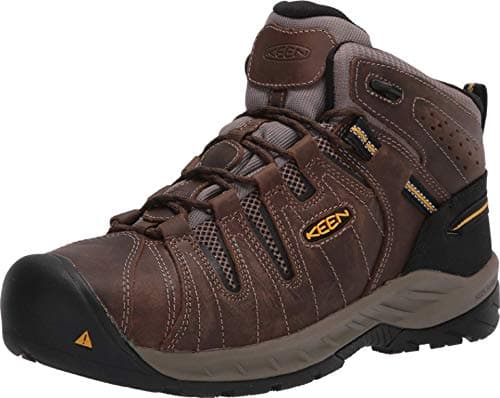
It is also, prosaically, how blisters form: friction between damp skin and fabric. Both are reasons to treat sock choice in heat as a performance decision rather than a comfort preference, and the same logic drives boots for hot weather and gloves for hot weather.
The boot is still the bigger lever
No sock can overcome a sealed boot. If your boots have a waterproof membrane and your summer work is dry, the membrane is trapping your sweat and that is the root cause - see boots for sweaty feet. An unlined boot plus a decent sock is a different experience from a membrane boot plus the best sock made.
And as everywhere on this hub: rotate two pairs of boots on alternate days, pull the insoles out nightly, and change socks midday. Those three habits are free and outperform any product on this page.
What we would skip
Skip thin cotton socks, which is the specific mistake this page exists to correct. Skip maximum-cushion socks in heat - that much material does hold heat. Skip waterproof boots for dry summer work. And skip wearing one pair of socks through a twelve-hour hot shift when a second pair in your bag costs almost nothing.
Frequently asked
What socks are best for work in hot weather?
A midweight synthetic moisture-wicking blend, or merino if you prefer odor control over drying speed. Avoid thin cotton socks, which hold sweat against your skin, lose their cushioning when wet and make blisters far more likely.
Are merino wool socks too hot for summer?
No - merino regulates temperature in both directions, buffering moisture and temperature at the skin surface, which is why many outdoor workers wear it year-round. The real limitation in heat is drying speed, so if you rinse or change socks during the day, synthetics suit that better.
Should work socks be thinner in summer?
Moderately, but thickness matters far less than fiber. A midweight merino or synthetic sock will keep your feet drier and more comfortable than a thin cotton one, because the cotton holds sweat against the skin. Avoid maximum-cushion socks in genuine heat.
Why do my feet blister more in summer?
Because damp skin is considerably more susceptible to shear damage than dry skin, and in heat your feet are wetter. Moisture-moving socks, a midday sock change and an unlined boot all reduce it more than padding does.
Sources
Back to Insoles & Work Socks, or see how we pick. Spotted something wrong? We publish corrections — see our editorial policy.