Best for construction
Best Knee Pads for Construction
Rough ground needs a hard cap and gel. Everything else about a pad is a strap problem.
Knee pads are cheap, they protect a joint that does not repair well, and a remarkable number of tradespeople own a pair they never wear. The reason is almost always the same: the pads are wrong for the surface they work on or the straps are unbearable, so the pads come off - and a pad in a toolbox protects nothing. So this page spends as much time on straps and caps as on cushioning.
Why kneeling deserves taking seriously
Kneeling puts most of your upper-body weight through a joint that is not designed to carry load that way, concentrated on a contact patch about the size of a coaster. Research on occupational kneeling consistently associates kneeling trades with higher rates of knee osteoarthritis and meniscal damage, and unlike a strain, cartilage damage does not reverse.
That makes pads one of the better value-for-money items in the whole kit - thirty dollars against a joint you need for the rest of your career. The problem has never been the price; it has been wearability.
The cap decides where the pad works
This is the surface-specific part. A hard domed cap rolls and pivots nicely on rough ground, protects against sharp debris, and skates alarmingly on smooth tile or sealed concrete. A flat, broad, grippy cap stays put on finished floors and lets you shuffle without standing up, and rocks awkwardly on rubble.
General construction mostly means debris and uneven ground, which argues for the hard cap - but check whether it is non-marking if you ever work on finished surfaces. If your work is predominantly on smooth floors, you want the other type entirely: knee pads for flooring.
Quick picks
Ranked by our published scoring rubric. Tap any row for the full write-up.
| # | Product | Best for | Score | Price |
|---|---|---|---|---|
| 1 | 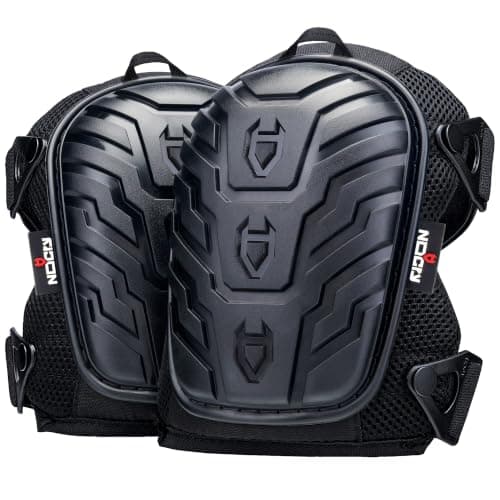 NoCry Professional Gel Knee PadsGel over foam with a reinforced non-marking cap and two straps - the best-balanced pad here. | General site work | 8.6 | |
| 2 | 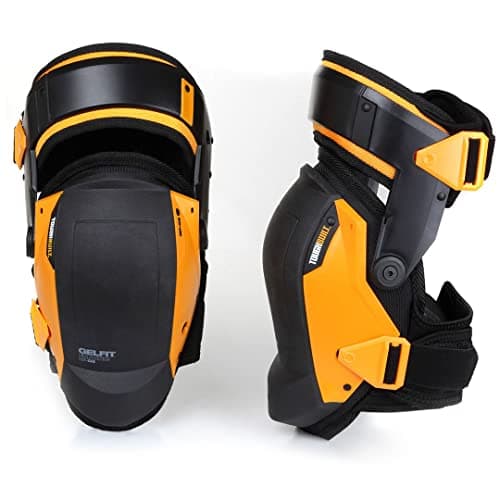 ToughBuilt GelFit Thigh Support Stabilization Knee PadsA thigh-support platform takes load off the joint rather than just padding it. | Hours of continuous kneeling | 8.4 | |
| 3 | 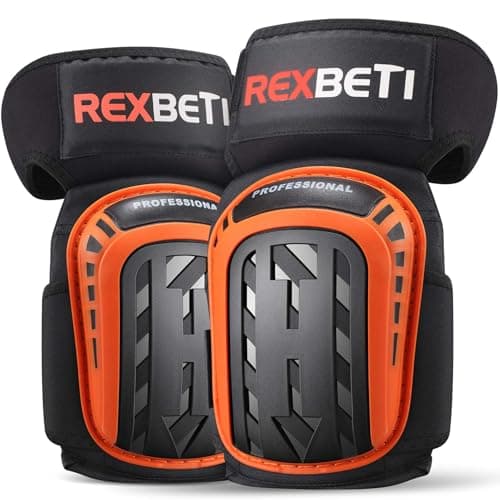 REXBETI Anti-Slip Construction Gel Knee PadsReal gel and an anti-slip cap at about half the price of the name brands. | A spare pair for the truck | 8.0 | |
| 4 | 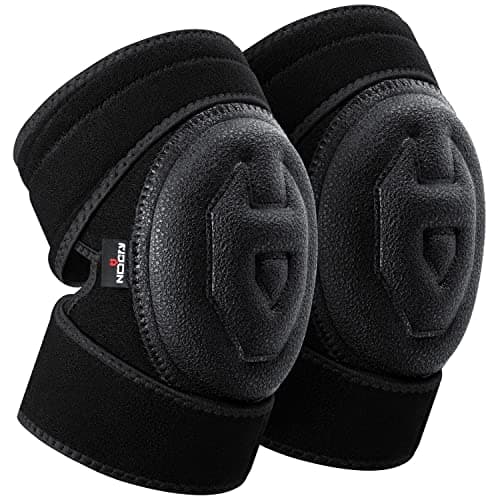 NoCry Gel Knee Pads with Soft Foam CushionSofter and lighter with a waterproof anti-slip cap - better on smooth surfaces. | Mixed rough and finished work | 8.0 |
#ad Prices pulled from Amazon and stamped as of October 6, 2026; they change, and we show no number we cannot verify. How we are funded.
Top pick · General site work
NoCry Professional Gel Knee Pads
Gel over foam with a reinforced non-marking cap and two straps - the best-balanced pad here.
Gel over foam is the right construction for construction: foam alone bottoms out under concentrated kneeling load, and gel spreads pressure far better. The reinforced cap handles the sharp debris that is on every site floor, and it is non-marking, which matters when you move from rough to finished work.
Two straps are the detail that makes a pad wearable: a single strap lets the pad rotate round your leg as you move, which is how pads end up on the side of your calf. The straps still chafe behind the knee over a long day, and these are bulky to walk in.
Specs that matter
- Cushion:
- Gel core over foam
- Cap:
- Reinforced, non-marking
- Straps:
- Dual adjustable straps
- Use:
- General construction
Our scoring
- Cushioning
- 8.8
- Debris protection
- 9.0
- Strap comfort
- 7.6
- Grip on surface
- 7.4
- Value
- 8.8
What works
- Gel-over-foam spreads load better than foam alone
- Non-marking cap will not scar a finished floor
- Dual straps stop the pad rotating as you move
What to know
- Straps behind the knee chafe over a long day
- Bulky to walk in — you take them off between tasks
- Hard cap slides on smooth tile
No. 2 · Hours of continuous kneeling
ToughBuilt GelFit Thigh Support Stabilization Knee Pads
A thigh-support platform takes load off the joint rather than just padding it.
#ad No buyable offer at the last price check. How we are funded
- Our score
- 8.4/10
The only genuinely different mechanism in this category. Instead of simply cushioning the kneecap, a thigh platform transfers part of your weight above the knee onto the thigh - so less of it goes through the joint at all. For sustained kneeling that is a meaningfully better approach.
It is by a clear margin the heaviest and bulkiest pad here, and awkward to walk in - so it is a pad you put on for a kneeling task rather than wear all day. Overkill for occasional kneeling.
Specs that matter
- Cushion:
- Gel insert, molded
- Support:
- Thigh stabilization platform
- Straps:
- Heavy-duty adjustable
- Use:
- Long kneeling sessions
Our scoring
- Cushioning
- 9.0
- Debris protection
- 8.4
- Strap comfort
- 8.0
- Grip on surface
- 7.0
- Value
- 7.4
What works
- Thigh platform genuinely redistributes load off the kneecap
- The best pad here for hours of continuous kneeling
- Heavy-duty build that survives site abuse
What to know
- The heaviest and bulkiest pad here by a clear margin
- Awkward to walk in — not a wear-all-day pad
- Overkill for occasional kneeling
Best value · A spare pair for the truck
REXBETI Anti-Slip Construction Gel Knee Pads
Real gel and an anti-slip cap at about half the price of the name brands.
The budget pad that is actually worth owning. It has a genuine gel layer rather than foam pretending to be one, an anti-slip textured cap, and dual straps - the three things that matter - at a price that makes a second pair for the truck an easy decision.
The straps and buckles are the first components to fail, the cap is thinner than premium pads, and the sizing suits average legs only.
Specs that matter
- Cushion:
- Gel over foam
- Cap:
- Anti-slip textured
- Straps:
- Dual adjustable
- Use:
- General construction
Our scoring
- Cushioning
- 7.8
- Debris protection
- 7.4
- Strap comfort
- 7.0
- Grip on surface
- 8.0
- Value
- 9.5
What works
- Cheapest pad here that still has a real gel layer
- Anti-slip cap performs better than the price suggests
- Fine as a spare pair to leave in the truck
What to know
- Straps and buckles are the first thing to fail
- Thinner cap than premium pads
- Sizing suits average legs only
No. 4 · Mixed rough and finished work
NoCry Gel Knee Pads with Soft Foam Cushion
Softer and lighter with a waterproof anti-slip cap - better on smooth surfaces.
The lighter NoCry, with a waterproof anti-slip cap that stays put on tile, sheet goods and sealed concrete, where a hard domed cap skates. If your site mixes rough ground with finished floors, this covers more of the week than a pure rubble pad.
The softer foam bottoms out on gravel and rubble, and there is less protection from sharp debris. For heavy demolition, take the Professional instead.
Specs that matter
- Cushion:
- Soft foam with gel insert
- Cap:
- Waterproof, anti-slip
- Straps:
- Easy-release buckles
- Use:
- Flooring, tiling, finish work
Our scoring
- Cushioning
- 7.6
- Debris protection
- 6.8
- Strap comfort
- 8.0
- Grip on surface
- 9.0
- Value
- 8.6
What works
- Anti-slip cap stays put on tile and sheet goods, where hard caps skate
- Softer and lighter than the Professional model
- Waterproof shell survives wet mortar and thinset
What to know
- Softer foam bottoms out on gravel and rubble
- Less protection from sharp debris
- Buckles are a wear point
Straps: why pads get abandoned
Every pad is held on by straps behind the knee, and that is where comfort is won or lost. The failure modes are specific and predictable:
- Straps in the joint crease chafe and restrict circulation. You want them positioned above and below the crease, not across it.
- A single strap lets the pad rotate as your leg moves, so it migrates to the side of your calf.
- Narrow straps concentrate pressure. Wider is better.
- Fiddly buckles matter because you will take the pads off twenty times a day. One-handed release is not a luxury.
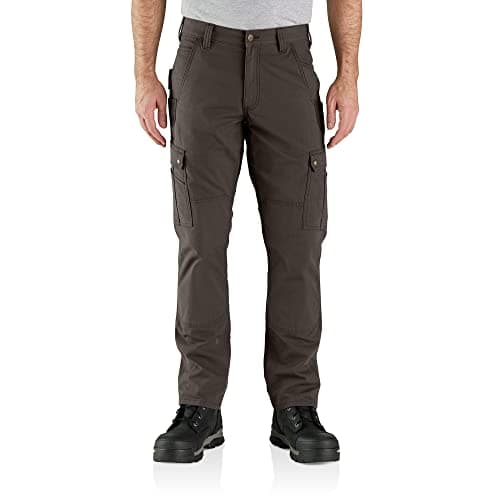
The alternative that avoids straps entirely is a pant with a built-in knee-pad pocket - the insert cannot rotate and never chafes. Those inserts are thinner than strap-on pads, so they are a comfort measure for intermittent kneeling rather than heavy protection. Work pants for construction covers the double-front pants that take them, and many people who kneel for a living use both.
What we would skip
Skip single-strap pads. Skip pure foam pads for anything more than occasional kneeling. Skip hard domed caps if you work mainly on finished floors, where they slide. And skip the assumption that pads are only for floor layers - electricians doing rough-in and plumbers under sinks kneel as much as anyone, which is why boots for plumbers and work pants for electricians both point back here.
Frequently asked
What are the best knee pads for construction work?
Gel-over-foam pads with a reinforced non-marking cap and two adjustable straps positioned above and below the knee crease. Foam alone bottoms out under kneeling load, a single strap lets the pad rotate, and a cap that marks finished floors causes its own problems.
Gel or foam knee pads - which is better?
Gel, for any sustained kneeling, because foam compresses fully under concentrated load and stops protecting. Foam is lighter and cheaper and is adequate for occasional kneeling. The best pads layer gel over a foam base to get both properties.
Why do my knee pads slide down or rotate?
Usually a single-strap design, straps sitting in the crease behind the knee, or a pad sized for a larger leg. Look for two wide straps positioned above and below the joint, and check the adjustment range against your actual leg circumference before buying.
Are knee pads or knee-pad pants better?
They solve different problems. Pants with pad pockets are more comfortable, cannot rotate and suit a day of intermittent kneeling. Strap-on pads are much thicker and far more protective for sustained kneeling. People who kneel for a living commonly use both together.
Sources
Back to Knee Pads, or see how we pick. Spotted something wrong? We publish corrections — see our editorial policy.