Best met guard boots
Best Metatarsal Guard Work Boots
A steel toe protects your toes. The bones across the top of your foot are the ones that get crushed.
The metatarsals are the five long bones running from the middle of your foot to the base of your toes, and they sit directly under the skin on the top of the foot with essentially no natural protection. A safety toe cap covers the last inch or so of your foot and nothing behind it. So in any job where something heavy can land across the top of your foot, the toe cap is protecting the wrong part.
The Mt rating, and why it is separate
ASTM F2413 tests metatarsal protection with its own procedure and marks it Mt in the boot's marking line, at two performance levels (Mt75 and Mt50 in the current revision's structure). It is entirely independent of the impact and compression ratings for the toe cap - which means a boot can be I/75 C/75 and offer zero metatarsal protection, and that describes most safety boots sold.
The practical consequence: if your employer's policy says metatarsal protection, you need to see Mt in the marking. A heavy boot, a tall boot or a boot with thick leather over the instep does not satisfy it, whatever it feels like. Every code in that marking line is decoded in ASTM F2413 safety ratings explained.
Who actually needs one
- Oilfield and pipeline work - drill pipe, tongs and elevators, and a sector where Mt is frequently mandatory: boots for oilfield.
- Welders and fabricators who handle their own plate and structural sections: boots for welding.
- Foundry, smelter and heavy industry where molten metal splash and heavy stock are both present.
- Masonry, hardscape and stone work, where heavy units are handled at ground level by hand.
- Logging and sawmill work, where falling timber is a routine hazard.
Quick picks
Ranked by our published scoring rubric. Tap any row for the full write-up.
| # | Product | Best for | Score | Price |
|---|---|---|---|---|
| 1 | 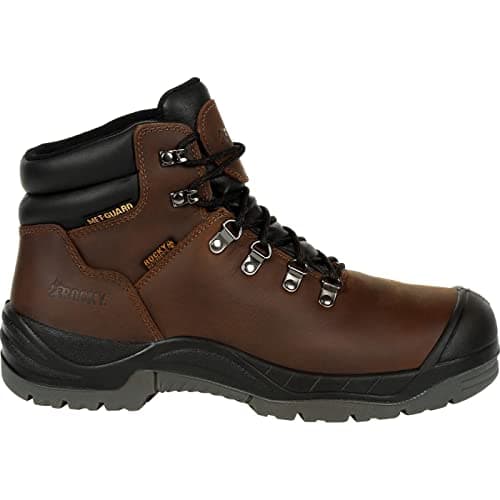 Rocky Worksmart Composite Toe Internal Met GuardAn internal Mt-rated guard, composite toe and waterproof - the one most people should buy. | Internal met protection at a sane price | 9.0 | |
| 2 | 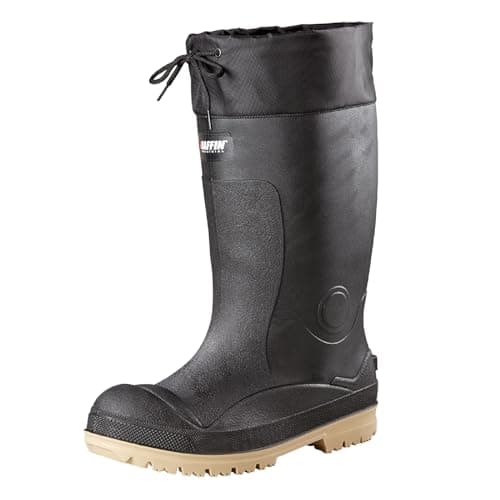 Baffin Titan Waterproof Steel Toe & Plate Slip-OnSteel toe plus a steel plate and deep insulation - heavy protection for cold industrial sites. | Industrial winter work with underfoot protection | 7.4 | |
| 3 | 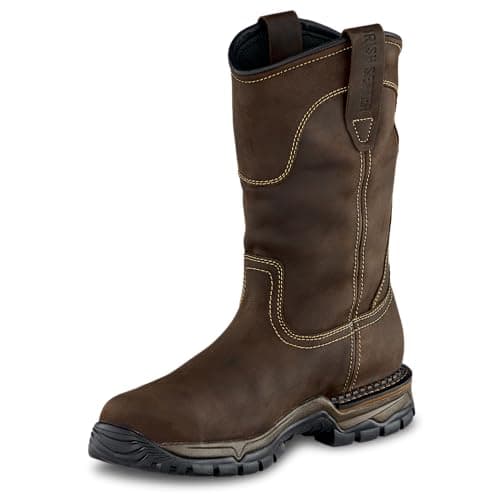 Irish Setter Two Harbors 11" Steel ToeNot Mt rated - but 11 inches of leather over the instep is real protection against spatter. | Height-based protection for welders | 7.0 | |
| 4 | 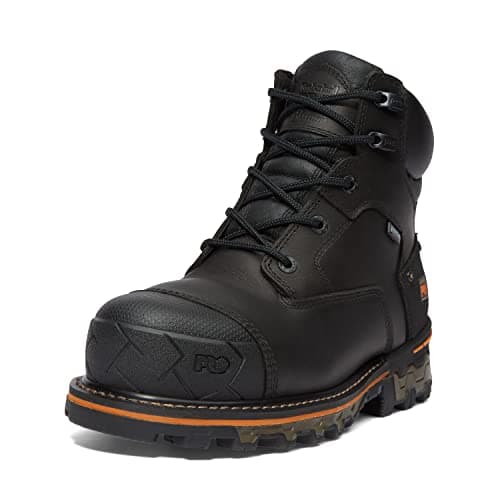 Timberland PRO Boondock 6" Composite Toe WaterproofNo Mt rating, but the most protective boot here underfoot and at the toe. | Maximum general protection without a met guard | 7.2 |
#ad Prices pulled from Amazon and stamped as of October 6, 2026; they change, and we show no number we cannot verify. How we are funded.
Top pick · Internal met protection at a sane price
Rocky Worksmart Composite Toe Internal Met Guard
An internal Mt-rated guard, composite toe and waterproof - the one most people should buy.
Metatarsal boots have a reputation for being abandoned in a locker, and the cause is almost always the external bib style. This uses an internal guard built into the boot, which protects the same bones with a fraction of the bulk and none of the flopping.
It is also composite and waterproof, and it costs far less than most met-guard boots. The guard does stiffen the instep, so expect pressure across the top of the foot for the first week, and the midfoot fit runs narrow.
Specs that matter
- Toe:
- Composite toe, ASTM F2413
- Met guard:
- Internal metatarsal guard, ASTM Mt rated
- Waterproof:
- Yes
- Height:
- 6 inch
Our scoring
- Met protection
- 9.4
- Wearability
- 8.6
- Toe protection
- 8.6
- Waterproofing
- 8.8
- Value
- 9.2
What works
- Internal met guard is far less bulky than the external bib style
- Met protection at a price most met-guard boots do not touch
- Non-metallic toe and guard
What to know
- The guard stiffens the instep — expect pressure at first
- Heavier than a plain composite-toe boot
- Fit runs narrow through the midfoot
No. 2 · Industrial winter work with underfoot protection
Baffin Titan Waterproof Steel Toe & Plate Slip-On
Steel toe plus a steel plate and deep insulation - heavy protection for cold industrial sites.
A different kind of protective boot: a steel toe, a steel puncture plate underfoot and a removable insulated liner, in a slip-on industrial design. It protects against the toe and the sole hazards rather than the metatarsals specifically, so check your site's exact requirement.
It is included here because for foundry, smelter and cold heavy-industry work it is often the boot that meets a multi-hazard spec. Very heavy, very warm, and wrong above freezing.
Specs that matter
- Toe:
- Steel toe, ASTM F2413
- Underfoot:
- Steel puncture plate
- Liner:
- Removable multi-layer insulation
- Style:
- Slip-on
Our scoring
- Met protection
- 6.0
- Wearability
- 5.8
- Toe protection
- 9.2
- Waterproofing
- 9.2
- Value
- 7.4
What works
- Toe, plate and deep insulation in one boot — rare combination
- Removable liner dries overnight
- Built for genuine extreme cold, not just a cold morning
What to know
- Heavy and bulky; not a boot for agility
- Far too warm above freezing
- Expensive
No. 3 · Height-based protection for welders
Irish Setter Two Harbors 11" Steel Toe
Not Mt rated - but 11 inches of leather over the instep is real protection against spatter.
An honest inclusion with a caveat. This boot carries no metatarsal rating, so it does not satisfy an Mt requirement. What it does give you is 11 inches of full-grain leather covering the instep and ankle, which is genuine protection against welding spatter and falling debris.
For welders whose hazard is molten metal rather than crush injury, that may be the more relevant protection - see boots for welding. If your site requires Mt, this is not the boot.
Specs that matter
- Toe:
- Steel toe, ASTM F2413
- Height:
- 11 inch pull-on
- Electrical hazard:
- EH rated
- Upper:
- Full-grain leather
Our scoring
- Met protection
- 5.5
- Wearability
- 7.0
- Toe protection
- 8.6
- Waterproofing
- 7.0
- Value
- 7.8
What works
- 11 inches of leather is real protection against spatter and debris
- No laces to burn through when welding
- Red Wing-family leather quality
What to know
- Hot — that much leather does not breathe
- Heavy
- Hard to size when your calf is large or small
No. 4 · Maximum general protection without a met guard
Timberland PRO Boondock 6" Composite Toe Waterproof
No Mt rating, but the most protective boot here underfoot and at the toe.
Also included with the same caveat: no metatarsal rating. The Boondock is here because many people searching for met-guard boots actually want maximum protection generally, and have not separated the hazards.
It is the stiffest and most protective boot on this page underfoot, waterproof and composite-toed. If your hazard is specifically something heavy landing on the top of your foot, take the Rocky instead.
Specs that matter
- Toe:
- Composite toe, ASTM F2413
- Height:
- 6 inch
- Waterproof:
- Yes, membrane lined
- Sole:
- Aggressive lug, slip and oil resisting
Our scoring
- Met protection
- 5.0
- Wearability
- 6.8
- Toe protection
- 9.0
- Waterproofing
- 9.0
- Value
- 7.6
What works
- Composite toe is non-metallic, so it clears metal detectors and conducts less cold
- Waterproof membrane plus a gusseted tongue genuinely keeps water out
- Outsole bites on broken ground where a wedge slides
What to know
- Heavy and stiff — a hard boot to stand on concrete in all day
- Long break-in; the outsole stays rigid for weeks
- Lug pattern tracks mud indoors
Internal versus external: the comfort decision that becomes a safety decision
An external bib guard is a flap of protective material that sits over the laces and instep, outside the boot. An internal guard is built into the boot's construction under the tongue. Both can achieve the Mt rating.
The bib is cheaper to produce and genuinely unpleasant to wear: it flops, it catches, it makes the boot awkward to put on, and it is the reason met-guard boots have the reputation they do. An internal guard is slightly less protective against glancing impacts across the whole instep but is comfortable enough to be worn every day - and PPE that is actually worn beats PPE that is better in a locker. Unless your site mandates the bib style, choose internal.
What we would skip
Skip external bib guards unless they are required. Skip assuming a heavy or tall boot gives metatarsal protection - only the Mt marking does. Skip met-guard boots altogether if your hazard is actually punctures from below, which needs a PR plate instead, or spatter, which needs height and leather. And skip buying before you have read your employer's written footwear policy, since in the sectors that need Mt, the policy usually specifies it exactly.
Frequently asked
What does a metatarsal guard protect against?
Impact and crush injuries to the metatarsal bones on the top of the foot - the area a toe cap does not cover at all. It is the relevant protection when heavy objects like pipe, plate, stone units or timber can land across the top of your foot.
Do I need metatarsal boots?
If you handle heavy material by hand at ground level - oilfield pipe, structural steel, masonry units, timber - the hazard is real and a toe cap does not address it. Many oilfield and heavy-industry employers mandate Mt-rated footwear. Check your site's written policy.
Internal or external metatarsal guards - which is better?
Internal, for almost everyone. External bibs are marginally more protective across the whole instep but are bulky and widely abandoned, and PPE that gets worn beats PPE that sits in a locker. Both can meet the ASTM Mt rating.
Are met guard boots uncomfortable?
Internal guards add stiffness across the instep, so expect about a week of unfamiliar pressure while the boot breaks in. External bibs remain awkward indefinitely. Lacing a little looser over the guard at first and building up wear time both help.
Sources
Back to Work Boots, or see how we pick. Spotted something wrong? We publish corrections — see our editorial policy.