Best for plumbers
Best Work Boots for Plumbers
Wet floors, customers' houses, and a lot of kneeling. Those three facts decide the boot.
Plumbing has an unusual footwear brief because the trade spans two incompatible environments. Half the job is wet, dirty and awkward - crawlspaces, trenches, flooded basements. The other half is inside a customer's finished home, where the boot that just came out of a crawlspace has to walk across a hardwood hallway without marking it. Most boot guides pick one of those and ignore the other.
Waterproof has two meanings, and the difference matters
A membrane-lined leather boot is waterproof against rain, splash and brief puddles. It is not waterproof against standing water: once water comes in over the collar it is inside, and the membrane now holds it there, so a boot that got swamped on Monday is still damp on Wednesday. A rubber boot has no entry path at all below the shaft height and dries in minutes because nothing absorbs.
The practical answer for most plumbers is both - a membrane boot as the daily and a tall rubber pull-on in the van for the wet jobs. Waterproof vs water resistant covers the terminology, and waterproof work boots is the broader shortlist.
Quick picks
Ranked by our published scoring rubric. Tap any row for the full write-up.
| # | Product | Best for | Score | Price |
|---|---|---|---|---|
| 1 | 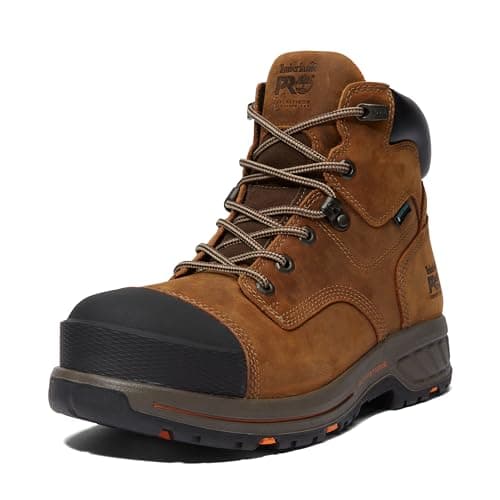 Timberland PRO Helix HD 6" Composite Toe WaterproofWaterproof, non-metallic, stable, and it behaves in a customer's house. | Service and residential plumbing | 8.6 | |
| 2 | 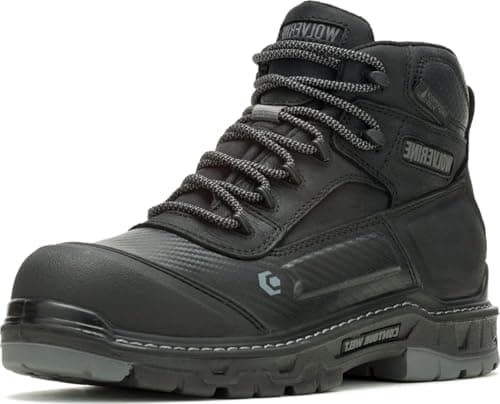 Wolverine Overpass 6" Composite Toe WaterproofThe most flexible waterproof boot here - it bends where your foot bends. | Crawlspaces and awkward positions | 8.5 | |
| 3 | 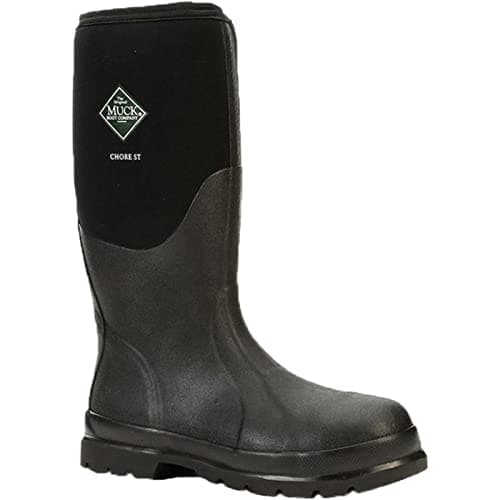 Muck Boot Chore Classic Tall Steel ToeWhen the job is actually wet, a membrane loses and rubber wins. | Standing in it | 8.2 | |
| 4 | 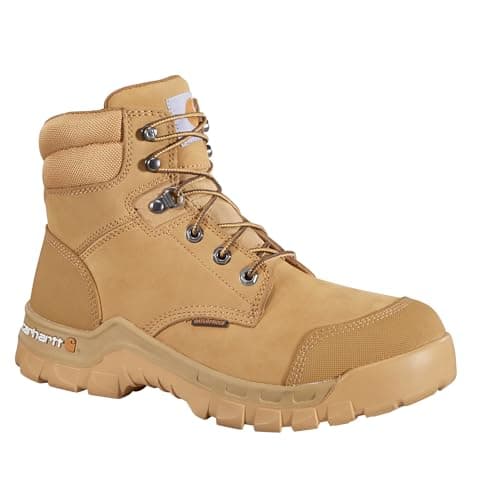 Carhartt Rugged Flex 6" Composite Toe WaterproofThe least boot-like option - light, flexible, waterproof and quick in and out of a van. | Light and clean service calls | 8.5 |
#ad Prices pulled from Amazon and stamped as of October 6, 2026; they change, and we show no number we cannot verify. How we are funded.
Top pick · Service and residential plumbing
Timberland PRO Helix HD 6" Composite Toe Waterproof
Waterproof, non-metallic, stable, and it behaves in a customer's house.
Plumbing is two jobs with one pair of boots: crawling into wet, dirty spaces, then walking across somebody's finished hallway. The Helix HD handles both - a waterproof membrane with a gusseted tongue for the first part, and a slip-resistant non-marking outsole for the second.
It is a stable, wide-platform boot, which matters more than it sounds when you are braced awkwardly under a sink or standing on the lip of a tub. Composite toe and EH rated, both useful in a trade that works around both water and wiring.
Specs that matter
- Toe:
- Composite toe, ASTM F2413
- Height:
- 6 inch
- Waterproof:
- Yes
- Electrical hazard:
- EH rated
Our scoring
- Waterproofing
- 9.0
- Grip on wet floors
- 8.8
- Kneeling comfort
- 7.8
- Customer-floor manners
- 8.6
- Value
- 7.8
What works
- Balances cushioning and support better than either Boondock or Hypercharge
- Wide platform feels stable on ladders and scaffold planks
- EH rated and non-metallic
What to know
- Middle-of-the-range in every dimension, best at nothing
- Membrane means warm feet in summer
- Cement construction, not resoleable
No. 2 · Crawlspaces and awkward positions
Wolverine Overpass 6" Composite Toe Waterproof
The most flexible waterproof boot here - it bends where your foot bends.
No trade adopts more awkward body positions than plumbing. Kneeling under a vanity, lying in a crawlspace, one foot braced on a joist - a stiff-soled boot fights every one of those, and you feel it across the top of your foot.
The Overpass's contour welt lets the forefoot flex properly while staying waterproof and safety-rated. You give up some underfoot stiffness, which matters on rubble and barely at all in a crawlspace.
Specs that matter
- Toe:
- Composite toe, ASTM F2413
- Height:
- 6 inch
- Waterproof:
- Yes
- Build:
- Contour Welt, flexible forefoot
Our scoring
- Waterproofing
- 8.6
- Grip on wet floors
- 8.2
- Kneeling comfort
- 9.0
- Customer-floor manners
- 8.0
- Value
- 8.4
What works
- Flexes at the forefoot, so climbing and kneeling feel natural
- Light for a waterproof composite-toe boot
- Good ankle hold without an 8-inch shaft
What to know
- Flexibility costs some underfoot protection on rebar and rubble
- Outsole wears faster than a stiffer boot's
- Not a cold-weather boot
No. 3 · Standing in it
Muck Boot Chore Classic Tall Steel Toe
When the job is actually wet, a membrane loses and rubber wins.
There is a category of plumbing work - sewer repair, flooded basements, septic, water main breaks - where a waterproof membrane is simply not enough. Membranes keep out rain and splash; they do not keep out standing water above the ankle, and once water comes in over the top, a lined leather boot stays wet for days.
A rubber-over-neoprene pull-on with a steel toe is the honest tool for that work. It hoses clean, it cannot wet out, and the neoprene insulates. Keep it as a second pair in the van rather than your daily boot - rubber does not breathe and has little arch support.
Specs that matter
- Toe:
- Steel toe, ASTM F2413
- Material:
- Rubber over neoprene
- Waterproof:
- Fully waterproof, not just resistant
- Height:
- Tall shaft
Our scoring
- Waterproofing
- 9.8
- Grip on wet floors
- 8.0
- Kneeling comfort
- 6.8
- Customer-floor manners
- 6.0
- Value
- 8.6
What works
- Genuinely waterproof in a way no membrane boot matches
- Neoprene lining insulates and flexes
- Rinses clean with a hose
What to know
- No breathability — feet sweat, so socks matter more than usual
- Rubber outsole wears fast on abrasive concrete
- Little arch support in the stock build
No. 4 · Light and clean service calls
Carhartt Rugged Flex 6" Composite Toe Waterproof
The least boot-like option - light, flexible, waterproof and quick in and out of a van.
For techs whose day is mostly diagnostics, fixture swaps and water-heater work in occupied homes, the heavy boot is overkill. This is light, needs no break-in, is still waterproof and non-metallic, and does not announce itself on a customer's floor.
The EVA midsole compresses over a year of daily wear - the standard price of cushioned comfort - and the softer upper will not survive heavy commercial work.
Specs that matter
- Toe:
- Composite toe, ASTM F2413
- Height:
- 6 inch
- Waterproof:
- Yes
- Midsole:
- Cushioned EVA
Our scoring
- Waterproofing
- 8.4
- Grip on wet floors
- 8.2
- Kneeling comfort
- 8.6
- Customer-floor manners
- 8.8
- Value
- 8.6
What works
- Flexes immediately — close to no break-in
- Lighter than the Force HD with the same toe protection
- Cushioned midsole helps on hard floors
What to know
- EVA midsole compresses over a year of daily wear
- Softer upper than the Force HD
- Membrane runs hot in summer
The customer's floor is part of the spec
This is the consideration that separates service plumbing from almost every other trade on this site. A dark rubber outsole can leave scuff marks on vinyl, laminate and light hardwood, and a non-marking compound is a specific property worth checking for. It also pays to think about tread: an aggressive lug pattern carries grit and water from a crawlspace into a house far more effectively than a flatter sole does.
Grip on wet tile is the other half. Water on a glazed tile floor is a genuinely low-friction surface, and this is where fine siping - the small channels cut across the sole's contact face - earns its keep by breaking the water film. Deep lugs do not help on tile; siping does.
Kneeling is the real long-term risk
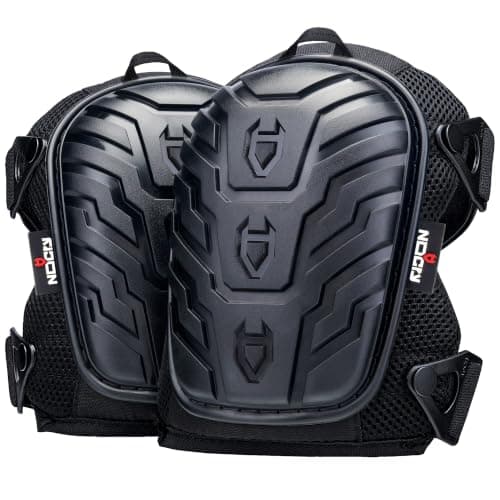
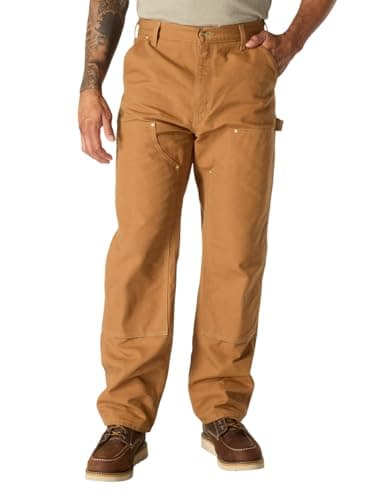
Plumbers kneel more than almost anyone, often on hard tile or concrete, often in a confined space where you cannot shift position. Occupational kneeling is consistently associated with higher rates of knee osteoarthritis, and no boot addresses it. Knee pads for construction covers the strap-on options, and the double-knee pants in our work pants hub take inserts that are more comfortable for intermittent kneeling.
What we would skip
Skip insulated boots - most plumbing is indoors, and insulation plus a membrane is a sweat problem. Skip suede and nubuck, which absorb water and sewage and never recover. Skip steel toes if you work around both water and electrical, since composite gives you the same protection without the conductive mass: see composite toe vs steel toe. And do not try to make one pair of boots cover both the sewer job and the kitchen remodel - that is what the second pair in the van is for.
Frequently asked
What boots should plumbers wear?
A waterproof, slip-resistant, non-marking safety boot as the daily pair - ideally with a flexible forefoot for crawlspace and under-sink work - plus a tall rubber pull-on kept in the van for genuinely wet jobs like sewer, septic and flooded basements.
Are waterproof boots enough for standing water?
No. A waterproof membrane stops rain and splash but offers nothing once water comes over the boot collar, and it then traps the water inside for days. Standing water needs a rubber boot tall enough to clear it.
What boots grip best on wet tile?
An outsole with fine siping - small channels cut across the contact surface that break the water film - rather than deep aggressive lugs. Lugs work by biting into soft ground and do little on glazed tile. Look for a stated slip-resistance rating, not just an "oil/slip resistant" marketing phrase.
Do plumbers need steel toe boots?
Commercial and new-build sites generally require an ASTM F2413 safety toe; residential service work often does not, though pipe and fixtures are heavy enough that many plumbers wear one anyway. Composite is usually the better choice in a trade that works around both water and live wiring.
Sources
Back to Work Boots, or see how we pick. Spotted something wrong? We publish corrections — see our editorial policy.