Best for welding
Best Work Boots for Welding
Molten spatter falls, rolls and finds gaps. Height and a smooth shaft matter more than the toe cap.
Welding is the one trade where the standard boot-buying logic is close to irrelevant. Cushioning, flex and lug patterns barely enter into it. What matters is whether molten metal at well over a thousand degrees can find a way into your boot, and the honest answer is that it will exploit any lace, gap or gusset you give it. So this list is organized around containment, which is why it is dominated by pull-ons.
Why laces are the problem
Spatter does not fall neatly. It bounces off the floor and the work, rolls across surfaces and lodges in anything textured. A laced boot presents a woven ladder of synthetic cord across the top of your foot, directly under where you are working, with gaps between the lace and the tongue for it to drop into. Burned-through laces are a routine welding complaint, and a lace that fails mid-shift is both an annoyance and a trip hazard.
A pull-on wellington removes the problem entirely: a smooth leather face with nothing to catch. If you must wear laced boots - because your site requires a spec only available laced, for instance - use leather laces rather than synthetic and cover the lace area with a leather spat. The shortlist of pull-on options is at pull-on work boots.
Quick picks
Ranked by our published scoring rubric. Tap any row for the full write-up.
| # | Product | Best for | Score | Price |
|---|---|---|---|---|
| 1 | 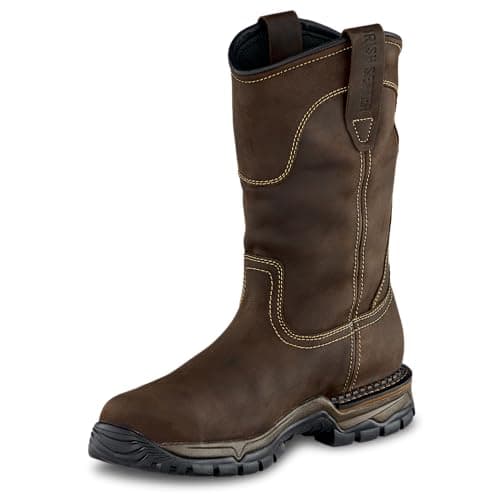 Irish Setter Two Harbors 11" Steel ToeEleven inches of leather and no laces - the classic answer, and still the right one. | Shop and structural welding | 8.6 | |
| 2 | 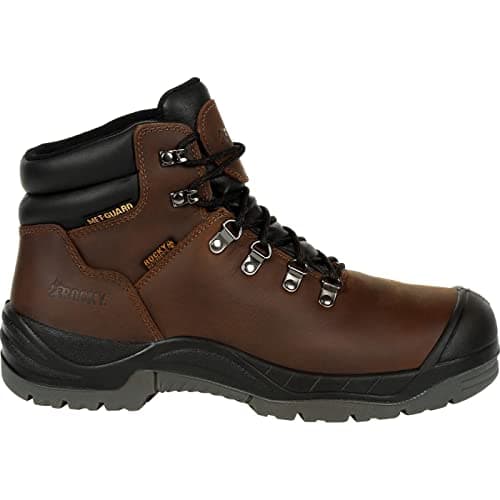 Rocky Worksmart Composite Toe Internal Met GuardThe only pick here with a real metatarsal guard, and it is internal rather than a bib. | Heavy plate and fabrication | 8.0 | |
| 3 | 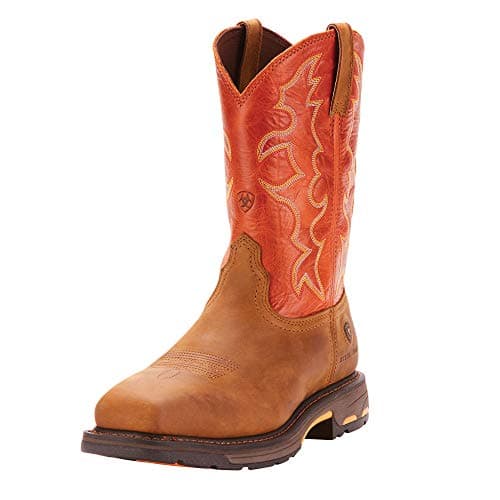 Ariat WorkHog Wide Square Toe Steel ToeA supportive pull-on for welders who are also walking uneven ground all day. | Pipeline and field welding | 8.2 | |
| 4 | 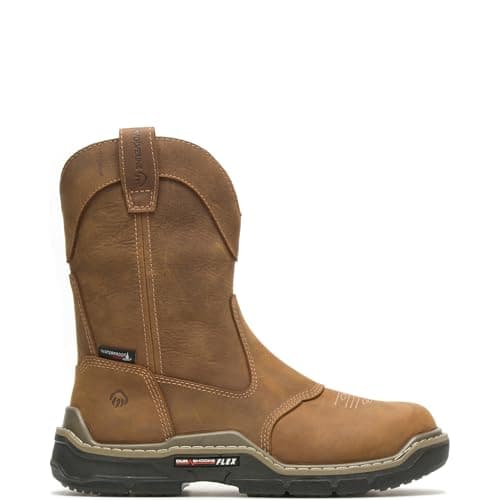 Wolverine Raider DuraShocks CarbonMax WellingtonPull-on spatter protection with a composite toe, for shops that require non-metallic. | A non-metallic pull-on | 8.3 |
#ad Prices pulled from Amazon and stamped as of October 6, 2026; they change, and we show no number we cannot verify. How we are funded.
Top pick · Shop and structural welding
Irish Setter Two Harbors 11" Steel Toe
Eleven inches of leather and no laces - the classic answer, and still the right one.
Welding footwear is a containment problem rather than an impact problem. Molten spatter falls, bounces and rolls, and it will find a lace, a tongue gusset or the top of a 6-inch boot. A tall pull-on shaft with a smooth outer face gives it nothing to lodge in and nothing to burn through.
Eleven inches covers the gap between boot and pant cuff that is where most welders actually get burned, and there are no laces to char and fail. It is hot and heavy - that is the honest cost of the protection, and it is why welders traditionally accept a heavier boot than other trades.
Specs that matter
- Toe:
- Steel toe, ASTM F2413
- Height:
- 11 inch pull-on
- Electrical hazard:
- EH rated
- Upper:
- Full-grain leather
Our scoring
- Spatter protection
- 9.5
- Shaft height
- 9.4
- Durability
- 8.8
- Comfort
- 6.8
- Value
- 7.8
What works
- 11 inches of leather is real protection against spatter and debris
- No laces to burn through when welding
- Red Wing-family leather quality
What to know
- Hot — that much leather does not breathe
- Heavy
- Hard to size when your calf is large or small
No. 2 · Heavy plate and fabrication
Rocky Worksmart Composite Toe Internal Met Guard
The only pick here with a real metatarsal guard, and it is internal rather than a bib.
If you handle heavy plate, pipe or structural steel as well as welding it, the hazard above your toe cap is a dropped section crushing your instep - and a toe cap does nothing for that. A metatarsal guard does, and ASTM rates it separately as Mt.
Most met-guard boots use an external bib that flops over the laces and is widely hated. This one puts the guard inside the boot, which is far less intrusive, and it is composite and waterproof as well. Pair it with a lace cover or pull-on spat if you need the lace area protected too.
Specs that matter
- Toe:
- Composite toe, ASTM F2413
- Met guard:
- Internal metatarsal guard, ASTM Mt rated
- Waterproof:
- Yes
- Height:
- 6 inch
Our scoring
- Spatter protection
- 7.6
- Shaft height
- 7.0
- Durability
- 8.6
- Comfort
- 7.4
- Value
- 8.8
What works
- Internal met guard is far less bulky than the external bib style
- Met protection at a price most met-guard boots do not touch
- Non-metallic toe and guard
What to know
- The guard stiffens the instep — expect pressure at first
- Heavier than a plain composite-toe boot
- Fit runs narrow through the midfoot
No. 3 · Pipeline and field welding
Ariat WorkHog Wide Square Toe Steel Toe
A supportive pull-on for welders who are also walking uneven ground all day.
Field welding is a different job from shop welding: you are walking rough ground, in and out of trenches and ditches, and the boot has to do two things at once. The WorkHog is a pull-on - so spatter has no lace to find - with a genuinely supportive shank for uneven terrain.
The heeled western sole is poor on flat shop concrete and good on broken ground, which is exactly the right way round for pipeline work. Steel toe and EH rated.
Specs that matter
- Toe:
- Steel toe, ASTM F2413
- Style:
- Pull-on, wide square toe
- Footbed:
- 4LR shank and footbed
- Electrical hazard:
- EH rated
Our scoring
- Spatter protection
- 8.6
- Shaft height
- 8.0
- Durability
- 9.0
- Comfort
- 7.6
- Value
- 7.0
What works
- Supportive shank genuinely helps on uneven ground and in stirrups
- Wide square toe gives the toes room a cowboy boot usually does not
- Durable enough for livestock and oilfield work
What to know
- Heeled western sole is poor on flat concrete
- Expensive
- Pull-on fit is unforgiving if your calf or instep is unusual
No. 4 · A non-metallic pull-on
Wolverine Raider DuraShocks CarbonMax Wellington
Pull-on spatter protection with a composite toe, for shops that require non-metallic.
#ad No buyable offer at the last price check. How we are funded
- Our score
- 8.3/10
Some fabrication shops specify non-metallic footwear, which rules out most traditional welding wellingtons. This one uses a CarbonMax composite toe in a 10-inch pull-on with cushioning aimed at standing on shop floors.
It is the most comfortable pull-on here for a static shop day. The usual pull-on caveat applies hard: you cannot tighten it, so the fit has to be right in the shop, and heel slip is common until the shaft softens.
Specs that matter
- Toe:
- CarbonMax composite toe, ASTM F2413
- Style:
- Pull-on wellington
- Cushioning:
- DuraShocks
- Height:
- 10 inch shaft
Our scoring
- Spatter protection
- 8.8
- Shaft height
- 8.4
- Durability
- 8.0
- Comfort
- 8.2
- Value
- 8.0
What works
- Nothing to lace, so it is on and off in seconds
- Non-metallic toe in a pull-on is hard to find
- Tall shaft keeps grain, mud and spatter out
What to know
- Pull-ons cannot be tightened, so fit must be right at purchase
- Less ankle support than a laced 8-inch boot
- Heel slip is common until the shaft softens
The metatarsal guard question
A toe cap protects your toes and nothing else. The long bones across the top of your foot - the metatarsals - are directly exposed, and if your work involves moving plate, pipe or structural sections by hand, that is the likelier injury. ASTM F2413 rates metatarsal protection separately with an Mt marking, and most welders who handle their own material should be looking for it: metatarsal guard boots and the ASTM guide cover it.
Internal guards are built into the boot and far more comfortable than the external bib style, which flops over the laces and is the main reason people abandon met-guard boots.
Comfort, within the constraints
Welders accept heavier, hotter boots than anyone else, and the way to make that liveable is inside the boot rather than outside it. Shop welding is largely standing still on concrete, which is a fatigue problem with a known fix: see insoles for concrete and the broader boots for standing on concrete page, whose reasoning applies directly here even though the boots differ.
What we would skip
Skip any boot with a nylon or mesh panel in the upper - it will melt and it will not protect you. Skip 6-inch boots for anything but the lightest tack work. Skip external bib met guards unless your site mandates them, because an internal guard protects the same bones and you will actually keep wearing it. And skip waterproof membranes: they add heat for no benefit in a shop, and in a fire-risk environment a membrane is another synthetic layer you do not need.
Frequently asked
What boots do welders wear?
Most welders prefer tall pull-on leather boots - typically 10 to 11 inches - with no laces, because molten spatter lodges in laces and burns through them. Where a laced boot is unavoidable, leather laces and a leather spat over the lace area are the usual workaround.
Do welders need metatarsal boots?
If you handle your own plate, pipe or structural steel, yes - a toe cap protects only your toes, while the metatarsal bones across the top of the foot are where a dropped section lands. ASTM F2413 marks metatarsal protection separately as Mt. Internal guards are much more comfortable than external bibs.
Can you wear synthetic socks for welding?
No. Synthetic fibers melt and adhere to skin, turning a burn that would otherwise be survivable into a serious injury. For welding and any hot work, wear wool or cotton socks, and avoid polyester-blend work pants for the same reason.
Are steel toe boots safe for welding?
Yes - a steel toe is fine for welding, and the toe cap is not where welders get hurt. The important features are shaft height, the absence of laces, and leather with no synthetic panels. Some fabrication shops specify non-metallic footwear, in which case a composite-toe pull-on is the answer.
Sources
Back to Work Boots, or see how we pick. Spotted something wrong? We publish corrections — see our editorial policy.