Best welding gloves
Best Welding Gloves
The stitching thread matters as much as the leather. Cotton thread burns through; Kevlar does not.
Welding gloves are chosen on different criteria from every other glove on this site, because the hazard is radiant and conducted heat plus molten metal rather than cuts or impact. Three things decide them: the process you are welding, the leather, and the thread holding the glove together. Dexterity is a distant fourth, and comfort barely registers - which is why most welders own two pairs and swap constantly.
Process decides thickness
| Process | Heat level | Glove type | Why |
|---|---|---|---|
| TIG | Low radiant heat, high precision | Thin goatskin or kidskin, short cuff | You are feeding filler by hand - feel is everything, and the heat load is low |
| MIG | Moderate, moderate spatter | Medium cowhide or pigskin, 14 inch | Balance of protection and workability |
| Stick / SMAW | High heat, heavy spatter | Heavy elkskin or cowhide, lined, 14 inch+ | Sustained radiant heat and spatter demand mass and insulation |
| Oxy-fuel cutting | Very high radiant heat | Heavy lined leather, long cuff | Continuous heat exposure rather than intermittent |
Using a stick glove for TIG is the most common mistake - you cannot feed filler accurately in it, so the work suffers. Using a TIG glove for stick is the dangerous version of the same error.
Quick picks
Ranked by our published scoring rubric. Tap any row for the full write-up.
| # | Product | Best for | Score | Price |
|---|---|---|---|---|
| 1 | 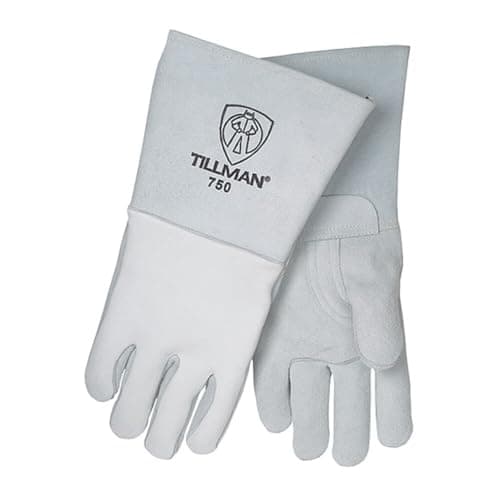 Tillman 14" Premium Elkskin Stick Welding GlovesElkskin resists hardening from heat cycling better than cowhide - the detail that matters most. | Stick welding and high heat | 8.4 | |
| 2 | 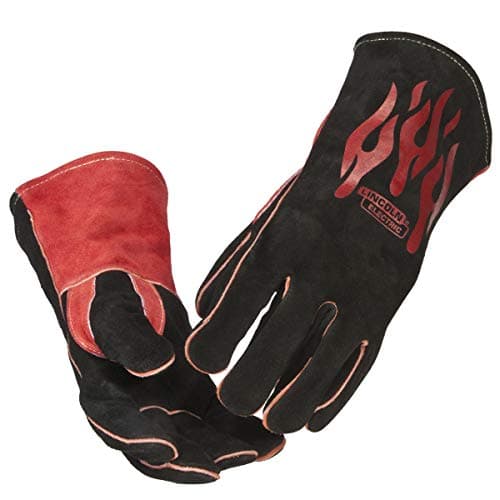 Lincoln Electric Traditional MIG/Stick Welding GlovesKevlar stitching and 14 inches of coverage at a sensible price. | MIG and general fabrication | 8.2 | |
| 3 | 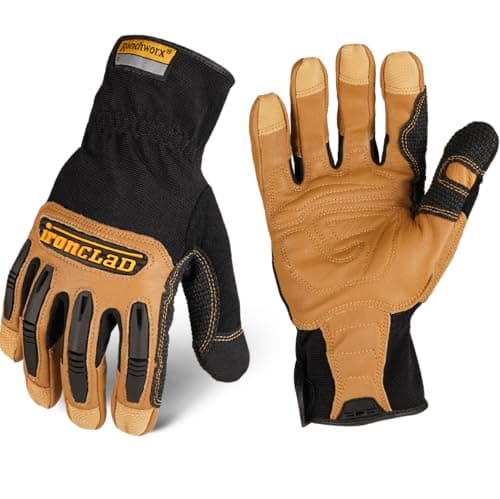 Ironclad Ranchworx Leather Work GlovesNot a welding glove - the dexterous leather glove for everything around the weld. | Grinding, fit-up and handling hot work | 7.4 |
#ad Prices pulled from Amazon and stamped as of October 6, 2026; they change, and we show no number we cannot verify. How we are funded.
Top pick · Stick welding and high heat
Tillman 14" Premium Elkskin Stick Welding Gloves
Elkskin resists hardening from heat cycling better than cowhide - the detail that matters most.
The failure mode of a heavy welding glove is not burning through, it is going hard. Repeated heat cycles drive the moisture and oils out of leather, and a cowhide glove that has been through a few hundred cycles becomes a stiff shell you cannot work in.
Elkskin holds up to that noticeably better and stays more pliable. The cotton-foam lining is also genuinely more comfortable than a plain lined glove, and the welted seams keep spatter out of the stitching. The most expensive glove here, and no dexterity to speak of.
Specs that matter
- Leather:
- Premium elkskin
- Length:
- 14 inch
- Lining:
- Cotton-foam lined
- Process:
- Stick welding, high heat
Our scoring
- Heat resistance
- 9.4
- Durability
- 9.0
- Comfort
- 8.0
- Dexterity
- 4.0
- Value
- 7.8
What works
- Elkskin resists hardening from repeated heat better than cowhide
- Foam lining is noticeably more comfortable than a plain lined glove
- Welted seams keep spatter out of the stitching
What to know
- Most expensive glove in this list
- No dexterity to speak of
- Overkill for MIG and wrong for TIG
No. 2 · MIG and general fabrication
Lincoln Electric Traditional MIG/Stick Welding Gloves
Kevlar stitching and 14 inches of coverage at a sensible price.
For MIG and general shop work, this covers the essentials properly: lined leather, 14 inches of length to protect the wrist and forearm, and - critically - Kevlar stitching. Cotton thread is what fails first on cheap welding gloves, and when the seams go the glove is finished regardless of how good the leather is.
Bulky and hot, with little hand feel. Too much glove for TIG, and the right amount for MIG and stick.
Specs that matter
- Length:
- 14 inch, covers the forearm
- Stitching:
- Kevlar thread
- Lining:
- Lined leather
- Process:
- MIG and stick
Our scoring
- Heat resistance
- 8.6
- Durability
- 8.4
- Comfort
- 7.4
- Dexterity
- 4.5
- Value
- 8.8
What works
- Kevlar stitching survives heat that destroys cotton-stitched gloves
- 14 inches protects the wrist and forearm from spatter
- Lined, so radiant heat takes longer to come through
What to know
- Far too bulky for TIG or any fine work
- Hot in summer
- Stiff, with little hand feel
No. 3 · Grinding, fit-up and handling hot work
Ironclad Ranchworx Leather Work Gloves
Not a welding glove - the dexterous leather glove for everything around the weld.
An honest inclusion with a clear caveat: this is not a welding glove and should not be used for welding. It is here because a great deal of fabrication is not welding - it is grinding, fit-up, clamping, moving material, and handling work that is still warm.
Reinforced leather with far more dexterity than any welding glove, which is what you want for those tasks. Keep it as the second pair alongside a proper welding glove.
Specs that matter
- Palm:
- Reinforced leather with double stitching
- Protection:
- Padded knuckle and impact zones
- Cut rating:
- None published
- Care:
- Machine washable
Our scoring
- Heat resistance
- 5.0
- Durability
- 9.2
- Comfort
- 7.4
- Dexterity
- 7.0
- Value
- 8.2
What works
- Survives barbed wire and sharp sheet stock that destroy nitrile gloves
- Reinforced fingertips are where cheap gloves blow out first
- Washable, unusually for a leather glove
What to know
- Bulky — poor for fine work
- Stiff until broken in
- No published cut rating despite the heft
Why the thread is the thing to check
Here is the detail that separates a glove that lasts a year from one that lasts a month. The leather can be excellent and the glove still fails at the seams, because the thread is exposed on the surface and takes the heat and spatter directly. Cotton thread chars and breaks; once a seam opens, the glove is done.
Kevlar (aramid) thread does not burn through at welding temperatures, which is why every decent welding glove specifies it. It is a cheap component and a reliable quality signal: a glove that does not mention its thread is usually sewn with cotton. Look also for welted seams, where the seam is protected by a strip of leather so spatter cannot lodge directly in the stitching.
What goes under and around the glove
The same melting rule that applies to socks and pants applies here. Do not wear synthetic glove liners under welding gloves - synthetic fibers melt and adhere to skin, converting a survivable burn into a serious one. Cotton or wool liners only. The identical logic is why boots for welding warns against synthetic socks and polyester work pants.
And do not wash welding gloves. Water removes the oils that keep the leather pliable and accelerates exactly the hardening that kills them. When a welding glove is finished, it is finished.
What we would skip
Skip any welding glove that does not state Kevlar or aramid stitching. Skip gloves with synthetic shell panels or synthetic liners. Skip short cuffs for overhead work, where spatter runs down your arm. Skip using a welding glove for grinding and fit-up, which is what wears them out for no benefit - keep a dexterous leather pair for that. And skip washing them, ever.
Frequently asked
What gloves are best for welding?
It depends on the process. Thin goatskin for TIG, where feel matters and heat is low; medium cowhide at 14 inches for MIG; heavy lined elkskin or cowhide for stick welding and oxy-fuel cutting. In all cases insist on Kevlar stitching rather than cotton.
Why do my welding gloves get stiff?
Heat cycling drives the moisture and oils out of the leather, which hardens it. Elkskin resists this better than cowhide. Washing them accelerates it badly, which is why welding gloves should never be washed - when they go hard, they are finished.
Are Kevlar-stitched welding gloves worth it?
Yes, and it is not really optional. The thread sits on the surface and takes spatter and heat directly; cotton thread chars and the seams open long before the leather fails. Kevlar is a cheap component and a reliable indicator of a properly made glove.
Can I wear glove liners under welding gloves?
Cotton or wool liners, yes. Never synthetic - synthetic fibers melt and adhere to skin, which turns a burn that would have been survivable into a serious injury. The same rule applies to socks and work pants for any hot work.
Sources
Back to Work Gloves, or see how we pick. Spotted something wrong? We publish corrections — see our editorial policy.