Best for farming
Best Work Boots for Farmers & Ranchers
Mud, manure, livestock and machinery. Plus the one requirement nobody writes down: they have to come off easily.
Farm footwear is chosen on criteria that would look strange to someone buying boots for a construction site. Chemical resistance to manure and milk-house wash. Whether they can be kicked off at the back door without using your hands. Whether the calf fits. Whether they can be hosed down. Those are the deciding factors, and they are why pull-ons and rubber boots dominate a trade that also has genuine machinery hazards.
Why pull-ons own this category
Three reasons, all of them practical rather than theoretical. Laces collect seeds, chaff, hay and manure and become unpleasant to handle. You go in and out of the house repeatedly during a day, and unlacing each time is not going to happen - so laced boots either get worn into the house or kicked off still laced, which wrecks them. And around augers, PTO shafts and belt drives, a dangling lace is an entanglement hazard in a way that is well documented in agricultural safety data.
The cost of a pull-on is fit: you cannot adjust it, so a boot that is slightly loose stays loose, and heel slip is common until the shaft softens. Buy with your work socks on and expect to size carefully. Pull-on work boots covers the category.
Quick picks
Ranked by our published scoring rubric. Tap any row for the full write-up.
| # | Product | Best for | Score | Price |
|---|---|---|---|---|
| 1 | 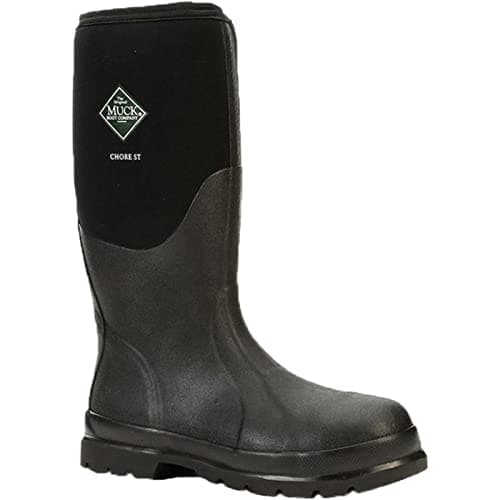 Muck Boot Chore Classic Tall Steel ToeHoses clean, cannot wet out, steel toe. The default farm boot for a reason. | Livestock, barns and daily chores | 8.8 | |
| 2 | 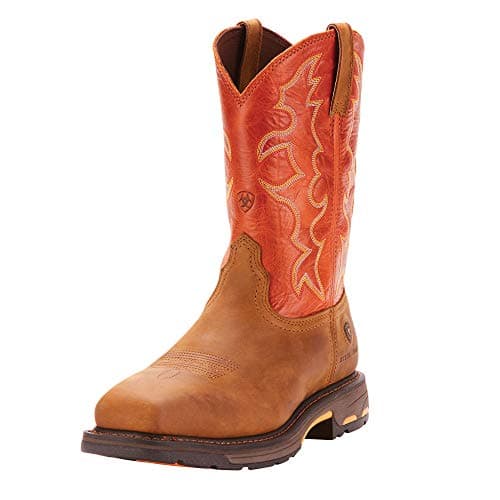 Ariat WorkHog Wide Square Toe Steel ToeA supportive pull-on that works in a stirrup and walks rough ground all day. | Riding, fencing and all-day ranch work | 7.8 | |
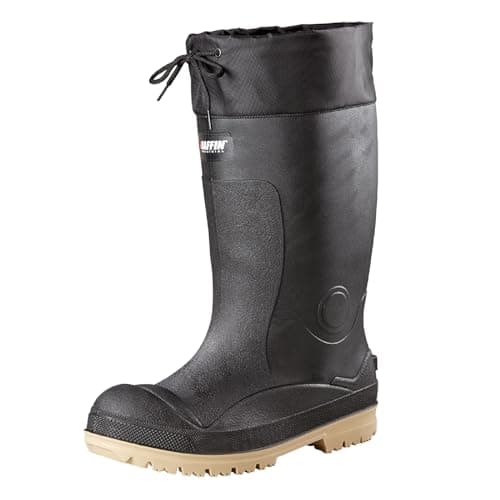
| 3 | 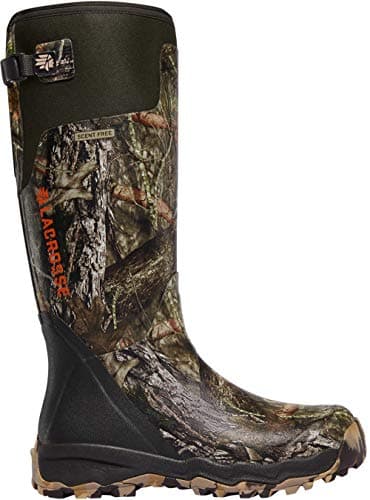 LaCrosse Alphaburly Pro 18" Rubber BootEighteen inches with an adjustable calf - the boot for spring, when everything is saturated. | Deep mud and flooded ground | 8.2 | |
| 4 | 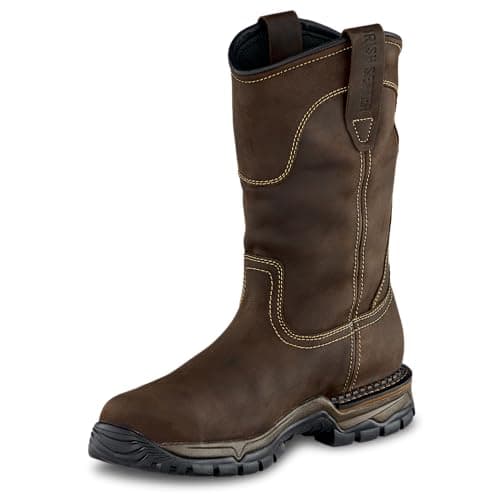 Irish Setter Two Harbors 11" Steel ToeAn 11-inch leather pull-on for the dry half of the operation. | Grain, equipment and shop work | 7.7 |
#ad Prices pulled from Amazon and stamped as of October 6, 2026; they change, and we show no number we cannot verify. How we are funded.
Top pick · Livestock, barns and daily chores
Muck Boot Chore Classic Tall Steel Toe
Hoses clean, cannot wet out, steel toe. The default farm boot for a reason.
Farm work puts boots in contact with things leather simply cannot survive - manure, urine, silage, milk-house chemicals, wash-down water. All of those are either chemically aggressive or permanently absorbed, and a leather boot in a dairy or livestock operation is a short-lived boot that smells.
A rubber-over-neoprene pull-on solves it outright: nothing absorbs, it rinses clean with a hose, and the neoprene lining insulates for winter chores. Steel toe handles the real hazard, which is being stood on by something that weighs half a ton.
Specs that matter
- Toe:
- Steel toe, ASTM F2413
- Material:
- Rubber over neoprene
- Waterproof:
- Fully waterproof, not just resistant
- Height:
- Tall shaft
Our scoring
- Chemical resistance
- 9.6
- Waterproofing
- 9.8
- Easy on/off
- 9.2
- Walking comfort
- 6.4
- Value
- 8.8
What works
- Genuinely waterproof in a way no membrane boot matches
- Neoprene lining insulates and flexes
- Rinses clean with a hose
What to know
- No breathability — feet sweat, so socks matter more than usual
- Rubber outsole wears fast on abrasive concrete
- Little arch support in the stock build
No. 2 · Riding, fencing and all-day ranch work
Ariat WorkHog Wide Square Toe Steel Toe
A supportive pull-on that works in a stirrup and walks rough ground all day.
Ranch work is different from barn work: you are walking uneven pasture, fencing, loading stock, and possibly in a saddle. That calls for a boot with real shank support and a heel that sits properly in a stirrup, which a rubber chore boot does not have.
The WorkHog is the standard answer, with a wide square toe that gives your toes far more room than a traditional cowboy boot. Steel toe and EH rated. The heeled western sole is poor on flat concrete, which is the right trade for pasture work.
Specs that matter
- Toe:
- Steel toe, ASTM F2413
- Style:
- Pull-on, wide square toe
- Footbed:
- 4LR shank and footbed
- Electrical hazard:
- EH rated
Our scoring
- Chemical resistance
- 6.4
- Waterproofing
- 6.8
- Easy on/off
- 8.8
- Walking comfort
- 8.4
- Value
- 7.2
What works
- Supportive shank genuinely helps on uneven ground and in stirrups
- Wide square toe gives the toes room a cowboy boot usually does not
- Durable enough for livestock and oilfield work
What to know
- Heeled western sole is poor on flat concrete
- Expensive
- Pull-on fit is unforgiving if your calf or instep is unusual
No. 3 · Deep mud and flooded ground
LaCrosse Alphaburly Pro 18" Rubber Boot
Eighteen inches with an adjustable calf - the boot for spring, when everything is saturated.
Every farm has a season where the ground is simply liquid. An 18-inch rubber boot clears water a standard chore boot does not, and the adjustable rear gusset is the feature that makes it wearable - most tall rubber boots either swim on a slim calf or will not close over a broad one.
Insulated versions handle genuine cold well. Soft toe on this model, so it is the wet-ground pair rather than the machinery pair, and it is hot for walking distances.
Specs that matter
- Toe:
- Soft toe (this model)
- Height:
- 18 inch
- Waterproof:
- Fully waterproof rubber
- Fit:
- Adjustable rear gusset
Our scoring
- Chemical resistance
- 9.2
- Waterproofing
- 9.8
- Easy on/off
- 8.4
- Walking comfort
- 6.0
- Value
- 7.8
What works
- Adjustable gusset solves the calf-fit problem that ruins most rubber boots
- 18 inches clears deeper water than a standard wellington
- Insulated versions handle genuine cold
What to know
- No safety toe on this model
- Heavy and hot for walking distances
- Expensive for a rubber boot
No. 4 · Grain, equipment and shop work
Irish Setter Two Harbors 11" Steel Toe
An 11-inch leather pull-on for the dry half of the operation.
Not all farm work is wet. Grain handling, equipment maintenance, shop work and hauling are dry, dusty jobs where a rubber boot is overkill and uncomfortable, and where you want leather's support and breathability.
An 11-inch steel-toe pull-on covers it: tall enough to keep grain and chaff out, no laces to pick seeds and debris out of, EH rated for working on equipment wiring, with proper full-grain leather. Hot and heavy, which is the cost of the height.
Specs that matter
- Toe:
- Steel toe, ASTM F2413
- Height:
- 11 inch pull-on
- Electrical hazard:
- EH rated
- Upper:
- Full-grain leather
Our scoring
- Chemical resistance
- 6.0
- Waterproofing
- 7.0
- Easy on/off
- 9.0
- Walking comfort
- 7.4
- Value
- 7.8
What works
- 11 inches of leather is real protection against spatter and debris
- No laces to burn through when welding
- Red Wing-family leather quality
What to know
- Hot — that much leather does not breathe
- Heavy
- Hard to size when your calf is large or small
Chemical exposure is the thing that kills farm boots
Leather is a protein structure, and manure and urine are both chemically and biologically aggressive toward it. Repeated exposure breaks down the fiber and the stitching, and no amount of conditioning fully reverses it - which is why a good leather boot can last years on a construction site and months in a dairy barn. If a significant part of your day is in livestock housing, rubber is not a compromise, it is the correct material.
Rubber's cost is breathability: there is none, so your feet sweat, and the sock becomes the whole moisture-management system. Merino or a synthetic blend, changed daily, is the difference between comfortable and miserable - see best work socks. A rubber boot also has minimal arch support as standard, which an insole fixes cheaply.
Machinery hazards deserve a safety toe
Agriculture has one of the highest occupational fatality rates of any US industry, and foot injuries from livestock, dropped implements and machinery are common. A safety toe is justified here even though farm boots are often sold without one - a horse or cow standing on an unprotected foot is a reliable fracture. If you handle heavy implements and attachments by hand, read metatarsal guard boots, since the top of the foot is exposed otherwise.
What we would skip
Skip laced boots for livestock and bin work specifically - the entanglement and contamination arguments are both real. Skip suede and nubuck entirely. Skip insulated rubber boots as your only pair, because they are unbearable in summer. And skip the idea that a traditional cowboy boot is adequate for machinery work: a narrow soft toe offers nothing against a dropped implement, and work boots vs cowboy boots goes through the trade honestly.
Frequently asked
What boots are best for farm work?
Most farms need two pairs: a steel-toe rubber pull-on for livestock, barn and wet work, because rubber resists manure and hoses clean, and a leather pull-on for dry work, equipment maintenance and grain handling where leather's support and breathability are better.
Why do farmers wear pull-on boots?
Laces collect chaff, seed and manure, you take boots off at the house door repeatedly each day, and around augers, PTO shafts and belt drives a dangling lace is a genuine entanglement hazard. Pull-ons solve all three. The trade-off is that you cannot adjust the fit.
Do farmers need steel toe boots?
The hazards strongly justify it. Livestock standing on a foot, dropped implements and machinery contact are all common causes of agricultural foot injuries, and agriculture has one of the highest occupational injury rates of any industry. Many farm boots are sold soft-toe, so check the spec.
How do you keep rubber farm boots from making your feet sweat?
Rubber does not breathe, so the sock does all the moisture management. Use merino or a synthetic blend - never cotton - change them daily, pull the insoles out to dry overnight, and alternate two pairs of boots in wet seasons so each gets a full day to dry.
Sources
Back to Work Boots, or see how we pick. Spotted something wrong? We publish corrections — see our editorial policy.