Best for construction
Best Work Pants for Construction
Sites destroy pants at the knees and the seat. Buy for those two places and the rest follows.
Construction is harder on pants than on any other garment in the kit. The failure points are predictable - knees, seat, pocket corners, crotch seam - and every one of them is a reinforcement question rather than a fabric-technology question. Which makes buying for a site simpler than buying for most trades: find out where the pant is reinforced, and ignore the rest of the marketing.
Where pants actually fail
- Knees. The first failure in any kneeling trade, and the reason double fronts exist. If you kneel, this is the only feature that matters.
- Seat and crotch seam. From squatting and climbing. A gusseted crotch or a reinforced seam here is worth looking for and rarely advertised.
- Pocket corners. Where a tape measure or a utility knife sits. Reinforced or riveted corners last considerably longer.
- Hems. Dragged under boot heels. Once a hem frays it unravels fast, and a longer inseam than you need accelerates it.
Quick picks
Ranked by our published scoring rubric. Tap any row for the full write-up.
| # | Product | Best for | Score | Price |
|---|---|---|---|---|
| 1 | 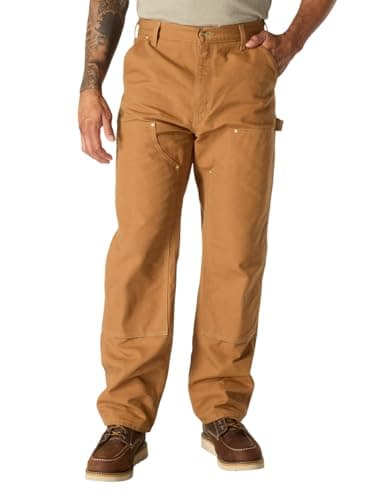 Carhartt Iconic B01 Firm Duck Double-Front DungareeTwelve-ounce duck with a double front. Nothing here lasts longer. | The most abrasive site work | 8.5 | |
| 2 | 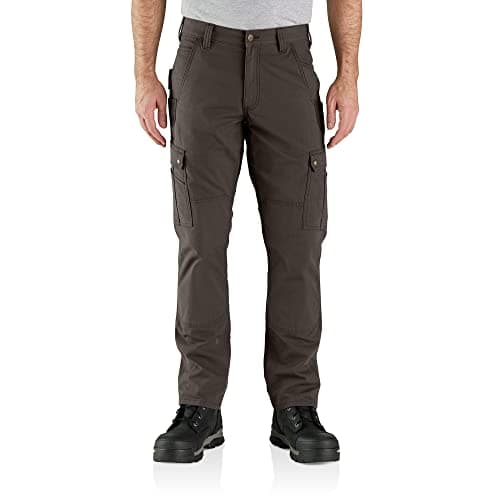 Carhartt Rugged Flex Ripstop Double-Front CargoDouble front, stretch and cargo pockets - the best all-round site pant. | Double knee without the stiffness | 8.6 | |
| 3 | 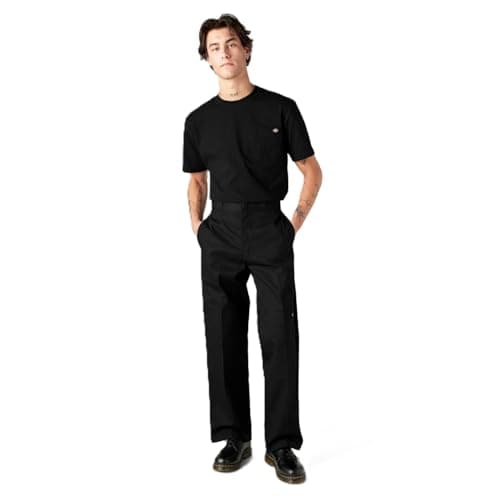 Dickies Loose Fit Double Knee Work PantThe cheap route into kneeling-trade durability. | Double knee on a budget | 8.0 | |
| 4 | 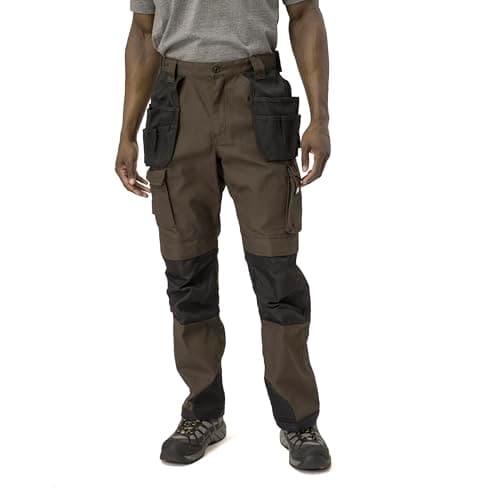 Caterpillar Trademark Work PantTriple-stitched where seams usually fail, at a mid-market price. | Reinforced seams and cargo capacity | 7.4 |
#ad Prices pulled from Amazon and stamped as of October 6, 2026; they change, and we show no number we cannot verify. How we are funded.
Top pick · The most abrasive site work
Carhartt Iconic B01 Firm Duck Double-Front Dungaree
Twelve-ounce duck with a double front. Nothing here lasts longer.
On a site where you drag material, kneel on broken concrete and brush past rebar all day, abrasion resistance is the only property that matters for lifespan, and heavy cotton duck is simply better at it than any stretch fabric. The double front means the knees - normally the first failure - outlast the rest.
Stiff and genuinely uncomfortable for a few weeks, restrictive when you climb, and hot in summer. Those are real costs; it is also the pant most likely to still be in service in three years.
Specs that matter
- Fabric:
- 12 oz firm-hand cotton duck
- Knees:
- Double front, knee-pad compatible
- Fit:
- Loose original fit
- Stretch:
- None
Our scoring
- Abrasion resistance
- 9.6
- Knee protection
- 9.0
- Mobility
- 5.5
- Breathability
- 5.5
- Value
- 8.8
What works
- Double front takes knee pads and survives kneeling trades
- 12 oz duck outlasts every stretch fabric on this list
- Softens into the best-fitting pant you own after a few months
What to know
- Genuinely stiff and uncomfortable for the first weeks
- No stretch at all — restrictive for climbing
- Heavy and hot in summer
No. 2 · Double knee without the stiffness
Carhartt Rugged Flex Ripstop Double-Front Cargo
Double front, stretch and cargo pockets - the best all-round site pant.
The practical choice for most people on a site, because it refuses the usual trade-off: a double front with a knee-pad pocket plus stretch ripstop, so you get the kneeling protection and can still climb a ladder without fighting your trousers.
Ripstop will not match firm duck on pure abrasion, and it costs more. Noticeably cooler than duck, which matters from May onward.
Specs that matter
- Fabric:
- Rugged Flex stretch ripstop
- Knees:
- Double front, knee-pad compatible
- Pockets:
- Cargo and utility
- Fit:
- Relaxed straight
Our scoring
- Abrasion resistance
- 8.2
- Knee protection
- 9.0
- Mobility
- 8.8
- Breathability
- 7.6
- Value
- 8.0
What works
- Double front and stretch together, which few pants manage
- Ripstop is noticeably cooler than 12 oz duck
- Cargo pockets sit flat enough not to snag
What to know
- Ripstop will not outlast firm duck
- Priciest pant here
- Stretch content means careful washing
Best value · Double knee on a budget
Dickies Loose Fit Double Knee Work Pant
The cheap route into kneeling-trade durability.
A double-knee duck pant at roughly half the price of the premium options, in a loose fit with genuine room for knee pads underneath. Honest cotton duck with no polyester, which also makes it safer than a twill around hot work.
Lighter duck than Carhartt's, so it wears out sooner, and no stretch at all. The loose fit catches on scaffolding - a real consideration if you climb.
Specs that matter
- Fabric:
- Cotton duck
- Knees:
- Double knee
- Fit:
- Loose, roomy seat and thigh
- Pockets:
- Tool and utility pockets
Our scoring
- Abrasion resistance
- 7.4
- Knee protection
- 8.6
- Mobility
- 6.4
- Breathability
- 6.6
- Value
- 9.4
What works
- Double knee for a fraction of the Carhartt price
- Loose fit leaves room for knee pads underneath
- Honest cotton duck, no polyester
What to know
- Lighter duck than Carhartt's — it wears out sooner
- No stretch
- Loose fit catches on scaffolding
No. 4 · Reinforced seams and cargo capacity
Caterpillar Trademark Work Pant
Triple-stitched where seams usually fail, at a mid-market price.
Pants rarely fail in the middle of a panel; they fail at the seams, the pocket corners and the crotch. Triple stitching at those stress points addresses the actual failure mode, and the canvas weight sits usefully between a twill and a heavy duck.
No stretch and no double knee, so this is for site work that is not kneeling-heavy. Sizing runs large.
Specs that matter
- Fabric:
- Heavy canvas
- Reinforcement:
- Triple-stitched stress points
- Pockets:
- Cargo plus utility
- Fit:
- Relaxed straight
Our scoring
- Abrasion resistance
- 8.0
- Knee protection
- 5.0
- Mobility
- 6.8
- Breathability
- 6.8
- Value
- 8.4
What works
- Triple stitching at the seams that normally go first
- Canvas weight sits between twill and duck — a usable compromise
- Good cargo capacity without looking tactical
What to know
- No stretch
- No double knee
- Sizing runs large
Duck or ripstop, in one paragraph
Cotton duck is a tight plain weave, usually 10 to 12 ounces, and nothing resists abrasion better - but it is stiff, hot, and takes months to soften. Ripstop is lighter, with a reinforcing grid woven in that stops a small tear from running across the panel; it is cooler and more mobile and will not match duck on pure abrasion. Choose duck if your site is abrasive and your work is not acrobatic; choose ripstop if you climb a lot or work in heat. Work pants for men has the full fabric table.
The knee-pad question
A double front with an internal pad pocket is comfortable, cannot rotate, and is enough for a day of intermittent kneeling. It is not enough for a trade where you kneel for hours - the inserts are thin, and for that you want proper strap-on pads over the top. Those are a surface-specific purchase, which is what knee pads for construction and knee pads for flooring are about.
If you are going to wear pads over your pants, buy the pants loose enough to accommodate them - a slim-fit pant with pads over it is uncomfortable in a way people rarely anticipate.
Pockets, and when they become a hazard
Cargo pockets are genuinely useful if you carry fasteners, a multimeter or small tools. They are genuinely a liability if you climb scaffolding or work near rotating machinery, because a loaded pocket swings and catches, and loose clothing around rotating equipment is a well-documented entanglement hazard. If your site involves either, a slimmer pant is the safer pant - the same reasoning applies to the pull-on versus laced decision in boots for farming.
What we would skip
Skip poly-cotton twill uniform pants on a construction site: they tear on snags, offer no reinforcement, and melt near hot work. Skip double knees if you genuinely do not kneel - that weight and heat buys you nothing. Skip hot washing and tumble drying anything with elastane in it. And skip buying a longer inseam than you need, which frays under your boot heels. The matching footwear shortlist is boots for construction.
Frequently asked
What pants do construction workers wear?
Mostly cotton duck or ripstop canvas work pants, very often with a double front or double knee. Heavy 12 oz duck lasts longest on abrasive sites; stretch ripstop with a double front is the better all-round choice if you climb and kneel in the same day.
Are double knee work pants worth it?
If you kneel regularly, yes - the knees are the first thing to fail on any work pant, and a double front roughly doubles the life. If you rarely kneel, you are carrying extra weight and heat for no benefit, and a single-front stretch pant will be more comfortable.
What is the most durable work pant fabric?
Heavy cotton duck, typically 10 to 12 ounces, resists abrasion better than any other common workwear fabric. Ripstop is more mobile and cooler but less abrasion resistant, and anything with elastane in it has a shorter useful life because the elastane degrades.
Can you wear knee pads with double knee pants?
Yes, and for a kneeling trade you probably should - the foam inserts that fit a double-front pocket are thinner than a strap-on pad and are a comfort measure rather than full protection. Buy the pants loose enough to accommodate pads over the top.
Sources
Back to Work Pants, or see how we pick. Spotted something wrong? We publish corrections — see our editorial policy.