Thorogood vs Ariat
Thorogood vs Ariat Work Boots
Flat concrete or broken ground? That single question answers this comparison.
These two brands rarely compete head to head because they come from different traditions - Thorogood from the industrial and union trades, Ariat from the equestrian and western world - but they overlap in agriculture, oilfield and anywhere a trade spans both worlds. The comparison turns out to be almost entirely about sole geometry, and that makes it unusually easy to answer.
Sole geometry decides it
A flat wedge contacts the ground across its entire area. On a hard flat surface that means lower peak pressure, better load spreading and no heel to catch - which is why wedge boots dominate indoor and flat-site work, and why they are the recommendation on boots for standing on concrete.
A heeled western sole does the opposite: it concentrates load on the heel and forefoot, which is uncomfortable on concrete, and it gives you a heel breast that catches a stirrup, a ladder rung or the edge of a rut. On loose and uneven ground that is a genuine advantage. Wedge sole vs heel is the full treatment.
Head to head
Ranked by our published scoring rubric. Tap any row for the full write-up.
| # | Product | Best for | Score | Price |
|---|---|---|---|---|
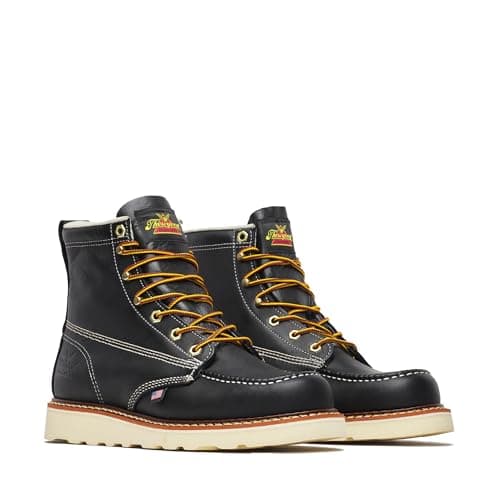
| 1 | 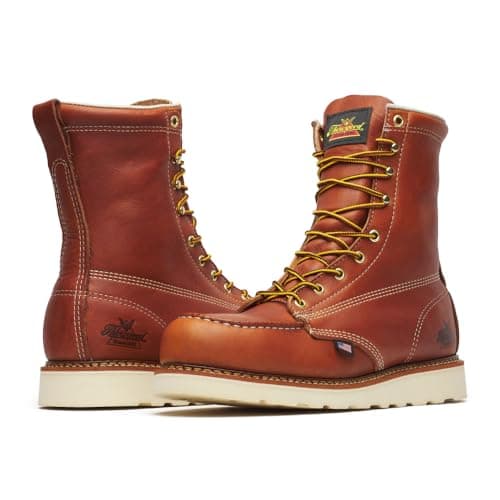 Thorogood American Heritage 8" Steel ToeWinner on flat ground: a load-spreading wedge on a resoleable welt. | Flat sites, shop floors and concrete | 8.4 | |
| 2 | 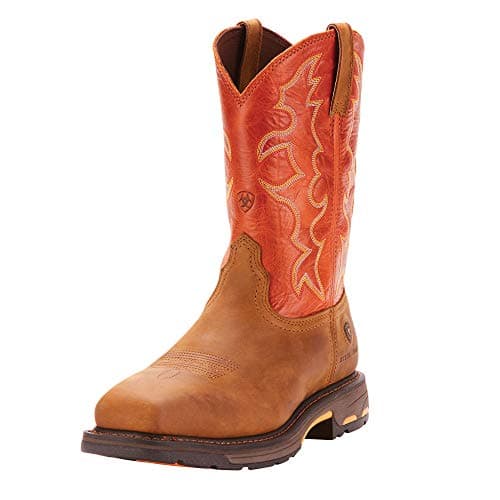 Ariat WorkHog Wide Square Toe Steel ToeWinner on broken ground: a real shank, a heel, and nothing to lace. | Uneven ground, ranch and oilfield | 8.0 | |
| 3 | 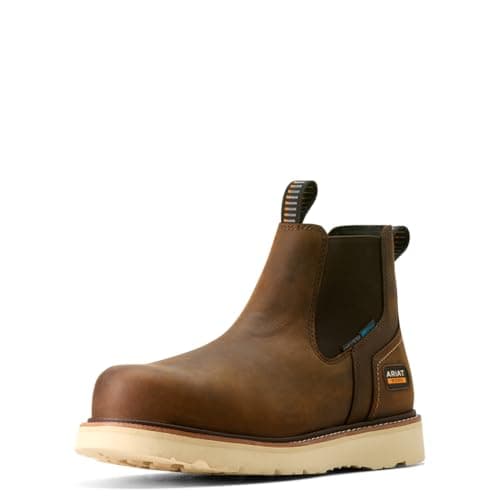 Ariat Rebar Wedge Chelsea Waterproof Composite ToeThe hybrid: Ariat's pull-on ease with a wedge sole and a composite toe. | Pull-on convenience on a flat sole | 7.8 |
#ad Prices pulled from Amazon and stamped as of October 6, 2026; they change, and we show no number we cannot verify. How we are funded.
Winner on flat ground · Flat sites, shop floors and concrete
Thorogood American Heritage 8" Steel Toe
Winner on flat ground: a load-spreading wedge on a resoleable welt.
On a flat surface the wedge sole spreads your weight across the whole footprint, which lowers the peak pressure under your heel and forefoot - the two places that hurt after nine hours. That is the entire reason wedge boots dominate shop, warehouse and flat-site work.
Add a steel toe and a resoleable storm welt and it is the better boot for most industrial settings. On rutted pasture or a lease road it is the wrong tool - no shank support and a sole that slides on loose ground.
Specs that matter
- Toe:
- Steel toe, ASTM F2413 rated
- Height:
- 8 inch
- Sole:
- MAXwear wedge
- Build:
- Goodyear storm welt
Our scoring
- Flat-ground comfort
- 9.2
- Rough-ground support
- 6.0
- Resoleability
- 9.4
- On/off speed
- 5.5
- Value
- 8.6
What works
- Safety toe plus resoleable welt construction in one boot
- Taller shaft keeps debris out on demolition and dirt work
- Full-grain leather that takes conditioner and keeps going
What to know
- Steel conducts cold in winter — composite is warmer
- 8 inch shaft takes longer to break in across the ankle
- Heavier than the composite-toe competition
Winner on rough ground · Uneven ground, ranch and oilfield
Ariat WorkHog Wide Square Toe Steel Toe
Winner on broken ground: a real shank, a heel, and nothing to lace.
On rutted pasture, lease roads and uneven fill, the Ariat's 4LR shank is doing structural work that a wedge boot simply does not - it holds the foot's shape over uneven terrain instead of letting it deform. The heeled western sole bites into soft ground and sits properly in a stirrup.
Pull-on convenience matters in agriculture and oilfield for practical reasons covered at pull-on work boots. On flat concrete the heel concentrates load and it is noticeably less comfortable, and it is expensive.
Specs that matter
- Toe:
- Steel toe, ASTM F2413
- Style:
- Pull-on, wide square toe
- Footbed:
- 4LR shank and footbed
- Electrical hazard:
- EH rated
Our scoring
- Flat-ground comfort
- 6.4
- Rough-ground support
- 9.2
- Resoleability
- 5.0
- On/off speed
- 8.8
- Value
- 7.2
What works
- Supportive shank genuinely helps on uneven ground and in stirrups
- Wide square toe gives the toes room a cowboy boot usually does not
- Durable enough for livestock and oilfield work
What to know
- Heeled western sole is poor on flat concrete
- Expensive
- Pull-on fit is unforgiving if your calf or instep is unusual
No. 3 · Pull-on convenience on a flat sole
Ariat Rebar Wedge Chelsea Waterproof Composite Toe
The hybrid: Ariat's pull-on ease with a wedge sole and a composite toe.
If you want the pull-on convenience without the heeled sole's penalty on concrete, this is the compromise - an elastic-gore Chelsea on a flat wedge, waterproof, with a non-metallic toe.
It is the fastest boot here to get on and off. The low shaft lets debris in over the top, the elastic gores are the first component to fail, and the wedge still slides on wet rungs.
Specs that matter
- Toe:
- Composite toe, ASTM F2413
- Style:
- Chelsea pull-on
- Waterproof:
- Yes
- Sole:
- Flat wedge
Our scoring
- Flat-ground comfort
- 8.4
- Rough-ground support
- 6.4
- Resoleability
- 3.0
- On/off speed
- 9.5
- Value
- 7.8
What works
- Wedge plus pull-on is a genuinely rare and useful combination
- Elastic gores make it the fastest boot here to get on
- Non-metallic toe and waterproof
What to know
- Low shaft means debris can get in over the top
- Elastic gores are the first thing to fail
- Wedge sole slips on wet rungs
The shank, which is the other real difference
The shank is a stiffening element in the midfoot, and Ariat's western work boots have a substantial one. On uneven ground it holds the boot's shape so your foot is not conforming to every rut and rock - which is both less tiring and more stable. On flat concrete there is nothing for it to resist, so it contributes little.
The same logic explains why boots for linemen prioritize shank stiffness: load concentrated across the midfoot needs structure, not cushioning.
Lacing versus pull-on
A secondary but practical difference. Laced boots let you tune the fit across the instep and give better ankle control. Pull-ons go on and off in seconds, have nothing to collect grain, mud or spatter, and remove a lace that could catch in machinery - which is why they dominate farm work and welding.
The cost is that a pull-on cannot be adjusted, so fit has to be right at purchase. Instep snugness is what holds a pull-on on, and heel slip that does not settle within a couple of weeks never will.
The verdict, plainly
Flat ground - shop, warehouse, slab, finished floors: Thorogood. The wedge and the resoleable welt both favor it. Uneven ground - ranch, pasture, lease roads, stirrups: Ariat. The shank and the heel are doing real work there. Both kinds of day: the Ariat Rebar Wedge is the honest hybrid, or own two pairs. See also Ariat vs Wolverine for the western-industrial question.
Frequently asked
Are Ariat or Thorogood work boots better?
It depends on the ground. Thorogood's flat wedge sole is better on concrete and flat sites, and it is resoleable. Ariat's shank and heeled western sole are better on uneven ground and in stirrups. Neither is better in the abstract.
Are Ariat work boots good for concrete floors?
Less so than a flat wedge boot. A heeled western sole concentrates load on the heel and forefoot rather than spreading it across the footprint, which is exactly what makes standing on a slab uncomfortable. The Rebar Wedge line is Ariat's flat-soled answer to that.
Can Ariat boots be resoled?
Most Ariat work boots use cemented or welt-free constructions and are not practically resoleable. Thorogood's Goodyear storm welt is stitched, so a cobbler can replace the outsole - which is a significant long-run cost difference if you wear boots full time.
What is a shank in a work boot and does it matter?
A stiffening element in the midfoot that holds the boot's shape. On uneven ground it stops your foot deforming over every rut, which is less tiring and more stable. On flat concrete it contributes little, which is why flat-site boots often have minimal shanks.
Sources
Back to Comparisons, or see how we pick. Spotted something wrong? We publish corrections — see our editorial policy.