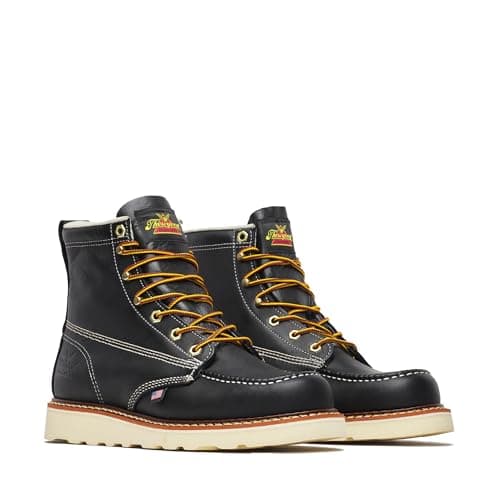
Ariat vs Wolverine
Ariat vs Wolverine Work Boots
Western support and pull-on speed against industrial flexibility. Different worlds, one budget.
These brands come from different traditions and meet in the trades that span both - agriculture, oilfield, utilities, anyone whose week includes a rutted track and a workshop. The deciding factors are terrain and whether laces are a problem in your work, and both of those are easy to assess honestly.
Terrain decides the sole and the shank
On uneven ground, a stiff shank stops your foot deforming over every rut and a heeled sole catches on the edges of ruts and in stirrups. That is Ariat's design, and it is genuinely better out there - the reasoning is the same as on boots for farming and boots for oilfield.
On hard flat floors, a heel concentrates load on two small areas and there is nothing for a shank to resist, so both features become costs rather than benefits. A flexible, cushioned, flatter boot is more comfortable - the argument made at length on boots for standing on concrete.
Head to head
Ranked by our published scoring rubric. Tap any row for the full write-up.
| # | Product | Best for | Score | Price |
|---|---|---|---|---|
| 1 | 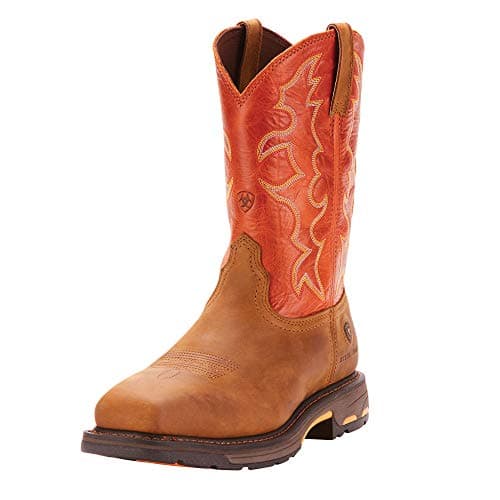 Ariat WorkHog Wide Square Toe Steel ToeWinner on rough terrain: a real shank, a heel and no laces. | Uneven ground, livestock and oilfield | 8.0 | |
| 2 | 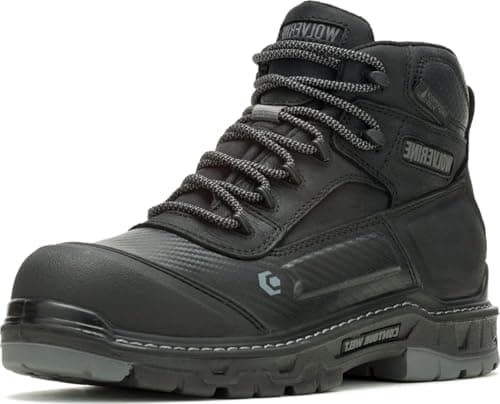 Wolverine Overpass 6" Composite Toe WaterproofWinner for mobility: flexes at the forefoot, which a western boot does not. | Climbing, kneeling and mechanical work | 8.2 | |
| 3 | 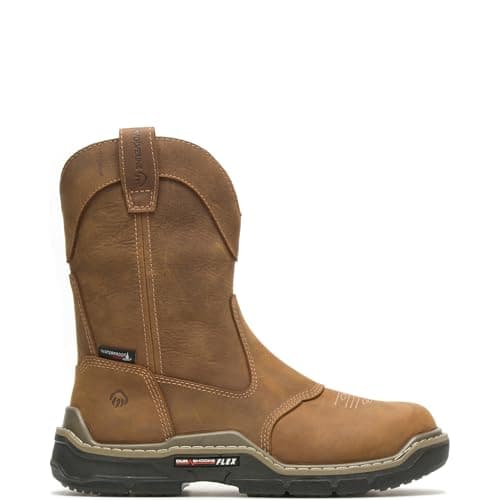 Wolverine Raider DuraShocks CarbonMax WellingtonThe hybrid: Wolverine's cushioning in a pull-on, with a composite cap. | Pull-on convenience with a non-metallic toe | 8.1 |
#ad Prices pulled from Amazon and stamped as of October 6, 2026; they change, and we show no number we cannot verify. How we are funded.
Winner on rough ground · Uneven ground, livestock and oilfield
Ariat WorkHog Wide Square Toe Steel Toe
Winner on rough terrain: a real shank, a heel and no laces.
The 4LR shank holds the boot's shape over ruts, rocks and uneven fill, which is structural support a flexible industrial boot does not provide. The heeled sole bites into soft ground and seats in a stirrup, and the pull-on design means nothing to lace, clog or catch in machinery.
The wide square toe gives far more room than a traditional cowboy boot. On flat concrete the heel concentrates load uncomfortably, it is expensive, and pull-on fit must be right at purchase.
Specs that matter
- Toe:
- Steel toe, ASTM F2413
- Style:
- Pull-on, wide square toe
- Footbed:
- 4LR shank and footbed
- Electrical hazard:
- EH rated
Our scoring
- Rough-ground support
- 9.2
- Flat-floor comfort
- 6.4
- On/off speed
- 8.8
- Flexibility
- 6.0
- Value
- 7.2
What works
- Supportive shank genuinely helps on uneven ground and in stirrups
- Wide square toe gives the toes room a cowboy boot usually does not
- Durable enough for livestock and oilfield work
What to know
- Heeled western sole is poor on flat concrete
- Expensive
- Pull-on fit is unforgiving if your calf or instep is unusual
Winner for mobility · Climbing, kneeling and mechanical work
Wolverine Overpass 6" Composite Toe Waterproof
Winner for mobility: flexes at the forefoot, which a western boot does not.
Wolverine's Contour Welt lets the forefoot bend where your foot bends, so ladders, kneeling and crawlspaces stop fighting you. For mechanical, service and construction trades that involve constant position changes, it is a different experience from a stiff western boot.
Waterproof, composite toe, and lighter. The flexibility costs underfoot protection on rubble, and the laced design has all the usual drawbacks around grain, spatter and machinery.
Specs that matter
- Toe:
- Composite toe, ASTM F2413
- Height:
- 6 inch
- Waterproof:
- Yes
- Build:
- Contour Welt, flexible forefoot
Our scoring
- Rough-ground support
- 7.4
- Flat-floor comfort
- 8.2
- On/off speed
- 5.5
- Flexibility
- 9.2
- Value
- 8.4
What works
- Flexes at the forefoot, so climbing and kneeling feel natural
- Light for a waterproof composite-toe boot
- Good ankle hold without an 8-inch shaft
What to know
- Flexibility costs some underfoot protection on rebar and rubble
- Outsole wears faster than a stiffer boot's
- Not a cold-weather boot
No. 3 · Pull-on convenience with a non-metallic toe
Wolverine Raider DuraShocks CarbonMax Wellington
The hybrid: Wolverine's cushioning in a pull-on, with a composite cap.
#ad No buyable offer at the last price check. How we are funded
- Our score
- 8.1/10
If what you want from Ariat is the pull-on and what you want from Wolverine is the comfort on hard floors, this is the overlap: a 10-inch CarbonMax composite-toe wellington with DuraShocks cushioning aimed at standing on shop floors.
Non-metallic pull-ons are genuinely scarce, which makes this useful for fabrication shops that specify them. Less shank support than the Ariat on rough ground, and heel slip until the shaft softens.
Specs that matter
- Toe:
- CarbonMax composite toe, ASTM F2413
- Style:
- Pull-on wellington
- Cushioning:
- DuraShocks
- Height:
- 10 inch shaft
Our scoring
- Rough-ground support
- 7.0
- Flat-floor comfort
- 8.4
- On/off speed
- 9.0
- Flexibility
- 7.0
- Value
- 8.0
What works
- Nothing to lace, so it is on and off in seconds
- Non-metallic toe in a pull-on is hard to find
- Tall shaft keeps grain, mud and spatter out
What to know
- Pull-ons cannot be tightened, so fit must be right at purchase
- Less ankle support than a laced 8-inch boot
- Heel slip is common until the shaft softens
Laces: a problem or a feature
Laces let you tune the fit across the instep and give better ankle control, which matters on ladders and for anyone with an unusual instep. They are a liability where they collect material or can catch: grain and chaff on a farm, spatter when welding, and rotating machinery anywhere. And practically, if you take boots off repeatedly during a day, unlacing each time does not happen.
Ariat's western boots are mostly pull-on; Wolverine's are mostly laced with the Raider wellington as the exception. Pull-on work boots covers the fit rules, which matter more for pull-ons because you cannot adjust them.
What they share
Both make genuinely durable boots at mid-to-upper prices, both offer composite and steel toe options, and neither is practically resoleable - so in both cases the boot's life ends with the outsole. If resoleability matters, see Red Wing vs Thorogood or Thorogood vs Ariat, which addresses the western-versus-welt question directly.
The verdict, plainly
Ariat for pasture, lease roads, stirrups and any work where laces are a nuisance or a hazard. Wolverine for construction, mechanical and service work that involves climbing, kneeling and hard flat floors. Both kinds of day: the Wolverine Raider wellington, which takes the pull-on convenience into a more floor-friendly boot.
Frequently asked
Are Ariat or Wolverine work boots better?
Ariat for uneven ground, livestock and oilfield work, where the shank support and heeled sole do real work and pull-on convenience matters. Wolverine for construction, mechanical and service work involving climbing, kneeling and hard flat floors, where flexibility wins.
Are western work boots good for construction?
On flat sites, not especially - the heeled sole concentrates load on the heel and forefoot, which is uncomfortable on concrete, and there is less flexibility for ladders and kneeling. On rough, rutted ground the shank support and heel are genuine advantages.
Can Ariat or Wolverine boots be resoled?
Generally no. Both use constructions that are not practically rebuildable, so the boot's life ends when the outsole does. For resoleable boots, look at Goodyear-welted options from Thorogood, Danner or KEEN's welted models.
Are there pull-on boots with composite toes?
Yes, but they are scarce. Wolverine's Raider CarbonMax wellington is one of the few, which makes it useful for fabrication shops and utilities that specify non-metallic footwear while the trade's practicalities favor a pull-on.
Sources
Back to Comparisons, or see how we pick. Spotted something wrong? We publish corrections — see our editorial policy.