Boots by trade
Choosing Work Boots by Trade
One table, every trade, the specs that matter. The fastest route to the right shortlist.
This is the shortcut guide. If you would rather not read about standards and sole construction, find your trade in the table, note the specs, and go to the shortlist linked at the end of the row. Everything in the table is derived from the hazards the trade actually presents, and the reasoning behind each spec is in the guides linked underneath.
The table
| Trade | Safety codes | Sole | Also matters | Shortlist |
|---|---|---|---|---|
| General construction | I/75 C/75, often PR | Lug, or wedge on flat sites | Underfoot stiffness, 6-8 inch | Construction |
| Electrician | I/75 C/75 EH, non-metallic | Heeled - ladders | Shank support for rungs | Electricians |
| Lineman | I/75 C/75 EH, non-metallic | Defined heel for climbers | Stiff shank, 8 inch+, laced | Linemen |
| HVAC | I/75 C/75 EH, non-metallic | Heeled - ladders | Light, breathable for attics | HVAC |
| Plumber | I/75 C/75, often EH | Siped, non-marking | Waterproof, flexible forefoot | Plumbers |
| Carpenter / framer | I/75 C/75, PR | Wedge for finish, lug for framing | Nail protection underfoot | Carpenters |
| Roofer | I/75 C/75 (site dependent) | Flat wedge - contact area | Heat tolerance, no membrane | Roofing |
| Welder | I/75 C/75, often Mt | Any - height matters more | 10-11 inch pull-on, no laces | Welding |
| Mechanic | I/75 C/75 | Oil resistant + siped | Oil-tanned leather upper | Mechanics |
| Warehouse | I/75 C/75, slip rating | Flat, finely siped | Low weight above all | Warehouse |
| Landscaper | I/75 C/75 | Deep, widely spaced lug | Waterproof, drainage, two pairs | Landscaping |
| Farmer / rancher | I/75 C/75 | Lug or western heel | Pull-on, rubber for livestock | Farming |
| Oilfield | I/75 C/75 Mt, oil resistant | Lug | Check operator policy first | Oilfield |
| Flooring / tile | Often none required | Flat, non-marking | Knee pads matter more | Knee pads |
| Masonry / hardscape | I/75 C/75, Mt | Lug | Alkaline resistance, rinse often | Construction |
Quick picks
Ranked by our published scoring rubric. Tap any row for the full write-up.
| # | Product | Best for | Score | Price |
|---|---|---|---|---|
| 1 | 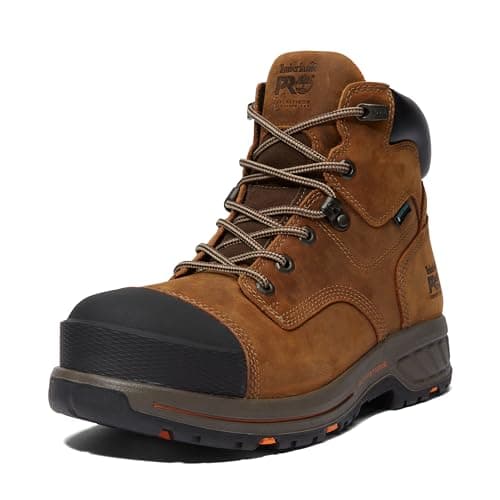 Timberland PRO Helix HD 6" Composite Toe WaterproofEH rated, non-metallic, waterproof - the spec that covers the widest range of trades. | The most broadly suitable spec | 8.7 | |
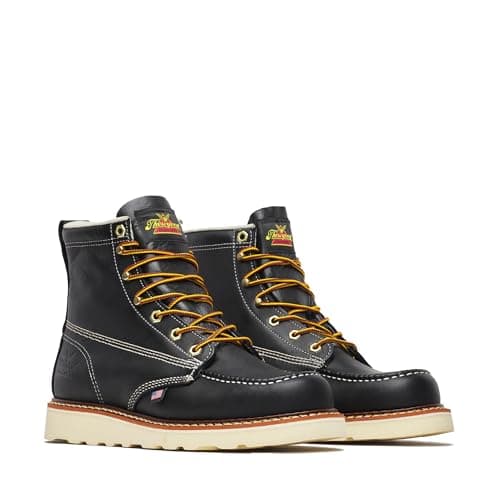
| 2 | 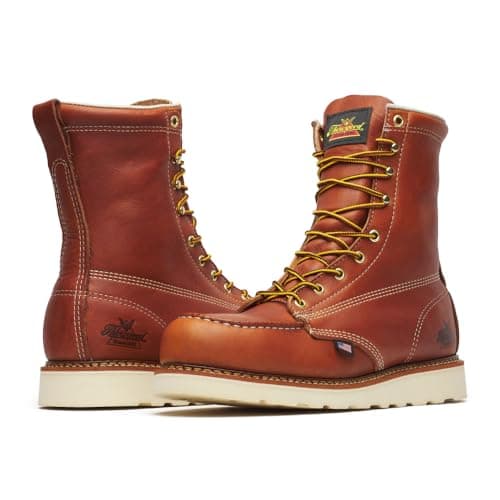 Thorogood American Heritage 8" Steel ToeWedge geometry plus a resoleable welt - the long-run pick for flat-site work. | Flat-ground trades that keep their boots | 8.4 | |
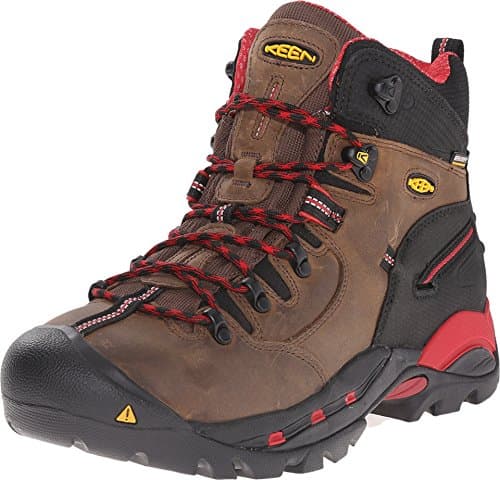
| 3 | 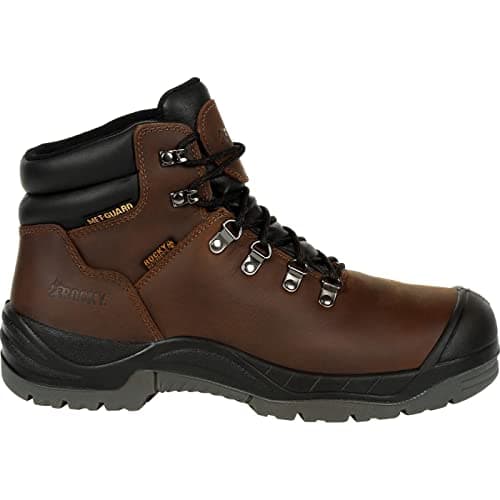 Rocky Worksmart Composite Toe Internal Met GuardThe affordable answer for the trades whose row says metatarsal. | Trades that need Mt protection | 8.4 |
#ad Prices pulled from Amazon and stamped as of October 6, 2026; they change, and we show no number we cannot verify. How we are funded.
Widest coverage · The most broadly suitable spec
Timberland PRO Helix HD 6" Composite Toe Waterproof
EH rated, non-metallic, waterproof - the spec that covers the widest range of trades.
If you want one boot that suits the largest number of trades in the table below, this is close to it: a composite toe, an EH rating, non-metallic construction, waterproofing and a stable platform. It covers electrical, HVAC, plumbing, general construction and most industrial work.
What it does not have is a metatarsal guard, a puncture plate, or the height some trades need. Those are the cases where the table matters.
Specs that matter
- Toe:
- Composite toe, ASTM F2413
- Height:
- 6 inch
- Waterproof:
- Yes
- Electrical hazard:
- EH rated
Our scoring
- Trade coverage
- 9.2
- Safety codes
- 8.6
- Comfort
- 8.2
- Durability
- 8.0
- Value
- 7.8
What works
- Balances cushioning and support better than either Boondock or Hypercharge
- Wide platform feels stable on ladders and scaffold planks
- EH rated and non-metallic
What to know
- Middle-of-the-range in every dimension, best at nothing
- Membrane means warm feet in summer
- Cement construction, not resoleable
No. 2 · Flat-ground trades that keep their boots
Thorogood American Heritage 8" Steel Toe
Wedge geometry plus a resoleable welt - the long-run pick for flat-site work.
For the trades in the table whose ground is flat - shop, warehouse, finish carpentry, flat-site construction - a wedge sole on a resoleable welt is the combination that is both most comfortable and longest-lived.
Steel toe and an 8-inch shaft for debris. The wedge is the limitation for any trade involving ladders or loose ground, which the table flags.
Specs that matter
- Toe:
- Steel toe, ASTM F2413 rated
- Height:
- 8 inch
- Sole:
- MAXwear wedge
- Build:
- Goodyear storm welt
Our scoring
- Trade coverage
- 7.6
- Safety codes
- 8.0
- Comfort
- 8.0
- Durability
- 9.6
- Value
- 8.2
What works
- Safety toe plus resoleable welt construction in one boot
- Taller shaft keeps debris out on demolition and dirt work
- Full-grain leather that takes conditioner and keeps going
What to know
- Steel conducts cold in winter — composite is warmer
- 8 inch shaft takes longer to break in across the ankle
- Heavier than the composite-toe competition
No. 3 · Trades that need Mt protection
Rocky Worksmart Composite Toe Internal Met Guard
The affordable answer for the trades whose row says metatarsal.
Several rows in the table below call for metatarsal protection - oilfield, welding, masonry, logging - and most Mt-rated boots are expensive or use the external bib design people abandon. This has an internal Mt-rated guard, a composite toe and waterproofing at a low price.
The guard stiffens the instep, so expect a break-in week, and the midfoot fit runs narrow.
Specs that matter
- Toe:
- Composite toe, ASTM F2413
- Met guard:
- Internal metatarsal guard, ASTM Mt rated
- Waterproof:
- Yes
- Height:
- 6 inch
Our scoring
- Trade coverage
- 7.0
- Safety codes
- 9.2
- Comfort
- 7.2
- Durability
- 8.6
- Value
- 9.2
What works
- Internal met guard is far less bulky than the external bib style
- Met protection at a price most met-guard boots do not touch
- Non-metallic toe and guard
What to know
- The guard stiffens the instep — expect pressure at first
- Heavier than a plain composite-toe boot
- Fit runs narrow through the midfoot
How to read the codes column
I/75 C/75 is the standard safety-toe rating - impact at 75 foot-pounds and compression at 2,500 pounds - and it covers the toe only. EH is electrical hazard, which is secondary protection in dry conditions and not insulation. Mt is metatarsal protection for the bones on top of the foot, which a toe cap does nothing for. PR is puncture resistance underfoot, for nails and sharp debris.
All four are decoded properly in ASTM F2413 safety ratings explained, and the key structural point is that EH, Mt and PR are separate and optional - a boot without the marking does not have the protection.
The ground decides the sole
Whatever your trade, the sole column follows one rule: hard flat surfaces want a flat wedge (grip comes from contact area, and a wedge spreads load), while soft or broken ground wants deep lugs (grip comes from lugs biting in). The exception is ladders, where you want a heel breast to catch the rung - which is why electrical and HVAC rows say heeled despite working on flat floors.
That is the whole of wedge sole vs heel, and work boot sole types adds construction and slip ratings.
The rest of the PPE, briefly
Most trades in that table need more than boots, and the same trade logic applies. Hands: work gloves by hazard - name the hazard (cut, impact, heat, cold) and buy for it. Legs: work pants - fabric weight, knee reinforcement, stretch. Knees: knee pads, where the surface decides the cap. Cold-weather trades: heated gear for static work, and winter boots for the removable-liner argument.
And whatever the table says, two things override it: your employer's written policy, and whether the boot fits. A compliant boot in the wrong size is worse than no shortlist at all: work boot fit and sizing.
Frequently asked
What work boots do I need for my trade?
Start with your employer's written footwear policy, which specifies the required ASTM codes. Then match the sole geometry to your ground - flat wedges for hard flat surfaces, deep lugs for soft or broken ground, a heeled sole if you are on ladders daily.
Which trades need metatarsal boots?
Those that handle heavy material by hand at ground level: oilfield, welding and fabrication, masonry and hardscape, and logging. ASTM marks metatarsal protection separately as Mt, and a boot without that marking has none regardless of how heavy it is.
Which trades need puncture-resistant boots?
Framing and rough carpentry above all, plus demolition and any site where fasteners and sharp debris are on the floor. The marking is PR. A steel toe does nothing about a nail through the sole, which is the most common puncture injury in those trades.
Do all trades need steel toe boots?
No. Most construction, industrial and warehouse employers require an ASTM safety toe, but it can be steel, composite or alloy - and some trades, like flooring and interior finish work, often have no requirement at all. The employer's written policy decides.
Sources
Back to Guides, or see how we pick. Spotted something wrong? We publish corrections — see our editorial policy.