Thorogood vs BRUNT
Thorogood vs BRUNT
One question decides this: do you want a boot you can resole, or a cheaper boot you replace?
This is the clearest incumbent-versus-challenger comparison in work footwear, and it has a clean answer because the two brands are optimizing for different things. Thorogood sells a boot designed to be rebuilt; BRUNT sells a boot designed to be affordable. Neither is wrong, and which one suits you comes down to a question about your own behavior rather than about the boots.
The construction difference, and what it is worth
A Goodyear welt stitches the outsole to a leather welt sewn to the upper. When the sole wears out - which on a work boot is nearly always the first failure - a cobbler cuts the stitching and sews on a new one. A cemented boot has the sole glued directly to the upper, and when it goes, the boot is done.
So the maths: if you wear through a sole in a year, a welted boot at twice the price that gets resoled twice is cheaper over five years than three cemented boots - and more comfortable throughout, because a broken-in welted boot keeps improving. Work boot sole types covers the construction methods in detail.
The catch is behavioral. Resoling requires finding a cobbler, being without your boots for a week or two, and paying for the service. Plenty of people who buy welted boots never do it, and for them the construction premium bought nothing.
Head to head
Ranked by our published scoring rubric. Tap any row for the full write-up.
| # | Product | Best for | Score | Price |
|---|---|---|---|---|
| 1 | 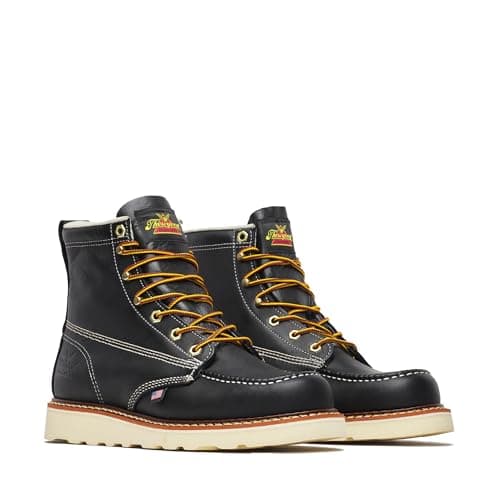 Thorogood American Heritage 6" Moc ToeWinner if you will actually get it resoled - the construction is the whole argument. | Keeping a boot for years | 8.4 | |
| 2 | 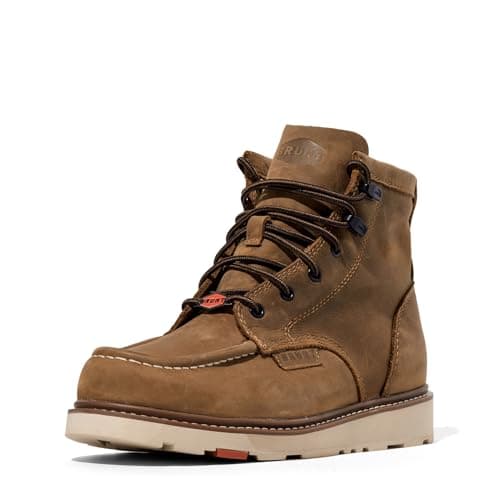 BRUNT Marin Composite Toe WedgeWinner on price and immediate comfort - a composite toe for well under the Thorogood. | Lowest cost of entry | 8.0 | |
| 3 | 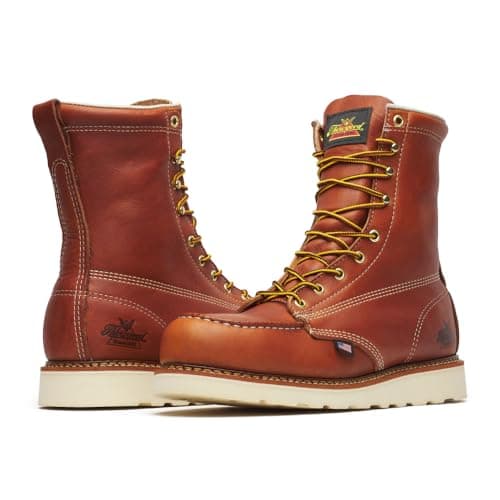 Thorogood American Heritage 8" Steel ToeThe Thorogood to buy if your site requires a cap - same welt, with steel. | Needing a safety toe on the welted platform | 8.2 |
#ad Prices pulled from Amazon and stamped as of October 6, 2026; they change, and we show no number we cannot verify. How we are funded.
Winner for the long run · Keeping a boot for years
Thorogood American Heritage 6" Moc Toe
Winner if you will actually get it resoled - the construction is the whole argument.
A Goodyear storm welt means the outsole is stitched to the boot and a cobbler can replace it for a fraction of a new pair. On a full-time trade where you wear through a sole inside a year, that turns a premium boot into the cheaper option over five years.
Full-grain leather that molds to your foot and a flat MAXwear wedge. Soft toe on this model, roughly double the BRUNT's price, and the honest caveat is that resoleability only pays if you actually take the boots to a cobbler.
Specs that matter
- Toe:
- Soft toe (no safety rating)
- Height:
- 6 inch
- Sole:
- MAXwear wedge, slip-resisting
- Build:
- Goodyear storm welt, resoleable
Our scoring
- Resoleability
- 9.4
- Leather quality
- 9.0
- Price
- 6.0
- Out-of-box comfort
- 8.0
- Breathability
- 7.4
What works
- Welt construction means a cobbler can resole it instead of you rebuying
- Flat wedge does not pack mud and does not scuff finished floors
- Removable footbed, so an aftermarket insole drops straight in
What to know
- Soft toe only — not legal where a safety toe is required
- Wedge sole gives up grip on wet steel and ladder rungs
- Premium price for a boot with no safety rating
Winner on price · Lowest cost of entry
BRUNT Marin Composite Toe Wedge
Winner on price and immediate comfort - a composite toe for well under the Thorogood.
BRUNT's direct-to-consumer model cuts out the retail margin, and the result is a composite-toe wedge boot at a price the heritage brands simply do not reach. It also arrives comfortable - unlined and flexible, with very little break-in.
Two honest caveats. It is cemented, not welted, so when the sole goes the boot is finished. And the brand is young, so its long-term durability record is shorter than the incumbents' - which matters when you are comparing against a boot designed to be rebuilt.
Specs that matter
- Toe:
- Composite toe, ASTM F2413
- Height:
- 6 inch
- Sole:
- Flat wedge
- Weight:
- Lightweight, unlined
Our scoring
- Resoleability
- 2.0
- Leather quality
- 7.4
- Price
- 9.2
- Out-of-box comfort
- 8.6
- Breathability
- 8.8
What works
- Composite-toe wedge at an entry-level price
- Unlined, so it breathes better than membrane boots
- Very little break-in
What to know
- Unlined means no waterproofing at all
- Young brand with a shorter durability record than the incumbents
- Wedge sole limits it on ladders and loose ground
No. 3 · Needing a safety toe on the welted platform
Thorogood American Heritage 8" Steel Toe
The Thorogood to buy if your site requires a cap - same welt, with steel.
Worth including because the comparison often comes down to a safety requirement. The BRUNT Marin has a composite toe and this Thorogood has steel, so both are compliant - but if you want the resoleable welt and a safety rating, this is the boot.
The 8-inch shaft keeps debris out on demolition and dirt work. Steel is cold in winter and heavier than BRUNT's composite, and the price gap widens further.
Specs that matter
- Toe:
- Steel toe, ASTM F2413 rated
- Height:
- 8 inch
- Sole:
- MAXwear wedge
- Build:
- Goodyear storm welt
Our scoring
- Resoleability
- 9.4
- Leather quality
- 9.0
- Price
- 5.5
- Out-of-box comfort
- 7.4
- Breathability
- 6.8
What works
- Safety toe plus resoleable welt construction in one boot
- Taller shaft keeps debris out on demolition and dirt work
- Full-grain leather that takes conditioner and keeps going
What to know
- Steel conducts cold in winter — composite is warmer
- 8 inch shaft takes longer to break in across the ankle
- Heavier than the composite-toe competition
Where BRUNT genuinely wins
- Price. Not marginally - substantially, because the direct model removes the retail layer.
- A composite toe as standard, which is lighter and far warmer than steel at the same rating: composite toe vs steel toe.
- Out-of-box comfort. Unlined and flexible, with almost no break-in, where a welted Thorogood takes weeks.
- Breathability. Unlined means it breathes better than any membrane boot - relevant in summer: boots for hot weather.
Where Thorogood wins
Leather quality and the depth of the range, as well as the welt. Thorogood offers 6-inch and 8-inch shafts, steel and soft toes, waterproof variants and a women's last - BRUNT's line is narrower. And there is a track record: Thorogood boots have been worn for decades, so the durability claims are observable rather than projected.
That last point is the fair criticism of any young brand. BRUNT may well prove as durable as it looks; it has not yet had the time to.
The verdict, plainly
Buy BRUNT if this is your first proper work boot, if money is the binding constraint, if you want a composite toe, or if you know you will never get boots resoled. Buy Thorogood if you are in a full-time trade for the long run and will actually use the welt, if you need a spec BRUNT does not offer, or if you want leather that improves over years. Both are reasonable; neither is a mistake. See also BRUNT vs Red Wing and BRUNT vs KEEN.
Frequently asked
Are BRUNT boots as good as Thorogood?
They are cheaper, lighter and more comfortable out of the box, with a composite toe as standard. What they lack is Goodyear welt construction, so they cannot be resoled, and a long durability track record. For a boot you keep for years, Thorogood; for lowest cost and immediate comfort, BRUNT.
Can BRUNT boots be resoled?
No - they use cemented construction, where the outsole is glued directly to the upper. When the sole wears out the boot is finished. Thorogood's Goodyear welt is stitched, so a cobbler can replace the sole for a fraction of the cost of new boots.
Is a Goodyear welt worth paying extra for?
If you wear boots full time and will actually get them resoled, yes - the sole is nearly always the first thing to fail, and resoling is far cheaper than a new pair. If you know you will never take boots to a cobbler, you are paying for a feature you will not use.
Why are BRUNT boots cheaper?
Mainly the direct-to-consumer model, which removes the retail margin, plus cemented rather than welted construction and an unlined build. The savings are real rather than a quality trick - but cemented construction does mean a shorter maximum life.
Sources
Back to Comparisons, or see how we pick. Spotted something wrong? We publish corrections — see our editorial policy.